
Download
3D Flyover
Add to list
More
24.4 km
~4 hrs 53 min
14 m
Point to Point
“Follow wind-swept dikes under vast skies, where engineered waters and Waterschans history quietly meet.”
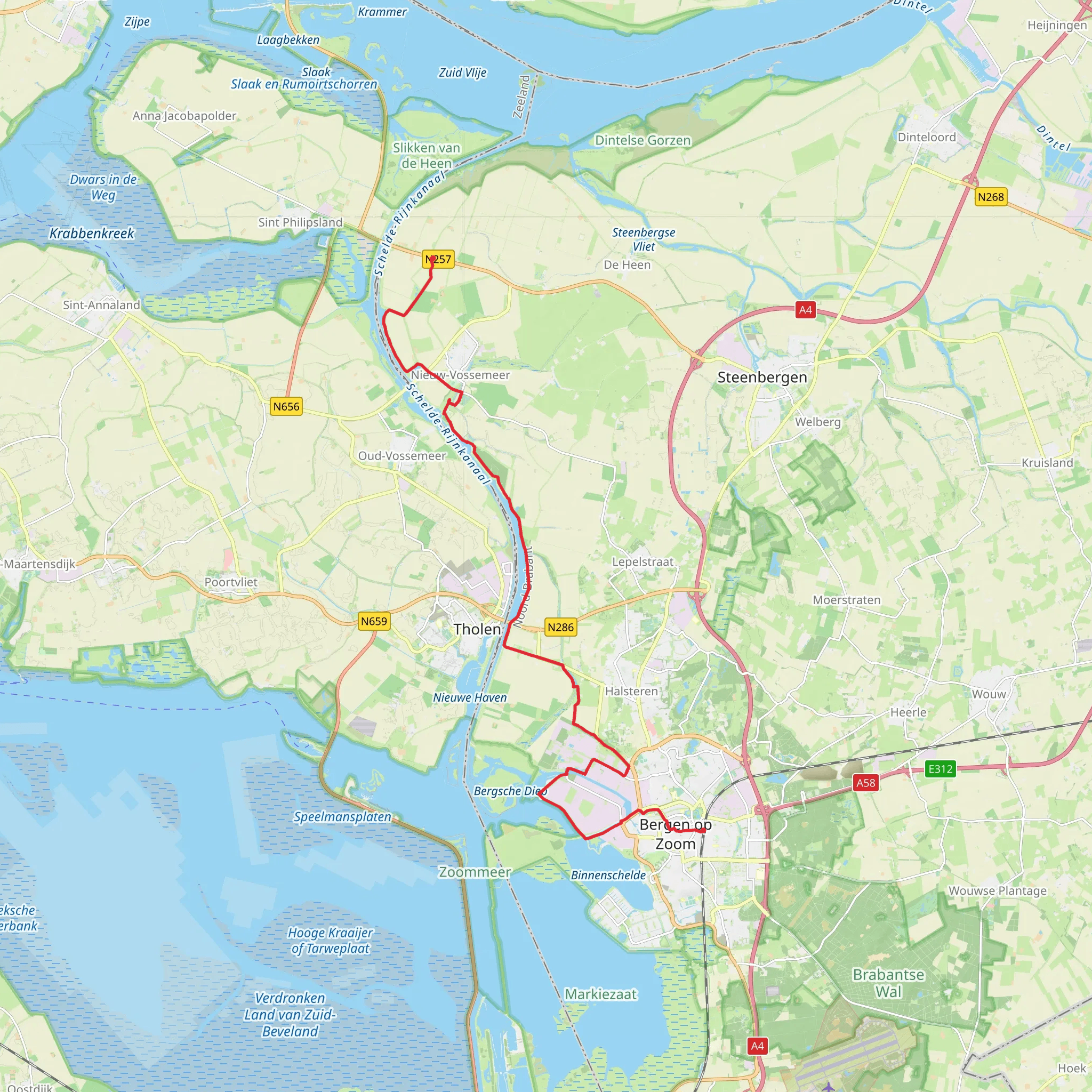
You’ll be walking a very flat, water-shaped slice of the southwest Netherlands: long dikes, big skies, reedbeds, and engineered waterways that quietly explain why this landscape exists at all. At ~24 km (about 15 miles) with roughly ~0 m / ~0 ft of climbing, the effort is mostly about time on feet, wind exposure, and keeping your feet happy on hard surfaces.
A practical start point near Slaakdam is the Slaakdam bridge area over the Scheldt–Rhine Canal (Schelde-Rijnkanaal)—the historic dam line that was cut through and bridged when the canal works were built. The Slaakdam itself is a ~2.77 km dam built in 1884 to connect Sint Philipsland with North Brabant; it was later cut through in 1972 for the Scheldt–Rhine connection and bridged. (encyclopedievanzeeland.nl)
Getting to the start (public transport + car)
- By public transport: A useful nearby stop is “Nieuw-Vossemeer, Slaakdam” (served by regional buses, e.g., line listings show Bus 102). From the stop, you can walk to the dike/canal crossing to pick up the route. (en.busti.me)
- By car: Aim for parking near the Slaakdam/canal crossing on the dike roads (small roadside pull-offs are common in this region). Because access points can be limited by waterworks and dike maintenance, it’s smart to confirm your exact start pin in HiiKER before you drive.
Expect open, exposed conditions right away: the canal corridor and dikes offer little shelter. If the wind is up (common here), it can make an “easy” flat walk feel longer—plan layers and consider a windproof shell even in mild temperatures.
Along the water: Zoommeer, dikes, and birdlife
As you angle toward Zoommeer, the character becomes distinctly “Delta Works Netherlands”: broad water surfaces, straight embankments, and long sightlines. Zoommeer is a freshwater lake created through major engineering works (including the Oesterdam and Markiezaatskade) and forms part of the tide-free Scheldt–Rhine shipping route linking major ports. (en.wikipedia.org)
Nature-wise, this is not “mountain wilderness,” but it is ecologically important. Parts of the Zoommeer area are designated Natura 2000, and you’ll often notice: - Waterfowl and marsh birds in reed edges and sheltered inlets (bring binoculars if you like wildlife). - Wide, open polder views with raptors occasionally hunting over fields and dike slopes. - Seasonal algae risk: Zoommeer has had recurring blue-green algae (cyanobacteria) issues. You’re not likely to be swimming on this hike, but it’s worth knowing if you’re traveling with dogs—avoid letting them drink from scummy shoreline water during warm spells. (en.wikipedia.org)
Underfoot, expect a mix of compacted path, dike-top pavement, and firm gravel. With essentially no elevation change, the main physical “gotchas” are repetitive impact and exposure: - Choose shoes you can comfortably walk 24 km / 15 mi in on hard surfaces. - Sun and wind can be stronger than they feel—there’s little shade.
Fort De Waterschans: a fortress that guarded the city’s lifeline
As you approach Bergen op Zoom, the route’s standout landmark is De Waterschans—the city’s oldest fortification, restored and reconstructed in recent years. A reliable navigation anchor (and a good “nearest known address” for this point) is:
Waterschans, Calandweg, 4612 PG Bergen op Zoom, Netherlands. (visitbrabant.com)
Historically, this spot mattered because Bergen op Zoom’s strength was tied to water access and controlled approaches. De Waterschans was laid out in 1584 on the initiative of William of Orange to help defend the harbor approach and secure supply lines from the Scheldt—effectively protecting the “key” to the city. (visitbrabant.com)
As you walk the fort area, look for: - Moats and waterlines that show how defense here relied on flooding, marshy ground, and controlled channels. - The sense of a “small settlement” footprint—historically there were buildings for
AI Planner
Days planned around your pace, with somewhere to stay each night.
Surfaces
Unknown
Asphalt
Paved
Cobblestone
Gravel
Concrete
Comments and Reviews
User comments, reviews and discussions about the Slaakdam to Bergen op Zoom via Zoommeer and Fort De Waterschans, Netherlands.
average rating out of 5
0 rating(s)

