
Download
3D Flyover
Add to list
More
10.4 km
~2 hrs 4 min
0 m
Loop
“A calm polder loop of big skies, reed-fringed ditches and dike views—wind permitting, a gentle half-day wander.”
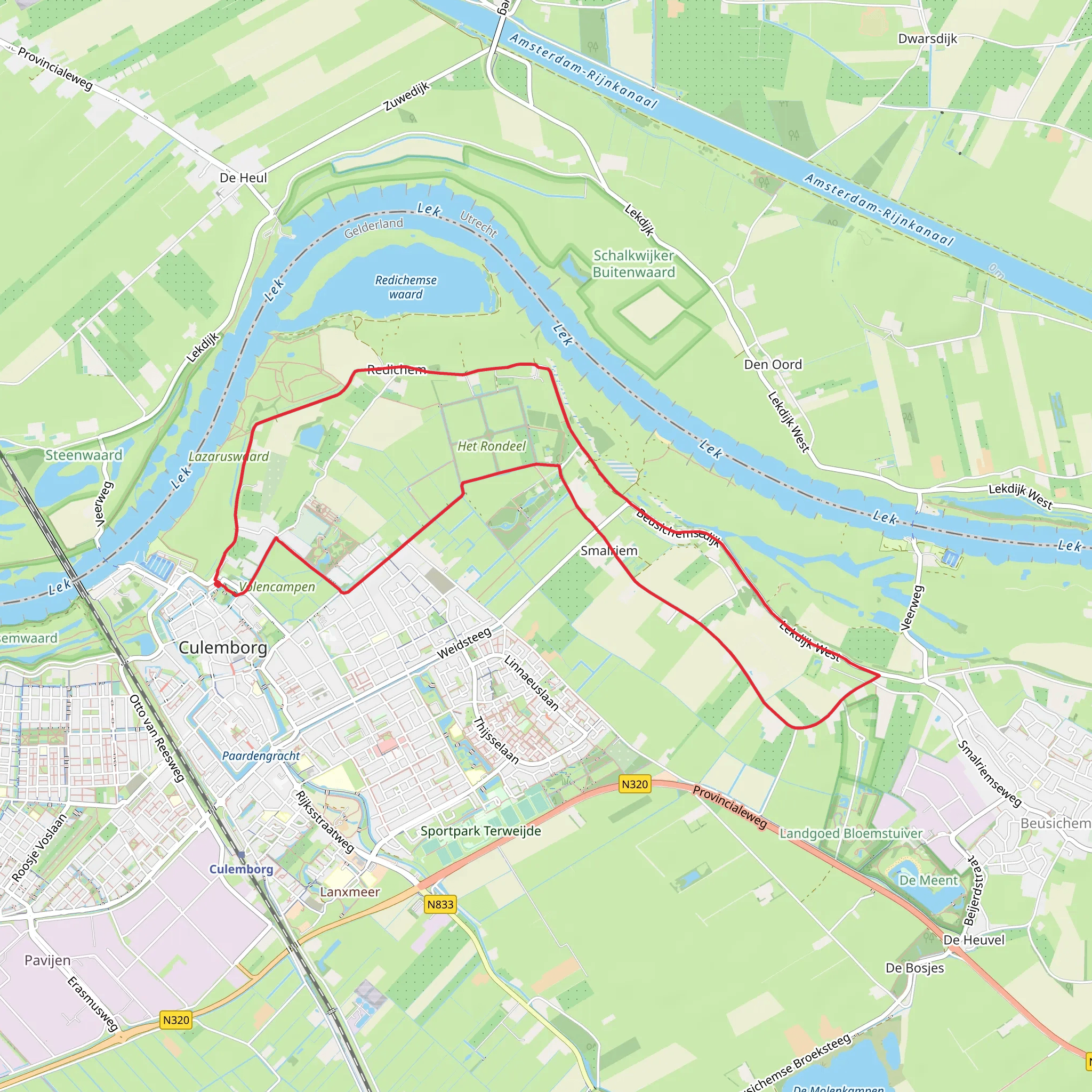
This easy, mostly level loop wanders through classic Dutch river-land scenery: open polder fields, drainage ditches, reed fringes, and broad skies, with long, unobstructed views that make the walk feel bigger than its modest distance. At around 10 km (6.2 mi) with roughly 0 m (0 ft) of climbing, it’s well-suited to a relaxed half-day outing, a family walk, or a winter “fresh-air” circuit when higher ground elsewhere is muddy.
Getting to the start (car + public transport)
Because the start point is only listed as “near” (no coordinates provided), the most practical approach is to aim for the Redichem / De Geer area in the western Netherlands and then use HiiKER to pin the exact trailhead once you open the route. If you share the trail’s lon/lat, I can convert it to the nearest recognizable address or landmark (for example, a specific dike road, farm access lane, bridge, or parking pull-off).
- By car: In this region, trailheads are commonly on narrow dike roads or at small parking bays near a bridge or pumping station. Expect limited parking—often just a few spaces—so arrive earlier on weekends. Use HiiKER navigation to avoid ending up on private farm tracks that look like public lanes.
- By public transport: The nearest access is typically via a local train station in the wider area, then a short bus ride and/or a walk or bike to the polder edge. In the Netherlands, combining transit with a rental bike is often the smoothest way to reach rural trailheads. Once you provide coordinates (or the nearest village name), I can suggest the most likely station/bus stop pairing.
What to bring for an easy polder loop: - Wind layer (polders can be surprisingly exposed year-round) - Waterproof footwear after rain (edges of ditches and field paths can be slick) - Insect protection in warmer months (mosquitoes/gnats near reeds and still water) - Binoculars if you enjoy birds—this is prime “scan the horizon” terrain
On the trail: surfaces, scenery, and what to expect
You’ll typically start on a firm track—often a mix of compacted gravel, short grass, and paved farm lanes—then settle into a rhythm of straight, quiet segments broken up by bridges, gates, and occasional turns along drainage channels. The “flat” elevation profile doesn’t mean effortless in all conditions: wind is the main factor that can make this feel harder than the rating suggests, especially on long, open dike stretches.
Expect a landscape shaped by water management: - Ditches and canals running parallel to paths - Culverts, small bridges, and sluice structures - Reedbeds and wet margins that change character with the seasons
Because the route is low-lying, pay attention to: - Soft verges: the edge of a path can drop quickly into a ditch; keep children and dogs close on narrow sections. - Mud and algae: wooden bridge decks and concrete edges can be slippery, particularly in damp weather. - Electric fences: some field boundaries use low electric lines for livestock—look for warning signs and keep to the marked line.
Landmarks and points of interest (approximate along a 10 km / 6.2 mi loop)
Exact features vary by the precise line of the loop, but a route named for Redichem and De Geer strongly suggests you’ll encounter a mix of: - Dike roads and water crossings early on (often within the first 1–2 km / 0.6–1.2 mi), where you get the widest views and the most wind exposure. - Polder interior tracks through open fields around the midsection (3–7 km / 1.9–4.3 mi), where the walking is straightforward and the scenery is defined by long lines—ditches, hedgerows, and farm boundaries. - A return leg that may follow a slightly different canal or field edge (last 2–3 km / 1.2–1.9 mi), often with a more sheltered feel if it runs behind tree lines or farm windbreaks.
If the loop passes any pumping stations, sluices, or older dike segments, they’re worth a pause: these are the quiet “infrastructure landmarks” that explain why the land looks the way it does.
Nature and wildlife to look for
This kind of lowland wet-farmland mosaic is excellent for wildlife viewing—especially birds—because sightlines are long and habitats change subtly from ditch edge to field to reedbed.
Common sightings (season-dependent): - Waterfowl and waders along ditches and canals (ducks, geese, herons; sometimes lapwings and other meadow birds in open fields) - Raptors using fence posts and lone trees as perches (you’ll often spot them by scanning for silhouettes) - Amphibians near still water in spring and early summer - Small mammals (hares are a classic polder sighting, especially at dawn/dusk)
Good etiquette here matters: many species nest on or near the ground in open meadows. Stay on the path, keep dogs under close control where required, and avoid lingering near nesting areas if birds are alarm-calling.
Historical context: why the landscape looks engineered
“Polder” terrain is inseparable from Dutch water history. Much of what you’ll walk through has been reclaimed, drained, and maintained over generations using
Surfaces
Asphalt
Unknown
Concrete
Wood
Comments and Reviews
User comments, reviews and discussions about the Polder Redichem and De Geer Loop, Netherlands.
average rating out of 5
0 rating(s)
