Download
3D Flyover
Add to list
More
24.9 km
~5 hrs
13 m
Point to Point
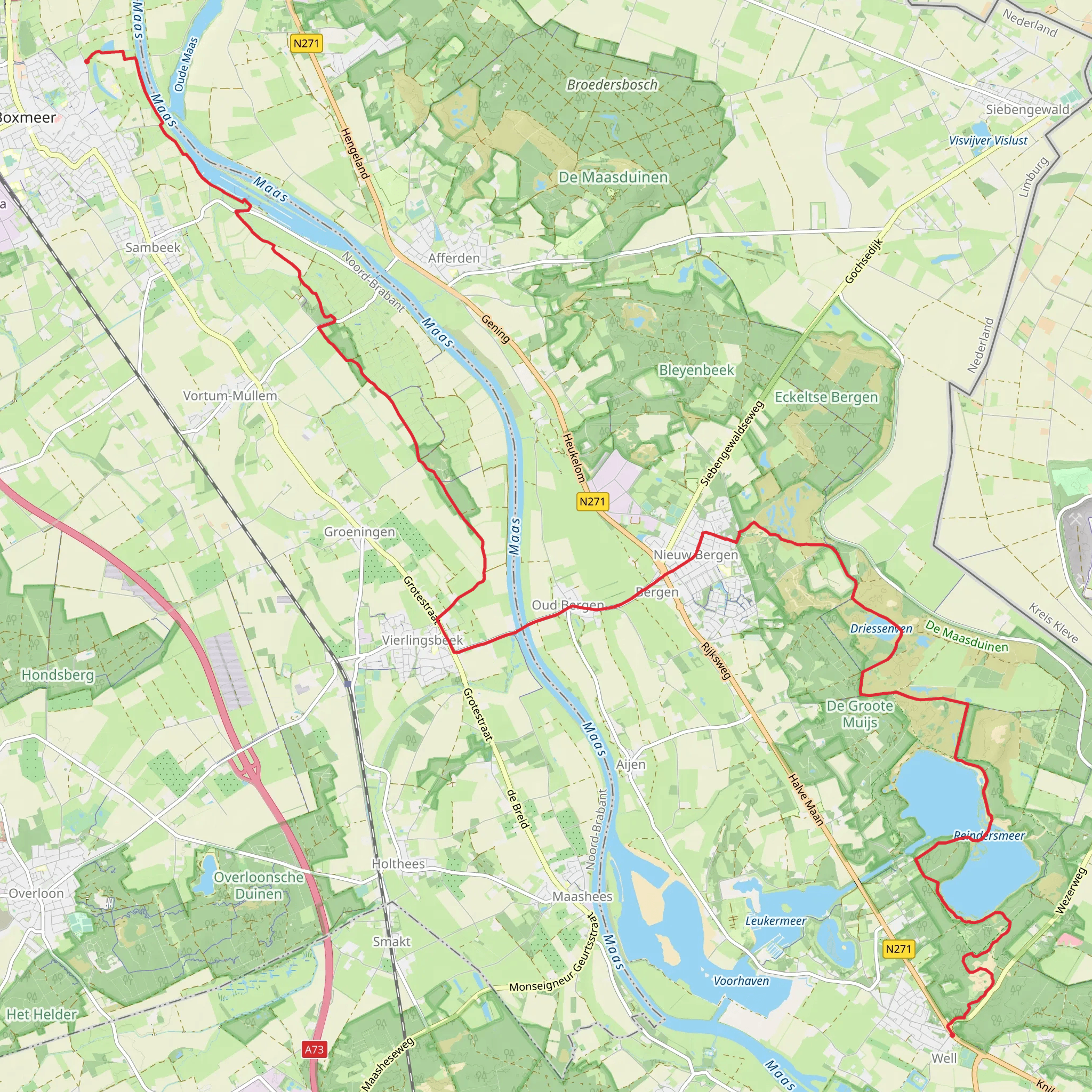
“From Boxmeer’s river-town hush to Reindersmeer’s sapphire dunes, a flat day of quiet wonder.”
This is a long, flat, lowland walk of about 25 km / 15.5 mi with ~0 m / ~0 ft of climbing, linking the river-town feel of Boxmeer to the dune-and-lake landscapes around Reindersmeer in Nationaal Park De Maasduinen, then finishing along Kasteellaan (a “Castle Lane” style road/avenue name that typically marks an approach to an estate or historic property in Dutch towns).
Getting to the start (Boxmeer)
- By train (public transport): Start from Boxmeer Station (rail line between Nijmegen and Venlo, often referred to as the Maaslijn). From the station area you can walk straight into town to pick up your route. (en.wikipedia.org)
- By car: Aim for parking near Boxmeer Station or the town center (signed “Centrum”). Boxmeer is compact, and starting near the station keeps logistics simple for a point-to-point hike.
A practical “known landmark” start point in town is Weijerplein (Boxmeer)—a central square used as a walking-route start for local town walks—close enough to the station area to be an easy on-foot link. (centrumboxmeer.nl)
What the route feels like underfoot
Expect classic Dutch walking surfaces: paved town sidewalks, cycle paths, farm lanes, and well-made park trails. Because the elevation change is negligible, the main “difficulty” factors are: - Distance and time on feet (25 km is still a full day for many hikers) - Wind exposure across open fields and along water - Seasonal mud or soft sand once you’re in the Maasduinen area (dunes/heath edges can be sandy; forest paths can hold water after rain)
Use HiiKER to keep track of junctions where multiple cycle paths and forest tracks intersect—this region can have frequent, similar-looking trail options.
Boxmeer: town landmarks and local history cues
Early on, you’ll likely pass close to Boxmeer’s historic core. If your line takes you near Kasteel Boxmeer, you’re skirting a site with medieval roots (originally 13th century), later altered over centuries; it’s a strong reminder that this stretch of the Meuse region has long been strategically and economically important. (en.wikipedia.org)
Even if you don’t detour into every sight, the “feel” here is of a river settlement shaped by trade routes, waterways, and later rail connections—then you quickly transition into quieter outskirts.
Between Boxmeer and the Maasduinen edge
As you leave town, the scenery typically opens into agricultural land, drainage ditches, and straight, efficient paths. Watch for: - Fast cyclists on shared paths (common in the Netherlands) - Livestock fencing and electric tape near pasture edges - Limited shade in open sections—sun and wind can be more fatiguing than hills on a flat route
Wildlife is often subtle here: small birds in hedgerows, waterfowl on canals/ditches, and occasional raptors over fields.
Reindersmeer and Nationaal Park De Maasduinen: the highlight section
The middle of the hike is defined by the approach to Reindersmeer, a striking, clear-water lake within De Maasduinen National Park. Reindersmeer is known for its azure, very clear water and a landscape that can feel surprisingly “northern” due to the contrast of water, forest, and low vegetation. (nationaleparken.nl)
Why the landscape looks like this (human + natural history)
This area’s lakes are closely tied to sand and gravel extraction in the mid-20th century. Reindersmeer itself formed after excavations in the early 1970s; later, further excavation was curtailed, and the area was arranged in a more nature-forward way as compensation for lost natural value. The lake is described as about 45 m deep and ~130 hectares in size—huge by local standards, and the depth helps explain the dramatic water color and clarity. (nationaleparken.nl)
What to look for on the ground
Around the lake, expect a mosaic of: - Heath and grasses on the banks - Mosses and low vegetation in sandy patches - Pine and mixed woodland giving shelter from wind (nationaleparken.nl)
This section is also where navigation can get “busy”: multiple recreational routes (walking/cycling/horse) can braid together. Keep an eye on your HiiKER track at junctions so you don’t accidentally follow a parallel loop.
Facilities and a notable landmark
Near Reindersmeer there is a distinctive visitor center built in/over an old lock chamber connecting waters in the area—an unusual piece of modern design tied directly to the site’s water-management and industrial past.
AI Planner
Days planned around your pace, with somewhere to stay each night.
Surfaces
Unknown
Sand
Asphalt
Concrete
Gravel
Unpaved
Paved
Dirt
Comments and Reviews
User comments, reviews and discussions about the Boxmeer to Kasteellan via Reindersmeer, Netherlands.
average rating out of 5
0 rating(s)