Download
3D Flyover
Add to list
More
49.6 km
2 days
81 m
Multi Day
“A colourful, wind-brushed wander across Drenthe’s sandy lanes and heath edges—best for steady navigators.”
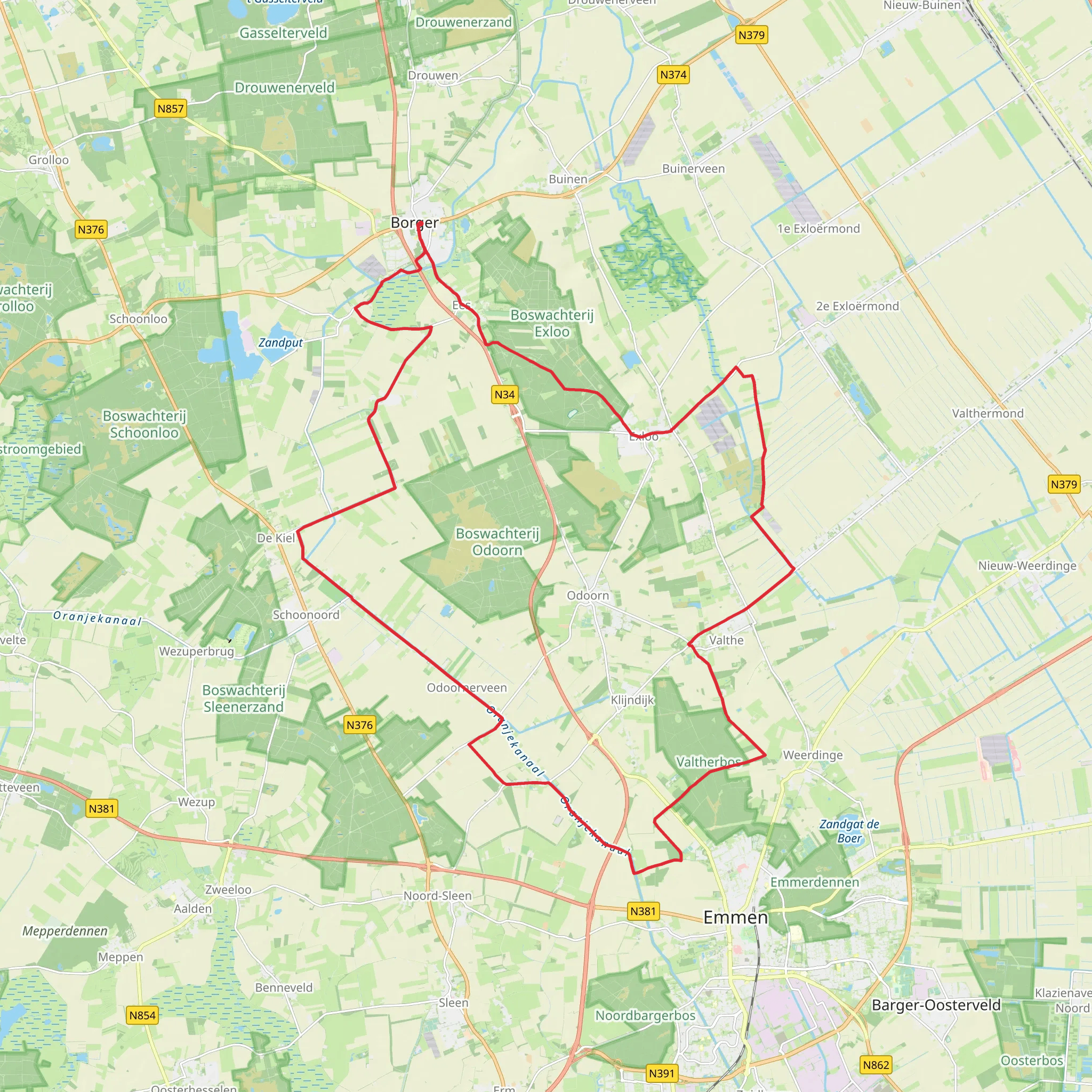
A big, low-elevation day through the Drenthe countryside: long straight sandy tracks, quiet farm lanes, and broad heath-and-woodland edges typical of the Hondsrug region. At ~50 km (31 mi) with only ~100 m (330 ft) of total ascent, the challenge is less about climbing and more about time-on-feet, wind exposure, and staying on course where multiple forestry and farm tracks intersect.
Where the hike starts (nearest landmark / address)
You didn’t include the “Hike head” location (it cuts off after “near”), so I can’t reliably convert the start lon/lat to a specific address or landmark yet. If you paste the start coordinates (or a HiiKER link), I’ll pin it to the nearest known place (e.g., a village center, trailhead car park, or a named nature area entrance) and tailor the transport directions precisely.
For now, plan on a typical Drenthe loop start being near a village edge with a small pull-in/parking area by a forestry track or a minor road—common around the Hondsrug ridge and the Weerdinge/Emmen area.
Getting there (car + public transport)
By car - Expect narrow rural roads and occasional farm traffic. Parking is usually informal (small gravel pull-offs) unless the loop begins at a signed nature-area entrance with a designated lot. - If you’re using HiiKER for navigation, download the route for offline use—mobile signal can be patchy in wooded stretches and on the more remote sandy tracks.
By public transport - In this part of Drenthe, the most practical approach is typically train to a larger hub (often Emmen or a nearby station depending on the exact start), then bus toward the nearest village, finishing with a short walk to the trailhead. - Once you share the start point, I can name the exact station/bus stop and give a realistic “last-mile” plan (including whether the first/last 1–3 km / 0.6–1.9 mi are on paved shoulders).
You’ll likely experience this loop as three distinct “textures,” matching the names: Exoeerweg (rural road feel), Hondsrugweg (the ridge-country character), and Weerdingerzandweg (sandier, more open nature-area edges).
What the terrain feels like over 50 km / 31 mi
- Underfoot: a mix of paved farm lanes, compacted gravel, and sandy tracks. After dry spells, sand can be energy-sapping; after rain, some sections can be soft with puddled ruts.
- Elevation: only ~100 m (330 ft) total gain across the whole day—so you won’t notice “climbs,” but you may feel gentle, rolling rises typical of the Hondsrug.
- Exposure: open fields and heath edges can be windy. In cooler months, wind chill matters more than the elevation profile suggests.
- Navigation complexity: low technical difficulty, but high “junction density”—many straight tracks that look similar. This is where HiiKER is especially useful to confirm you’re taking the correct branch at forestry intersections.
Landmarks, landscape, and the character of the Hondsrug
The Hondsrug is a long, subtle ridge running through Drenthe into Groningen, shaped by Ice Age processes. Even though the elevation changes are modest, the ridge influences drainage, soils, and vegetation—one reason you’ll see alternating bands of: - Sandy, well-drained ground (more heath, pine, and dry woodland edges) - Lower, wetter pockets (ditches, small wet hollows, and greener pasture margins)
Along roads like Exoeerweg and Hondsrugweg, expect classic Drenthe rural scenery: - Long views over fields, shelterbelts, and farmyards - Straight lanes with drainage ditches - Occasional small wooded blocks and windbreak rows
On or near Weerdingerzandweg, the name hints at sandier ground (“zand”), and you may pass: - Broader, more open stretches where the track surface turns pale and loose - Heath/grassland edges and young woodland regeneration - Quiet, wide forestry corridors that can feel surprisingly remote despite the gentle terrain
Nature and wildlife to look out for
Wildlife sightings depend heavily on time of day and season, but this region commonly offers: - Roe deer at woodland edges and field margins, especially early/late - Hares and rabbits in open farmland and sandy verges - Foxes (often more heard/seen at dawn/dusk) - Birdlife: buzzards overhead, woodpeckers in mixed woodland, and a variety of farmland birds along hedgerows and ditches - Insects: in warmer months, expect mosquitoes/gnats near wetter pockets and still woodland; ticks can be present in grassy/heathy margins—long socks and a post-hike check are sensible
Vegetation cues you’ll notice: - Heather and acid-soil plants where the ground is sandier and poorer - Pine and mixed woodland blocks planted for forestry, with straight rides and uniform stands - Ditch-side greenery—nettles, reeds, and moisture-loving plants along the lower lines
Historical significance (what you’re walking through)
Drenthe is known for its deep prehistory and long human use of these landscapes. Even if this specific loop doesn’t pass a named monument, the broader Hondsrug area is strongly associated with: - Ice Age landforms that created the ridge and influenced settlement patterns - Ancient routeways and rural roads that
AI Planner
Days planned around your pace, with somewhere to stay each night.
Surfaces
Unknown
Asphalt
Concrete
Cobblestone
Sand
Comments and Reviews
User comments, reviews and discussions about the Exoeerweg, Hondsrugweg and Weerdingerzandweg Loop, Netherlands.
average rating out of 5
0 rating(s)