
Download
3D Flyover
Add to list
More
48.4 km
3 days
96 m
Multi Day
“A big-sky Dutch farm-loop of quiet lanes and ditches—flat, wind-swept, and quietly testing.”
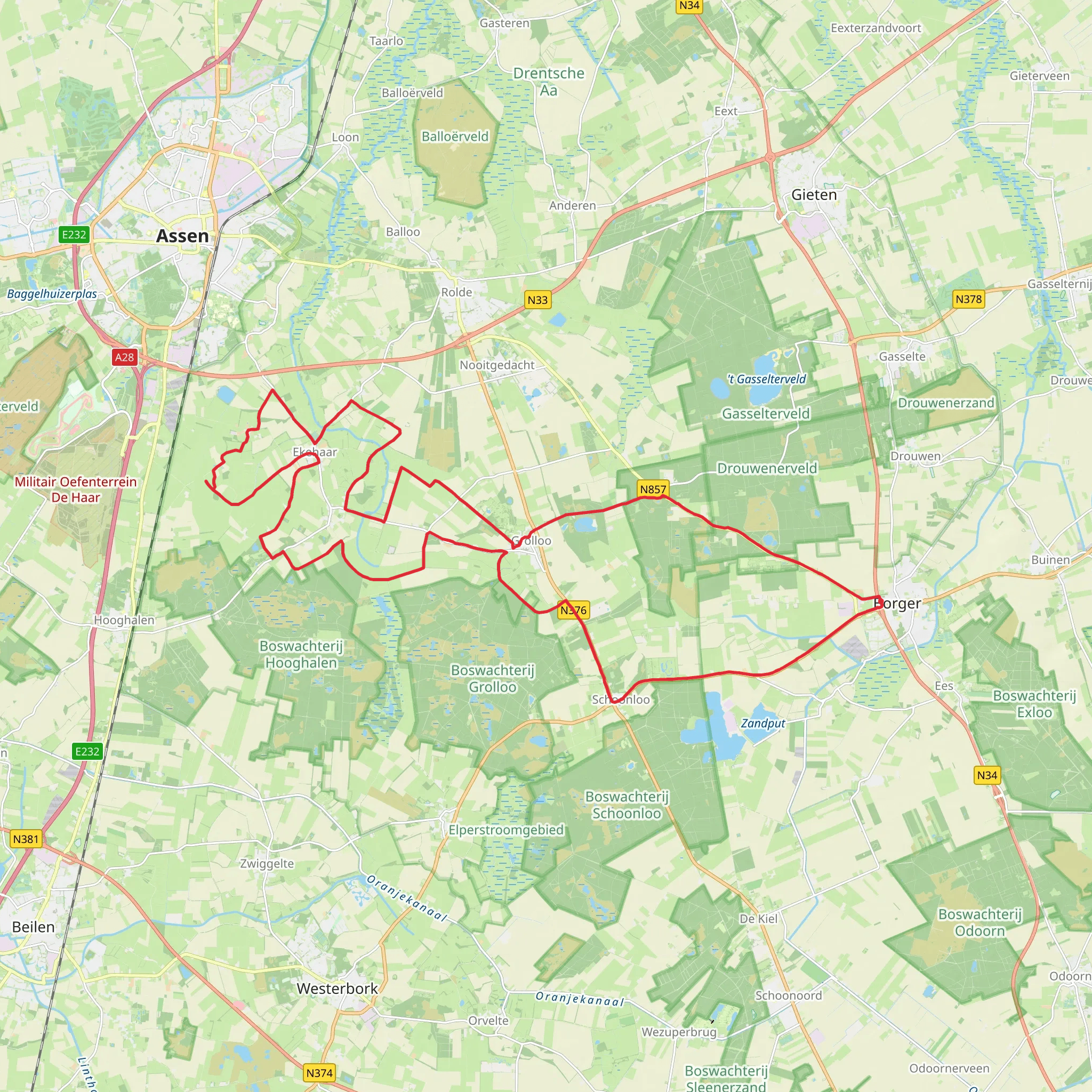
This is a long, low-relief countryside loop of roughly 48 km (29.8 mi) with only about 100 m (328 ft) of total climbing—more of an endurance day than a steep one. Expect a patchwork of quiet farm lanes, field-edge tracks, and small village connectors, with big skies, drainage ditches, and long sightlines typical of the northeastern Netherlands.
Getting to the start (and what “near” usually means here)
You didn’t include the exact start point (“Hike head: near …” is blank), so plan to anchor the start near a clear, easy-to-find landmark along the loop’s named roads—most commonly a village center, church, or a bus stop on/near Westdorperstraat (Westdorp area) or Amerweg (Amer area). If you share a coordinate, I can convert it to the nearest recognizable landmark/address.
By car - Aim for public parking in a village core along the loop (look for signed village parking near a church, community hall, or sports fields). In this region, parking is usually straightforward but can be limited on narrow residential streets—avoid blocking farm gates and field access.
By public transport - The most reliable approach is typically train to a larger hub town in Drenthe/Groningen and then a regional bus to a stop in/near Westdorp/Amer (or the nearest village on Westdorperstraat/Amerweg). Rural bus frequency can be limited, especially evenings and Sundays—check the day-of-week timetable before committing to a full 48 km.
What the route feels like underfoot
Most of this loop is “easy” because it’s flat and non-technical, but it’s still a full-day (or very long) outing. Surfaces commonly include: - Paved farm lanes (fast, consistent footing; can be hard on feet over 48 km) - Compacted gravel or dirt tracks along fields - Short grassy verges and occasional muddy patches near ditches after rain
Because the elevation gain is modest, the main challenges are distance, wind exposure, and repetitive surfaces rather than steep climbs.
Segment-by-segment expectations (approximate)
Distances will vary slightly depending on the exact start point and any small connectors, but this is a useful planning breakdown for a ~48 km loop:
0–12 km (0–7.5 mi): Settling into the farmland grid - You’ll likely begin on quiet lanes with wide views over arable fields and pasture. - The first hours are about finding a steady rhythm: the terrain is nearly level, with only gentle rises (often road embankments or subtle undulations). - Watch for farm traffic—tractors and wide implements can appear quickly on narrow roads.
12–26 km (7.5–16.2 mi): Villages, hedgerows, and long straightaways - As you pass through or near small settlements, you’ll see a shift from open fields to tree-lined streets, hedges, and older farmsteads. - This is usually where you’ll find the best chance to top up water or snacks (if there’s a small shop/café), though options can be sparse—don’t assume services in every village. - Expect long, straight sections where navigation is simple but mentally repetitive; wind can be a bigger factor than you’d expect on a “flat” hike.
26–38 km (16.2–23.6 mi): Quiet backroads and drainage landscapes - The landscape often becomes more “big-sky” again: ditches, canals, and field boundaries define the geometry. - After rain, edges of tracks can be soft; keep an eye out for slick mud where farm vehicles have churned the surface. - If you’re using HiiKER, this is a good place to confirm you’re staying on the intended connectors—many lanes look similar, and a wrong turn can add several kilometers before you notice.
38–48 km (23.6–29.8 mi): The long finish - The final 10 km is where foot care and pacing matter most. Even easy terrain can feel demanding late in the day. - If the loop returns via more pavement, consider brief walking breaks to reduce impact fatigue. - Stay alert at road crossings—tired hikers are more likely to misjudge traffic on rural roads.
Navigation and wayfinding (use HiiKER)
This is generally straightforward countryside navigation, but the “gotchas” are: - Multiple parallel farm lanes that look identical - Unsigned junctions where a track meets a paved lane at an odd angle - Seasonal field-edge diversions (temporary closures or muddy detours)
Use HiiKER to: - Download the route for offline use (rural signal can be patchy) - Keep an eye on “distance to next turn” on long straight segments - Confirm you’re on the correct lane when two roads run side-by-side
Nature, wildlife, and what to look for
Even in heavily farmed areas, there’s plenty to notice—especially along ditches, hedgerows, and small wooded pockets: - Birdlife: You’re likely to see common farmland and wet-ditch species—look for raptors hovering over fields and waterbirds along canals/ditches. - Mammals: Hares and roe deer are possible at field edges, especially early/late in the day. - Seasonal highlights: Spring brings active birdlife and fresh green growth; late summer can mean tall crops limiting views; winter can be stark but beautiful, with more wind exposure.
Stay respectful around livestock and working farms: - Give animals space, keep gates as
AI Planner
Days planned around your pace, with somewhere to stay each night.
Surfaces
Asphalt
Unknown
Concrete
Sand
Wood
Comments and Reviews
User comments, reviews and discussions about the Borgerveldweg, Westdorperstraat, Amerweg and Hemmenweg Loop, Netherlands.
average rating out of 5
0 rating(s)


