Download
3D Flyover
Add to list
More
43.1 km
2 days
113 m
Multi Day
“A long, horizon-wide loop of farm tracks and heath, where mud, sand, and focus test endurance.”
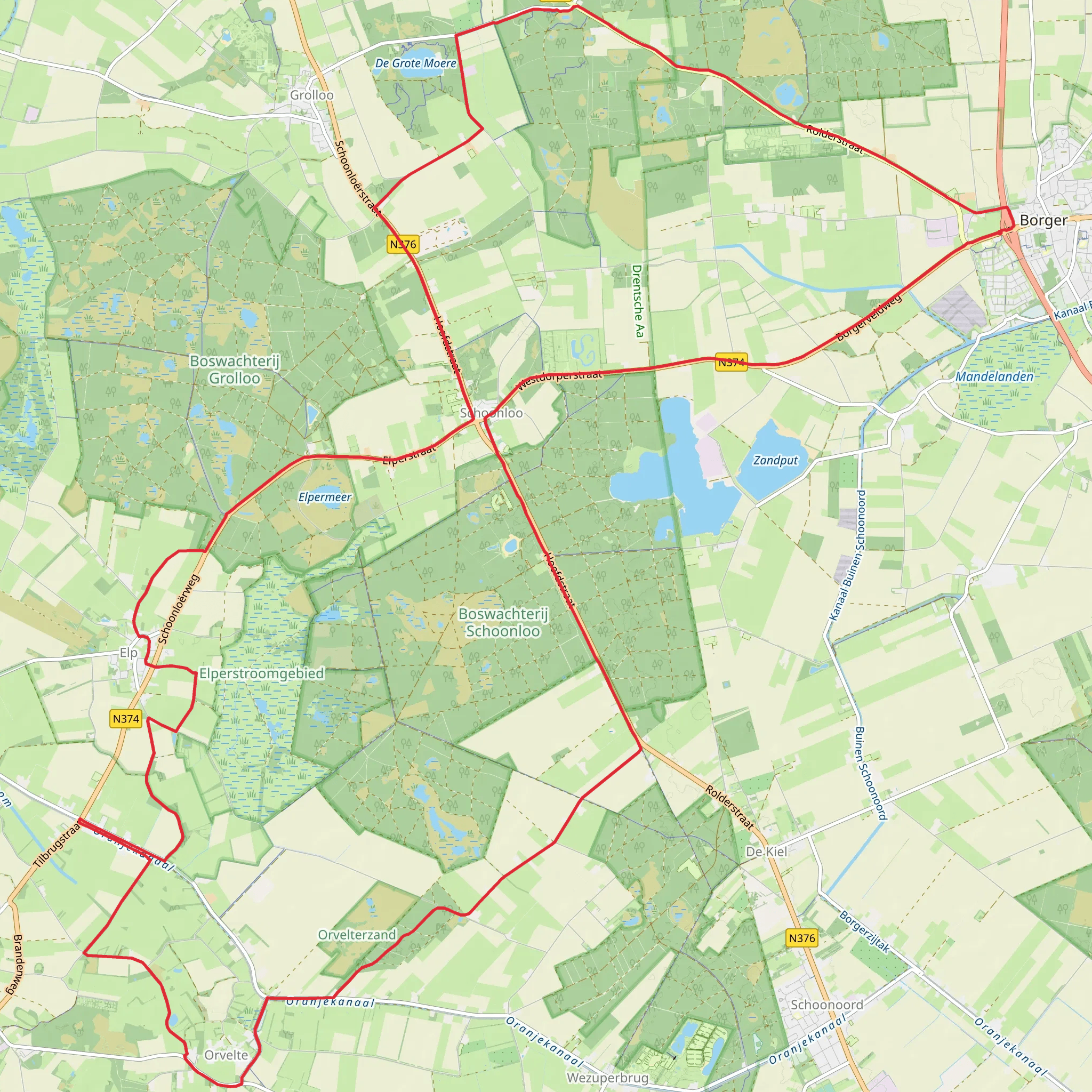
This is a long, low-relief loop of roughly 43 km (26.7 mi) with only about 100 m (330 ft) of total climbing, so the challenge is less about steepness and more about time on feet, exposed stretches, and staying oriented through a patchwork of farm tracks, sandy paths, and heathland edges. Expect a full-day outing for most hikers, and in wetter months, plan for muddy tractor ruts and waterlogged verge sections that can slow your pace.
Getting to the start (car + public transport)
Because the start point is listed only as “near” (no coordinates provided), the most reliable way to pin down the exact trailhead is to open the route in HiiKER and use its start-point navigation to identify the nearest drivable access and parking pull-off. In this region, trailheads are commonly at: - small roadside lay-bys beside farm access roads (often unsigned), - forest/heath car parks at reserve entrances, - or village-edge parking near a church, café, or community hall.
By car: You’ll typically be approaching via local rural roads; parking is usually informal (gravel pull-offs) or at designated nature-area car parks. Avoid blocking farm gates—agricultural traffic is frequent on Borgerveldweg-type lanes.
By public transport: The practical pattern is train to a nearby town, then a regional bus toward the closest village, finishing with a walk-in of 1–5 km (0.6–3.1 mi) to the loop. Use HiiKER to confirm which stop leaves you with the shortest and safest road-walk (some rural roads have narrow shoulders).
If you share the lon/lat for the start (or a HiiKER link), I can convert it to the nearest known address or landmark precisely.
You’ll likely begin on a quiet rural lane or wide track, easing into the day with almost no elevation change. The first 5–10 km (3–6 mi) are typically about settling into rhythm: firm surfaces, long sightlines, and the occasional sandy patch where bikes and tractors have churned the top layer. Because the total ascent is only around 100 m (330 ft) across the whole loop, any “ups” you feel will be subtle—low rises, embankments, and gentle undulations rather than hills.
As the loop strings together Borgerveldweg and the Jacob Trippad, expect frequent transitions between: - farm edges and field boundaries (straight, efficient walking), - heath or scrubby margins (more texture underfoot), - and wooded belts that provide windbreak and shade.
Underfoot conditions and pacing
Over 43 km (26.7 mi), small surface changes matter. Plan for: - Hard-packed farm track: fast but can be monotonous; watch for passing vehicles. - Sandy sections: energy-sapping, especially if dry; gaiters can help keep grit out. - Rutted/muddy lanes: common after rain; waterproof footwear and trekking poles help with balance. - Narrow path segments: where vegetation encroaches in late spring/summer, long socks help against ticks and scratchy heather.
Even with “easy” elevation, this distance is best treated as endurance: bring enough calories for 8–10+ hours depending on pace and stops, and carry water capacity that matches the scarcity of taps in rural stretches.
Nature, landscapes, and wildlife to look for
This kind of lowland loop is often defined by open skies, big horizons, and a mosaic of managed land and semi-wild heath/woodland. Likely highlights include: - Heathland vegetation: heather, gorse, and tough grasses on poorer sandy soils; late summer can be especially scenic when heather blooms. - Woodland edges: mixed stands and shelterbelts where you’ll notice more birdsong and less wind. - Ditches, small canals, and wet hollows: these can be subtle but are important habitat corridors.
Wildlife you may encounter (season-dependent): - Roe deer at dawn/dusk along woodland margins. - Hares and rabbits in open fields and sandy tracks. - Buzzards and kestrels hunting over open ground. - In wetter pockets, frogs/newts and dragonflies in warmer months.
What to look out for: - Ticks in grassy/heathy margins (especially spring through autumn). Do checks during breaks. - Ground-nesting birds in open heath areas—stay on the path where signage requests it. - Livestock near pasture crossings; keep distance and move calmly.
Landmarks and regional character (and why it looks like this)
Routes like this often pass through landscapes shaped by a long interplay of agriculture, drainage, and heath management. The presence of straight farm lanes and field grids typically reflects land consolidation and modern farming efficiency, while surviving heath/woodland patches hint at older land uses—grazing, turf cutting, and managed commons. If the loop skirts protected heath or reserve land, you may see: - information boards about habitat restoration, - grazing management (sometimes with hardy cattle or sheep), - and firebreak-style sandy tracks used for access and conservation work.
Historically, these lowland border landscapes were often economically marginal compared with richer clay soils elsewhere, which is one reason heathland persisted in places: sandy, nutrient-poor ground resisted intensive cropping until modern amendments and forestry changed the balance.
Navigation and wayfinding
Although the terrain is gentle, navigation can be
AI Planner
Days planned around your pace, with somewhere to stay each night.
Surfaces
Asphalt
Unknown
Concrete
Comments and Reviews
User comments, reviews and discussions about the Borgerveldweg and Jacob Trippad Loop, Netherlands.
average rating out of 5
0 rating(s)