
Asserstraat, Balloeerstraat and Verlengde Asserstraat and Drouwenerstraat Loop
Download
3D Flyover
Add to list
More
57.4 km
3 days
126 m
Multi Day
“A wind-swept Drenthe loop of lanes, farms, and heath—quietly testing endurance and foot comfort.”
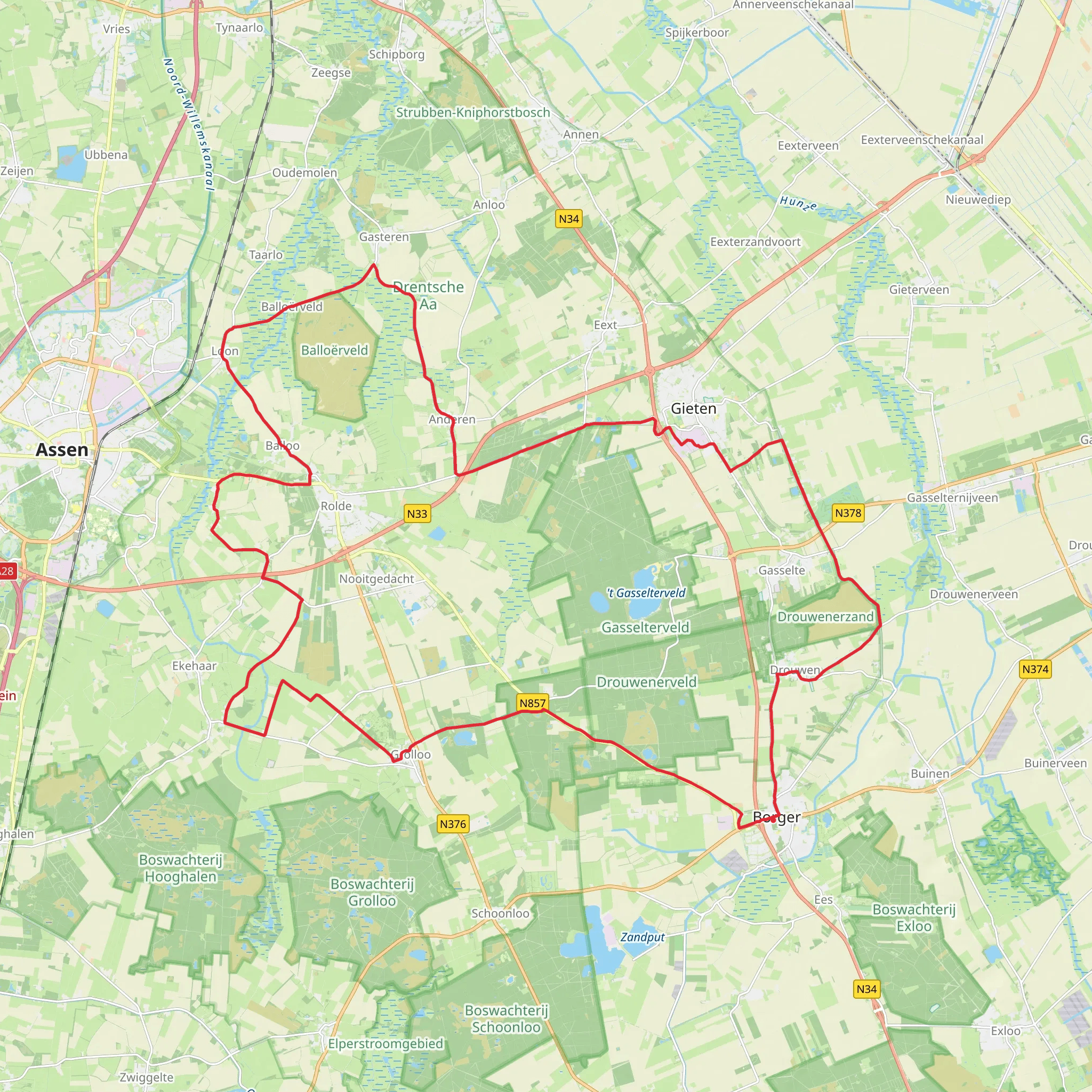
This is a long, low-relief loop of roughly 57 km (35.4 mi) with about 100 m (328 ft) of total climbing—more of an endurance day than a steep hike. Expect a steady rhythm of quiet country lanes, farm tracks, and village-to-village connectors, with frequent views across open fields and patches of heath/woodland typical of Drenthe. Because the elevation gain is modest, the main challenges are distance, wind exposure across open farmland, and keeping your feet comfortable over many hours.
Getting to the start (car + public transport) - By car: Plan to park in or near Assen (Drenthe, Netherlands)—a practical “hike head” area for roads named Asserstraat / Verlengde Asserstraat. A reliable target for navigation and meeting up is Assen railway station (Station Assen), which is a well-known landmark with nearby streets, parking options, and services (food, water, restrooms). From there, you can position yourself toward the first segment on local streets and lanes. - By public transport: Train to Station Assen is the simplest anchor point (frequent regional connections). From the station area you can walk to the loop’s nearby streets/lanes and begin the circuit. If you’re coming from smaller villages along the route (e.g., around Balloo / Rolde / Borger / Drouwen areas), local buses can reduce the approach walk, but schedules vary—check the day-of-week timing before committing.
Use HiiKER to confirm the exact start point and to keep you on the correct sequence of roads (especially where similarly named streets reappear or where farm tracks intersect).
What the terrain feels like You’re essentially moving through gentle Drenthe countryside: long straight stretches, occasional bends through villages, and short transitions between open agricultural land and more sheltered green corridors. Underfoot is typically firm—paved lanes, compacted gravel, and occasional softer track edges. After rain, the “easy” rating can feel less easy if you’re on muddy verges or if water pools on farm access tracks.
Because the loop is long, plan it like a small expedition: - Time on feet: Many hikers will take 10–14 hours depending on pace and breaks. - Wind factor: Open fields can be deceptively tiring; a headwind can add a lot of effort even on flat ground. - Foot care: The biggest risk is friction over distance—dial in socks, lacing, and blister prevention.
Route flow and distance planning
A useful way to think about this loop is in four broad quarters, each around 14–15 km (8.7–9.3 mi). Even if the exact street-by-street sequence varies, this mental model helps with pacing, food, and “decision points”:
0–15 km (0–9.3 mi): Settling into the countryside You’ll likely start on quieter streets and lanes leaving the Assen area, quickly transitioning into rural connectors. This is where you want to keep the pace conservative—your legs should feel almost “too fresh.” Elevation change is minimal, but you may notice gentle rises onto slightly higher sandy ground and dips toward drainage channels.
15–30 km (9.3–18.6 mi): Long, steady middle miles This is typically the most psychologically demanding portion: the scenery is pleasant but repetitive, and the distance starts to accumulate. Look for village edges where you can top up water or grab a snack. If you’re using HiiKER, keep an eye on any short “cut-through” tracks between roads—these can be easy to miss when you’re tired.
30–45 km (18.6–28.0 mi): Heath/woodland pockets and cultural landscape Drenthe is known for its mix of farmland and remnants of heathland/woodland. Where the route skirts more natural patches, you’ll often get a change in soundscape—less traffic, more birdsong, and a softer feel underfoot if you’re on gravel or track.
45–57 km (28.0–35.4 mi): The return leg This is where small discomforts become big ones: hot spots on feet, tight hips, and fatigue. Keep breaks short and purposeful. If you’re finishing back toward Assen, services become more available again—use that to your advantage for a final water top-up if needed.
Landmarks, nature, and what to watch for - Village corridors and historic settlement patterns: The names in your loop—Asserstraat (linked to Assen), Balloo/Ballooërstraat, and roads toward Borger/Drouwen—sit in a region shaped by centuries of farming on sandy soils. Drenthe’s landscape is a classic Dutch “cultural landscape,” where fields, hedgerows, and drainage features reflect long-term land use. - Prehistoric heritage nearby: Drenthe is famous for hunebedden (megalithic tombs) and prehistoric archaeology, especially around the Borger area. Depending on your exact line, you may be within a short detour of notable sites and interpretive points. If you’re interested, check HiiKER for nearby points of interest and decide in advance whether you’ll add a short out-and-back (even 1–2 km / 0.6–1.2 mi extra can matter late in the day). - Wildlife you’re likely to notice: Expect common countryside species—hares, rabbits, roe deer (often at field edges early/late), and a wide range of birds. In wetter ditches and canals you may see water
AI Planner
Days planned around your pace, with somewhere to stay each night.
Surfaces
Unknown
Asphalt
Concrete
Comments and Reviews
User comments, reviews and discussions about the Asserstraat, Balloeerstraat and Verlengde Asserstraat and Drouwenerstraat Loop, Netherlands.
average rating out of 5
0 rating(s)


