
Download
3D Flyover
Add to list
More
88.4 km
5 days
14 m
Multi Day
“A wind-swept, dead-flat Dutch farm-and-canal loop—endurance through villages, birdsong, and big skies.”
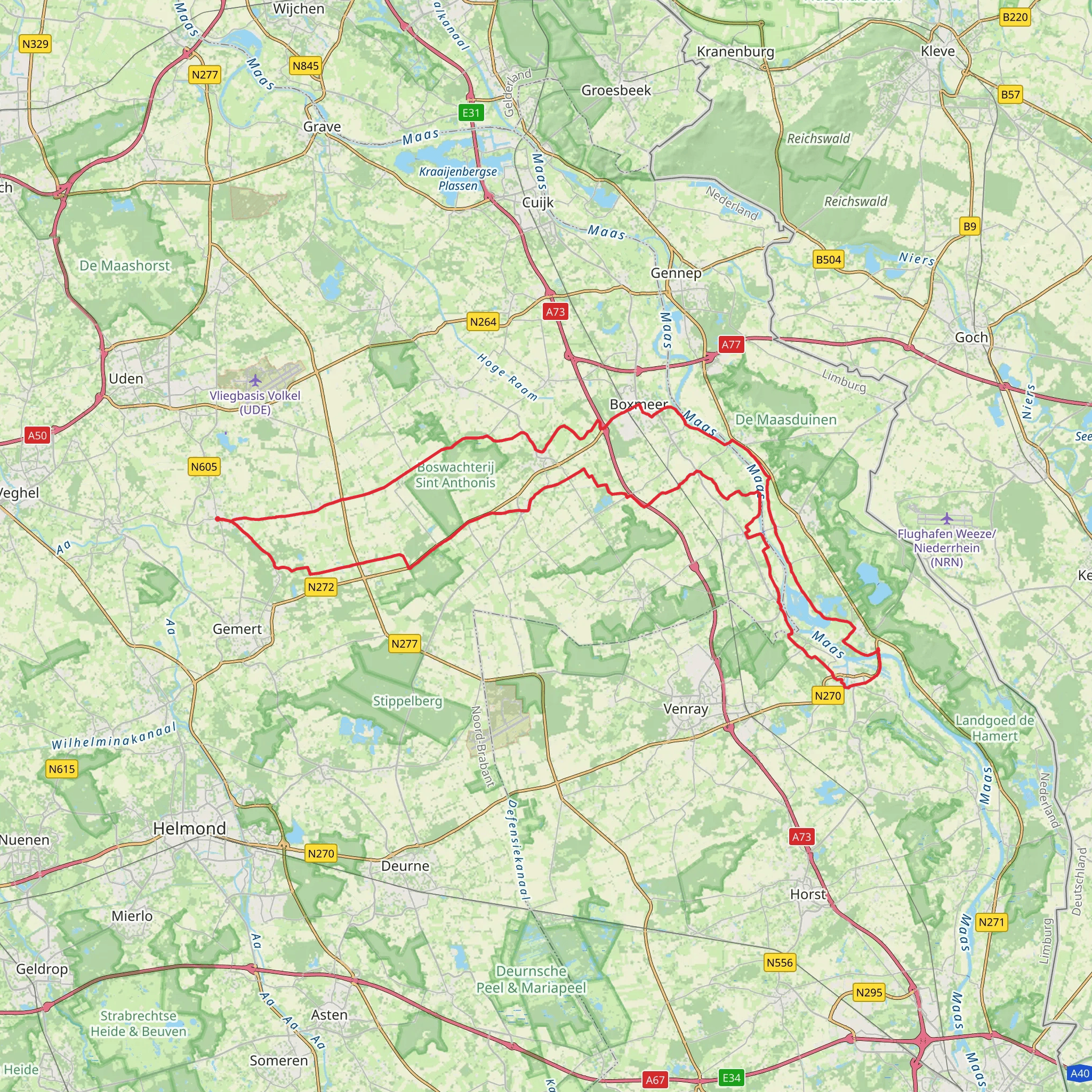
This is a long, very flat countryside loop of about 88 km (55 mi) with roughly 0 m (0 ft) of climbing—more of an endurance day (or relaxed 2-day) than a “hard” hike. Expect a patchwork of farm lanes, village streets, canal/ditch edges, and straight polder-style roads where pacing, wind, and foot comfort matter more than elevation.
Because the start point is listed only as “near” (missing the location), I can’t reliably convert the route’s lon/lat to a nearest address or landmark yet. If you share either (a) the starting coordinates, (b) a GPX, or (c) the nearest town/village, I’ll pin the start to the closest known address/landmark and tailor the access directions precisely.
Getting to the start (general approach, since the exact start is unspecified)
By car - In this part of the Netherlands, loops named for roads like Statenweg / De Quayweg / Gemertseweg / Arendstraat typically pass through small villages with limited curbside parking. Plan on using a public car park near a church square, sports club, or community center, then walking a few minutes to the route line. - Bring a windproof layer even on mild days—open agricultural land can feel colder than the forecast.
By public transport - The most common pattern is train to a regional hub, then a bus to a village stop near the loop. In rural areas, buses can be infrequent and may stop early in the evening—check schedules carefully and build in buffer time. - If you’ll finish late, plan a fallback (taxi number saved, or a shorter bail-out option).
If you tell me the nearest town, I’ll specify the most likely train station + bus line/stop combination and the best place to park.
What the terrain feels like over 88 km / 55 mi
- Surface: Mostly paved or hard-packed farm track with occasional gravel. After rain, the edges of lanes and any unpaved connectors can be slick with mud, algae, or farm runoff.
- Gradient: Essentially flat. The “difficulty” comes from distance, monotony, and exposure rather than hills.
- Exposure: Expect long stretches with little shade. Sun and wind are the main environmental factors.
- Navigation: Straight roads can lull you into missing turns where a lane splits or a farm track branches. Load the route in HiiKER and keep an eye on junction density—the “easy” navigation is where people drift off-course.
Pacing and time planning
For most hikers, 88 km is best treated as: - A very long single day: typically 14–20 hours moving time depending on breaks and speed, or - A 2-day outing: ~44 km (27 mi) per day, which is still substantial on flat ground.
If you’re aiming for one day, plan resupply points (villages, cafés, supermarkets) and identify shortcuts back to a bus stop or main road.
Landmarks, landscape, and what you’ll notice
With road names like these, the loop is likely a village-to-village circuit through a classic lowland cultural landscape: - Agricultural mosaic: fields, pasture, drainage ditches, and shelterbelts. You’ll often walk beside canals/ditches—watch for narrow verges and soft shoulders. - Village cores: expect churches, small bridges, and older farmsteads. Even when the route is “rural,” you’ll periodically pass through built-up areas where you can top up water and food. - Road heritage: names like Statenweg often indicate an older through-route (historically important road alignment), while smaller streets (Arendstraat) tend to be local connectors. The region’s history is typically tied to agriculture, land management, and trade routes rather than dramatic topography.
If you share the nearest town(s), I can call out specific points—e.g., notable churches, historic farm complexes, mills, or protected landscape parcels along the way.
Nature and wildlife (what to look for)
Even in heavily farmed lowlands, wildlife can be excellent—especially along wet edges: - Birdlife: herons, egrets, gulls, lapwings, geese, and a variety of songbirds. Early morning and late afternoon are best. - Mammals: rabbits and hares are common; foxes are possible; deer may appear near quieter field margins. - Amphibians/insects: wetter ditches can mean frogs and abundant insects in warm months—pack repellent if you’re sensitive.
Be mindful during spring: ground-nesting birds may be present in open fields; keep to the route and avoid disturbing field margins.
Practical hazards and what to watch out for
- Traffic: Even “quiet” rural roads can have fast-moving local traffic (including farm machinery). Walk facing traffic where safe, use bright clothing in low light, and be extra cautious at bends and bridge approaches.
- Farm operations: tractors, slurry spreading, temporary closures, and muddy track sections are normal. Give machinery space and expect occasional detours.
- Foot care: Flat, repetitive surfaces can cause hotspots and tendon irritation. Consider cushioned footwear, change socks once, and carry blister care.
- Weather exposure: With minimal elevation, conditions are dominated by wind chill, sun exposure, and rain. A light waterproof and
AI Planner
Days planned around your pace, with somewhere to stay each night.
Surfaces
Unknown
Asphalt
Concrete
Paved
Dirt
Wood
Comments and Reviews
User comments, reviews and discussions about the Statenweg, De Quayweg, Gemertseweg and Arendstraat Loop, Netherlands.
average rating out of 5
0 rating(s)



