Download
3D Flyover
Add to list
More
29.1 km
~6 hrs 2 min
135 m
Loop
“A breezy dune-and-lake loop of big skies, birdlife, and junction-hopping—best savoured unhurried.”
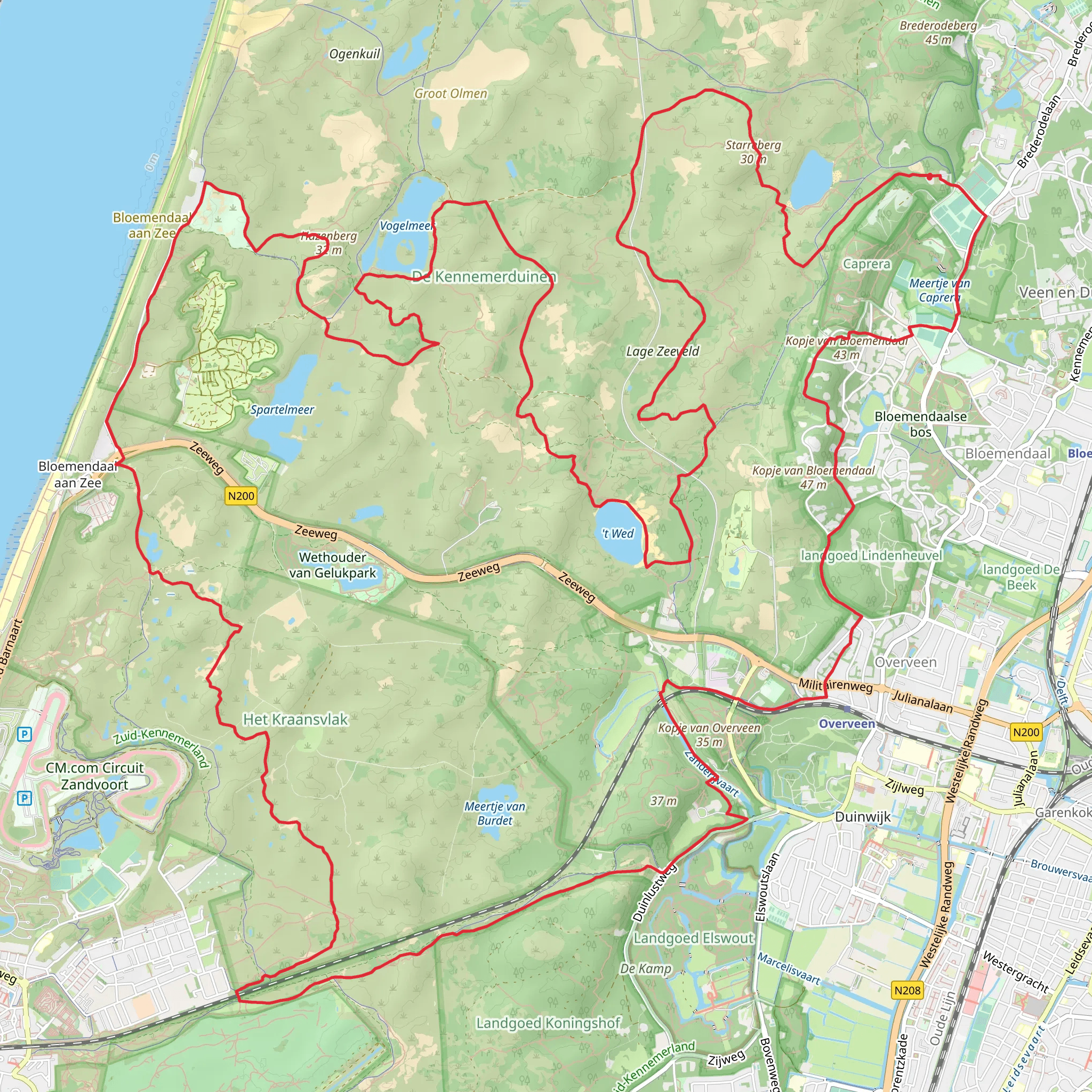
This is a long, low-relief loop of roughly 29 km (18.0 mi) with about 100 m (330 ft) of total climbing—more of a steady day on your feet than a physically demanding hike. Expect mostly flat, well-surfaced paths (pavement, compacted gravel, and wide park tracks), frequent water views, and lots of “micro-navigation” at junctions where multiple park paths intersect.
Getting to the start (car + public transport)
Because the start point is listed only as “near,” the most reliable way to pin it down is to anchor to the first major named feature on the loop. For this route, the most practical “start area” is typically near Vogelmeer (a well-known lake area in the Kennemerduinen / Zuid-Kennemerland dunes region near Overveen/Bloemendaal in the Netherlands). If you share the route’s coordinates (or a HiiKER link), I can convert them to the nearest exact street address or trailhead landmark.
By car - Aim for a major access point to the Zuid-Kennemerland dune/park network near Overveen/Bloemendaal (common access areas are near large park entrances and parking zones serving the dunes and lakes). - Arrive early on fair-weather weekends—these areas can be busy with walkers and cyclists.
By public transport - The easiest approach is usually train to Overveen or Haarlem, then a short bus ride and/or walk to the dune/park entrances near the Vogelmeer area. - Plan your final approach so you’re not forced onto narrow roadside shoulders—use HiiKER to choose a pedestrian-friendly connector from the station/bus stop to the first lake/park path.
What the terrain feels like over 29 km (18 mi)
- Underfoot: Mostly firm and fast—good for trail runners and hikers alike. After rain, some low spots near water edges can be muddy, but you’re rarely in deep sand for long on this kind of loop.
- Elevation: The 100 m (330 ft) gain is spread out in tiny rises—dune undulations, bridge ramps, and gentle embankments. You’ll notice it more in your calves late in the day than in any single “climb.”
- Pacing: Many hikers underestimate how long 29 km feels on flat multi-use paths. A typical moving pace might be 4–5 km/h (2.5–3.1 mph), but junction pauses, wildlife watching, and café/bench stops can add time.
Route flow and key places you’ll pass
You’ll be moving through a mosaic of dune landscapes, managed parkland, and water features. The names in the loop—Vogelmeer, Het Kraansvlak, Brouwerskolkpark, and Oosterplas—hint at the main rhythm: lake/pond edges, open dune sections, then greener park corridors, then back to water.
0–8 km (0–5 mi): Vogelmeer and the first water-and-woodland stretch - The day often starts with easy walking near Vogelmeer (“bird lake”), where you’ll likely see waterfowl (ducks, geese, coots) and, in migration seasons, a wider variety of birds using the lake margins. - Paths here can be popular. Expect cyclists and families; keep right and be predictable at bends. - Look for reeds and wetland edges—these are prime spots for birds and also where the path can be slick with leaf litter or algae on shaded pavement.
8–17 km (5–10.5 mi): Het Kraansvlak—open dunes, big skies, and wildlife potential - This is where the landscape typically feels more “dune reserve” than “city park.” You’ll get broader views, more wind exposure, and a more natural feel even though you’re still on established tracks. - Wind is the main “difficulty” multiplier here. A headwind on open dune paths can make an easy loop feel surprisingly tiring—bring a light shell even on mild days. - Wildlife to watch for in dune reserves: - Deer are common in many Dutch dune areas, especially at quieter times of day. - Grazers may be present in managed dune systems (used to maintain open habitats). Give them space and never try to pass between animals and their young. - Stay on designated paths—dune vegetation is fragile, and many areas have conservation rules.
17–24 km (10.5–15 mi): Brouwerskolkpark—greener corridors and junction-heavy navigation - As you transition into more park-like terrain, you’ll often encounter more intersections: side paths, cycle routes, and short connectors between ponds and lawns. - This is where people most often “lose” the loop—not because it’s remote, but because there are so many tempting parallel paths. - Use HiiKER to confirm each major turn, especially where two paths run alongside the same water body. If you drift onto a parallel track, it may still reconnect, but it can add distance.
24–29 km (15–18 mi): Oosterplas and the return leg - The final section tends to feel relaxing: water views, birds, and a gentle roll back toward the start area. - Late in the day, watch your footing on shared paths—fatigue plus fast cyclists is a common combination for minor mishaps. - If you’re finishing near busier access points, expect more people and dogs close to trailheads.
Landmarks, nature, and what to look out for
- **Water features (meer/plas/kolk
AI Planner
Days planned around your pace, with somewhere to stay each night.
Surfaces
Unknown
Sand
Unpaved
Asphalt
Ground
Gravel
Dirt
Wood
Concrete
Comments and Reviews
User comments, reviews and discussions about the Vogelmeer, Het Kraansvlak, Brouwerskolkpark and Oosterplas Loop, Netherlands.
average rating out of 5
0 rating(s)