
Download
3D Flyover
Add to list
More
48.8 km
3 days
7 m
Multi Day
“A wind-swept polder-to-dune loop—flat horizons, whispering woods, and sand that tests resolve.”
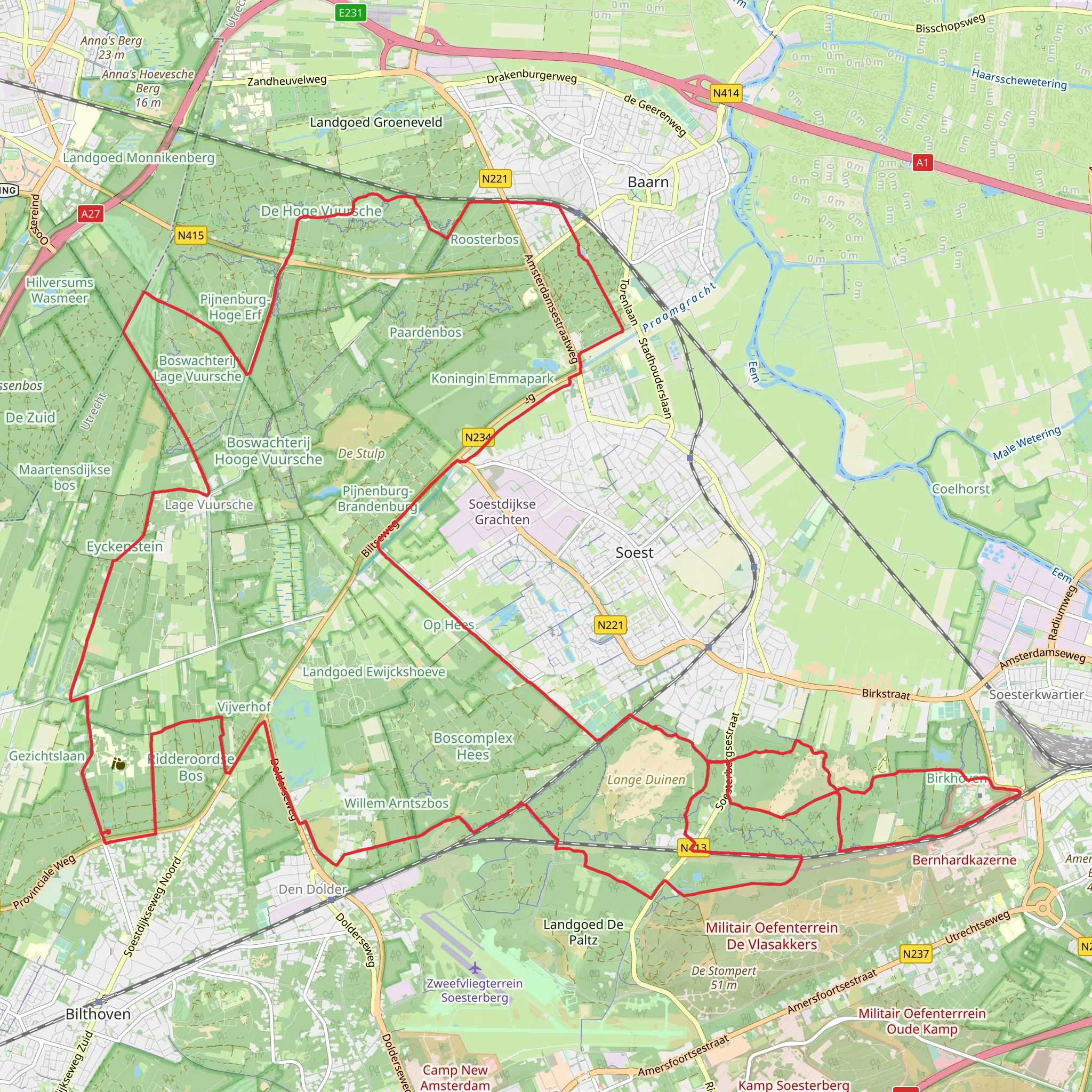
This is a long, low-lying loop through classic Dutch polder-and-dune country: straight farm lanes and drainage canals early on, then increasingly wooded “bosch” paths and sandy “duinen” tracks later. At ~49 km (30.5 mi) with roughly ~0 m / ~0 ft of climbing, the challenge is less about elevation and more about time on feet, wind exposure, and keeping a steady pace on mixed surfaces (pavement, compacted gravel, forest singletrack, and occasional soft sand).
Because your start point is listed only as “near” (no coordinates provided), I can’t reliably convert the lon/lat to a nearest address or landmark yet. If you share the start lon/lat (or a HiiKER link), I’ll pin it to the closest recognizable place (e.g., a station, trailhead parking area, or named crossroads) and tailor the access directions precisely.
Getting to the start (car + public transport)
By car (general approach): - These routes typically begin near a village edge where polder roads meet woodland access tracks. Look for a signed parking area at a forest entrance (“bos”/“duinen” access) or a small pull-in near a farm road junction. Arrive early—weekends can fill quickly where dunes/woodland are popular. - Plan for limited services at the trailhead: carry water and food from the nearest town.
By public transport (general approach): - In this region, the most practical pattern is train to the nearest larger town, then bus to a village stop, then a short walk (0.5–2 km / 0.3–1.2 mi) to the loop. - If you tell me the nearest town name (or provide coordinates), I’ll specify the most likely station/bus stop and the walking approach.
What the route feels like underfoot
Expect a “four-part” character that matches the place names:
1) Wieksloterweg Westzijde (early kilometers: fast, exposed, very flat) - The opening section is usually on straight, open polder road—excellent for making time, but it can be windy with little shelter. - Surfaces are commonly asphalt or hard-packed lane, so foot fatigue can build over 49 km (30.5 mi). Cushioned shoes and fresh socks matter more than aggressive tread here. - Watch for farm traffic (tractors, delivery vans) and cyclists moving quickly on narrow lanes.
2) Monnikenboschpad (transition into woodland paths) - You’ll likely shift from open fields into wooded corridors with more shade and softer footing. - “Bosch/bos” areas often have interlaced paths—easy to drift onto a parallel track. Keep HiiKER handy and confirm junctions, especially where multiple sandy paths run side-by-side.
3) Roosterbosch (deeper woodland, quieter stretches) - This portion tends to feel more secluded: taller trees, leaf litter, and occasional muddy patches after rain. - In wetter seasons, expect standing water in low spots even though the overall elevation gain is near zero—this is drainage-country, and water doesn’t “run off” so much as it collects. - Wildlife is often subtle rather than dramatic: listen for songbirds and woodpeckers, and watch edges for hares/rabbits. In many Dutch woodland-dune mosaics, roe deer are possible at dawn/dusk.
4) Korte Duinen (sandy, energy-sapping finish if you hit soft sections) - “Duinen” usually means sandier terrain. Even small sandy stretches can slow pace late in the day. - If the track turns into loose sand, shorten stride and keep cadence steady. Gaiters can help keep sand out, but even without them, plan a quick stop to empty shoes if needed.
Distance, timing, and pacing
- Total distance: ~49 km (30.5 mi)
- Elevation gain: ~0 m (~0 ft)
- Time planning: Most hikers will want a full-day window. A steady walking pace with breaks commonly lands in the 9–12 hour range depending on surface (sand slows you) and wind.
A practical way to break it up: - 0–15 km (0–9.3 mi): settle into rhythm on the straighter lanes; don’t go out too fast. - 15–35 km (9.3–21.7 mi): woodland sections—more junctions, more variable footing. - 35–49 km (21.7–30.5 mi): dunes/forest mix—manage fatigue and any sand.
Navigation and wayfinding (HiiKER)
This loop’s difficulty is “Easy” in terms of gradient, but junction density in wooded/dune areas can make it deceptively easy to wander. - Use HiiKER to confirm you’re on the correct branch whenever you hit: - a multi-track sandy intersection - a T-junction with similar-looking paths - a forest edge where paths re-enter open fields - In open polder sections, navigation is straightforward, but wind and monotony can make it easy to miss a turn—check HiiKER at major road bends and canal crossings.
Landmarks, landscape, and historical context
This landscape is shaped by centuries of Dutch water management and land use: - Polders, ditches, and canals reflect long-term drainage and reclamation—flat horizons, straight roads, and engineered waterways
AI Planner
Days planned around your pace, with somewhere to stay each night.
Surfaces
Unknown
Asphalt
Concrete
Sand
Gravel
Unpaved
Dirt
Cobblestone
Ground
Grass
Paved
Comments and Reviews
User comments, reviews and discussions about the Wieksloterweg Westzijde, Monnikenboschpad, Roosterbosch and Korte Duinen Loop, Netherlands.
average rating out of 5
0 rating(s)



