
Download
3D Flyover
Add to list
More
19.4 km
~3 hrs 52 min
0 m
Point to Point
“A level Reestdal ramble of big skies, reed-lined canals, and quiet lanes—weather-dependent.”
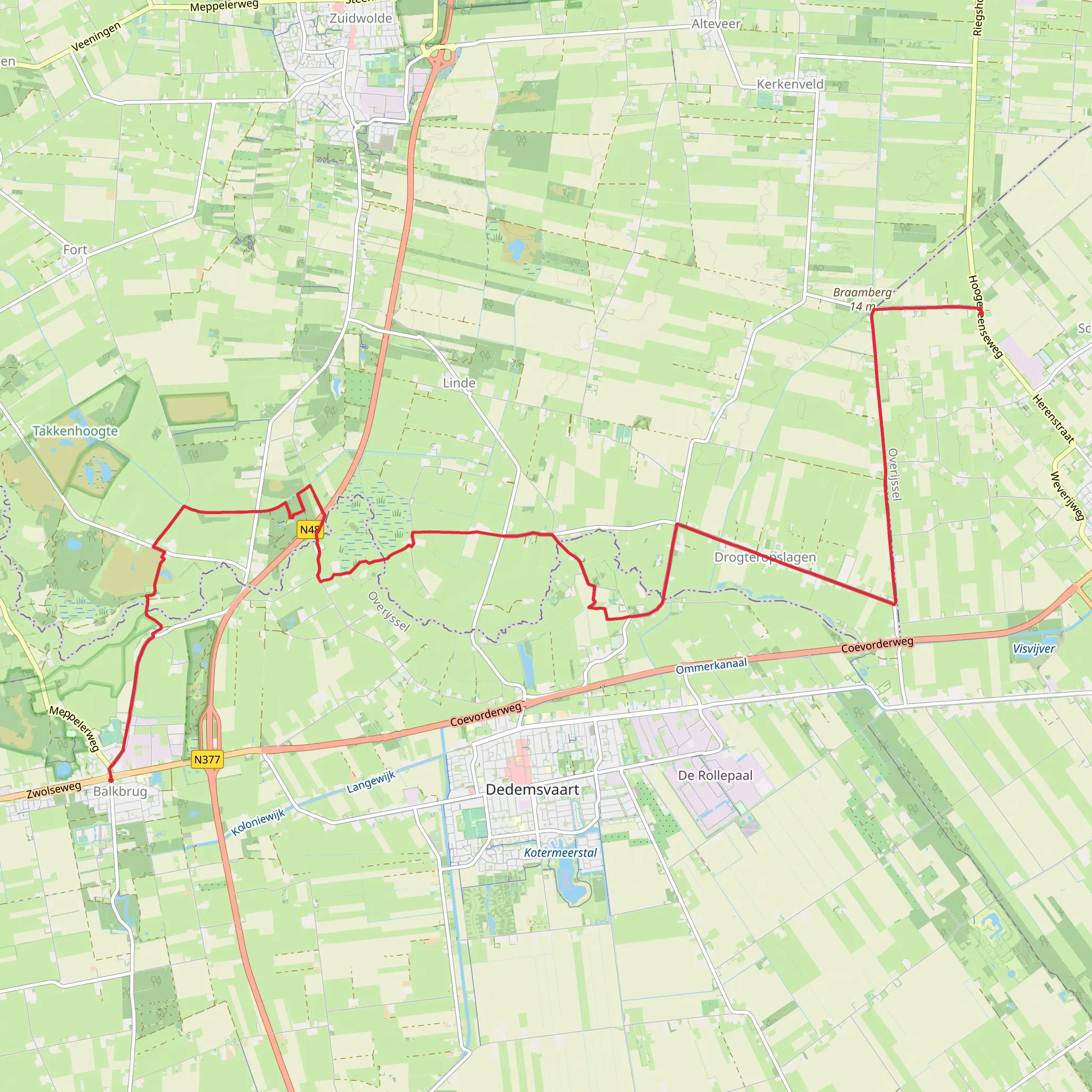
This is a mostly level, countryside walk through the Reestdal border region of Overijssel/Drenthe—expect quiet farm lanes, straight drainage canals, grassy field edges, and small wooded pockets rather than hills. At ~19 km (11.8 mi) with ~0 m (0 ft) of climbing, it’s ideal for a relaxed day, but wind and wet ground can make it feel more demanding than the numbers suggest.
Getting to the start (Balkbrug)
By public transport - Train: The nearest major rail hubs are typically Meppel and Hoogeveen. From either, you’ll usually continue by bus toward Balkbrug (routes and stops can change seasonally—check current schedules before you go). - Bus: Aim for a stop in or near Balkbrug village center (around the main shopping street and church area). From there, it’s usually a short walk to pick up the route.
By car - Balkbrug sits close to the N48 corridor. Parking is generally easiest around the village center (near shops/supermarket areas) or at small public pull-ins by local roads on the edge of town. Choose a spot that doesn’t block farm access—agricultural traffic is common.
What the route feels like underfoot
You’ll be on a mix of paved village streets, quiet asphalt farm roads, and unsealed tracks (often compacted gravel or dirt). Because the area is low-lying, after rain you can run into: - Soft verges and muddy edges where you step off the pavement to pass others - Puddled tractor tracks on unsealed sections - Slippery grass along field margins, especially in cooler months
Water management is a defining feature here: expect ditches, canals, and culverts throughout. They’re great for birdlife, but the banks can be steep and slick—watch footing if you stop for photos.
Route breakdown with landmarks (approximate)
0–3 km (0–1.9 mi): Balkbrug out to open farmland You’ll leave the built-up area fairly quickly and transition into open fields. The landscape is classic reclaimed lowland: long sightlines, straight drainage lines, and scattered farmsteads. In windy weather there’s little shelter—plan a layer you can add/remove easily.
3–7 km (1.9–4.3 mi): Toward Nolderhoeve As you approach the Nolderhoeve area, the route tends to feel more rural and quiet, with occasional hedgerows and small tree belts. This is a good stretch to settle into a steady pace; the terrain is flat, so the main “effort” comes from distance and exposure.
Look out for: - Reed-lined ditches (often holding moorhens, coots, and herons) - Pastures with cattle or sheep—keep distance, especially if calves are present - Seasonal field activity (spraying, harvesting). Give machinery plenty of room.
7–12 km (4.3–7.5 mi): Bijenberg and the Reestdal character Near Bijenberg, you’re in the broader Reestdal landscape—an area shaped by the small Reest River and centuries of farming on wet ground. Even when you don’t walk directly beside the river, you’ll notice the same low, damp character: wetter soils, drainage channels, and patches of woodland on slightly higher ground.
Wildlife is often best here: - Birds: grey heron, kestrel hovering over fields, buzzards, and in migration periods, mixed flocks of geese. - Mammals: hares are common in open farmland; roe deer can appear at field edges early/late in the day. - Insects: in warmer months, expect mosquitoes/gnats near still water—pack repellent.
12–16 km (7.5–9.9 mi): Long, level return legs This portion is typically the most “linear”: straight lanes and big skies. It can feel longer than it is because there are fewer obvious landmarks. Break it up with planned pauses—ditch crossings and small bridges make natural stopping points.
Practical notes: - If it’s sunny, there may be limited shade for several kilometers. - If it’s wet, the road spray from occasional cars and the mud at track junctions are the main annoyances—gaiters can help but aren’t essential.
16–19 km (9.9–11.8 mi): Back toward Braambergerweg and Balkbrug You’ll gradually pick up more signs of settlement again—more houses, tidier verges, and slightly busier roads. Stay alert at intersections: even quiet rural roads can have fast-moving local traffic.
Navigation (use HiiKER)
The terrain is flat and the road network is dense, so it’s easy to take a “nearly right” turn that costs time later. Use HiiKER to: - Confirm turns at farm-road junctions where multiple lanes run parallel - Keep track of progress on the long straight sections (helps pacing and morale) - Identify nearby alternatives if a track is waterlogged or temporarily closed for farm work
Weather, timing, and what to pack
- Time on feet: Most hikers will take 4–5.5 hours for 19 km (11.8 mi) depending on stops and surface conditions.
- Footwear: Light hiking shoes are fine in dry spells; after rain, choose something with better grip and some water resistance.
- **Wind/rain
AI Planner
Days planned around your pace, with somewhere to stay each night.
Surfaces
Unknown
Asphalt
Grass
Sand
Unpaved
Comments and Reviews
User comments, reviews and discussions about the Balkbrug to Braambergerweg via Nolderhoeve and Bijenberg, Netherlands.
average rating out of 5
0 rating(s)

