
Download
3D Flyover
Add to list
More
16.0 km
~3 hrs 12 min
0 m
Loop
“Drift beside Nieuwe Meer’s big skies and quiet birdlife on a mostly level Amsterdamse Bos loop.”
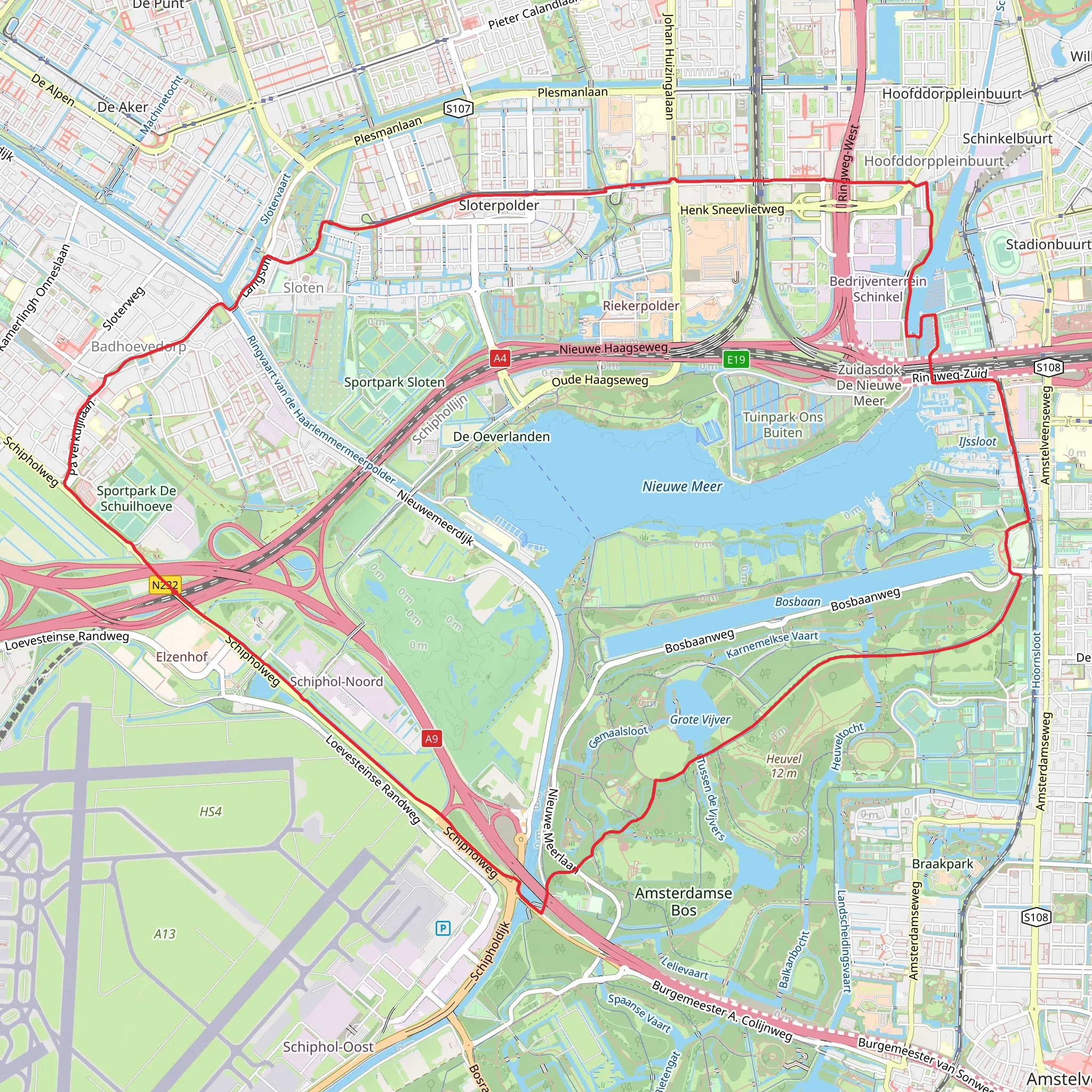
A flat, waterside circuit through Amsterdam’s Amsterdamse Bos and the Nieuwe Meer (the “New Lake”) area, this easy loop is ideal when you want long stretches of path with minimal effort: about 16 km / 10 miles with roughly 0 m / 0 ft of climbing (any “ups and downs” are typically just small bridge ramps and underpasses).
Getting to the start (public transport + car)
Because “near …” is incomplete, the most practical and common place to begin this loop is at a major, easy-to-find access point on the northeast edge of Amsterdamse Bos:
- Nearest major landmark to use as your start: Amsterdamse Bos – Bosbaan / main entrance area (close to the rowing course “Bosbaan” and the park’s busier access roads).
- By public transport: From central Amsterdam, take a tram/metro toward Amsterdam Zuid and connect to a bus that stops at/near Amsterdamse Bos (Bosbaan area). From there, you can walk a few minutes to the main paths and begin the loop. (Exact lines change periodically—check current routing and stops before you go.)
- By car: Navigate to Amsterdamse Bos (Bosbaan / main parking areas) and use the signed park parking. Arrive earlier on weekends—this area is popular with walkers, runners, and rowing events.
If you share the intended start coordinates (lon/lat), I can convert them to the nearest specific address or named landmark and tailor the directions precisely.
What the route feels like underfoot
Expect a mix of wide paved multi-use paths, hard-packed gravel, and occasional narrower park tracks. It’s generally stroller- and bike-friendly, and you’ll likely share space with cyclists—especially on the straighter commuter-style paths. After rain, the unpaved sections can hold shallow puddles, but the terrain stays straightforward.
Because the loop is essentially level, pacing is easy: most hikers finish in 3.5–5 hours depending on stops, wind exposure along the lake, and how often you pause for viewpoints.
Along the water: Nieuwe Meer and big-sky views
A highlight is the long, open shoreline feel around Nieuwe Meer, where you’ll get broad water views and frequent bird activity. The lake edges can be breezy; even on mild days, wind off the water can make it feel cooler—bring a light layer.
You’ll pass: - Reedbeds and wet margins that attract waterfowl - Small jetties and fishing spots - Open lawns and picnic clearings where locals sunbathe in warmer months
Keep an eye out for typical Dutch urban-wetland wildlife: swans, coots, moorhens, mallards, grebes, herons, and (seasonally) a variety of migrating birds. Early morning and late afternoon are usually best for sightings.
Through Amsterdamse Bos: woodland, canals, and park landmarks
Amsterdamse Bos is a designed forest-park landscape with long straight avenues, water channels, and mixed woodland. You’ll move between: - Tree-lined corridors (sheltered, quieter) - Canal crossings and small bridges - Open recreation zones (busier, with runners and families)
Notable points you may skirt depending on the exact line you take: - The Bosbaan rowing course area (a major sporting feature) - Cafés/kiosks in the busier nodes (useful for water refills or a break) - Occasional sculptures, memorial features, and park infrastructure typical of large European city parks
Navigation and wayfinding (using HiiKER)
This is a path-dense area with many intersections where multiple loops overlap. Use HiiKER to: - Confirm you’re staying on the intended shoreline segments (it’s easy to drift onto a shorter inner loop) - Identify the best crossing points if you need to detour around busy cycling corridors - Mark water/food stops and the nearest public transport exits in case you want to shorten the day
Hazards and things to watch for
- Cyclists and fast e-bikes: The biggest “risk” here is speed differences on shared paths. Keep right, be predictable, and listen for bells.
- Slippery edges near water: Some banks are muddy or slick, especially near reeds and fishing spots.
- Wind exposure: The lakefront can feel significantly colder; pack a wind layer even for an easy walk.
- Seasonal insects: Near still water in warm months, mosquitoes/gnats can be noticeable—repellent helps.
- Low-light sections: In winter afternoons, wooded stretches can get dim early; a small light is useful if you start late.
Cultural and historical context
This landscape reflects the Netherlands’ long relationship with water management and land shaping. The broader Amsterdam area has been engineered for centuries through drainage, canals, and controlled waterways—so even a “natural-feeling” loop like this often follows managed shorelines, constructed channels, and planned woodland. Amsterdamse Bos itself is a major green space created to provide recreation and nature close to the city, and today it functions as both a wildlife corridor and a heavily used urban escape.
Practical planning: what to bring for an easy 16 km / 10 mi
- Footwear: Light hiking shoes or trainers with decent grip (paved + gravel mix).
- Water: At least 1–1.5 L per person; more on warm, sunny days due to exposed sections.
- Layers: A windproof top for the lakefront; a warmer layer in cooler months.
- Snacks: Enough for a
AI Planner
Days planned around your pace, with somewhere to stay each night.
Surfaces
Unknown
Asphalt
Gravel
Paved
Concrete
Comments and Reviews
User comments, reviews and discussions about the Nieuwe Meer Loop, Netherlands.
average rating out of 5
0 rating(s)

