
Download
3D Flyover
Add to list
More
24.5 km
~4 hrs 53 min
0 m
Loop
“Follow the Amstel’s ribbon past houseboats, rowing wakes, birds, and wind-swept shared paths.”
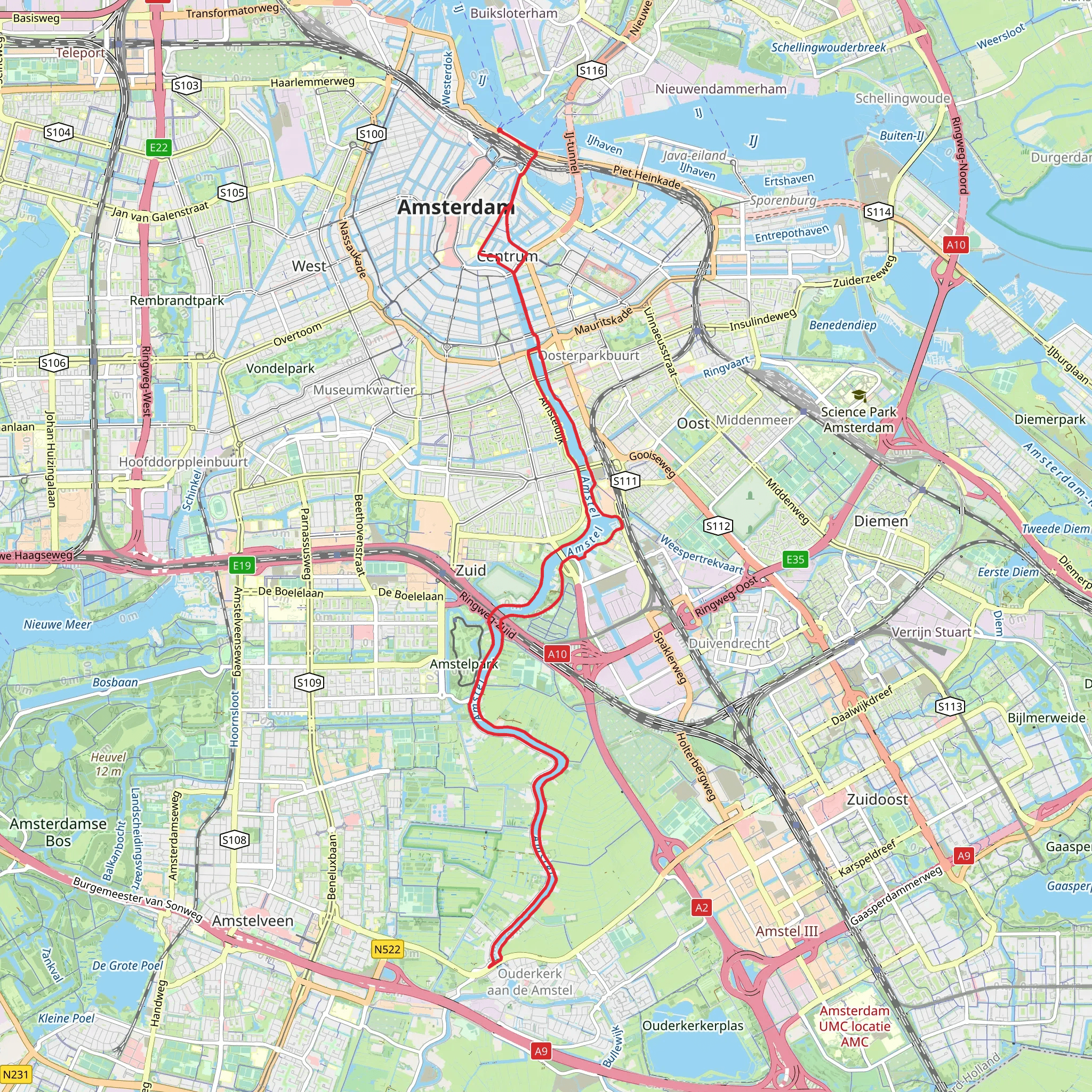
A flat, waterside walk that strings together some of Amsterdam’s most distinctive “edge-of-city” scenery: broad river views on the Amstel, houseboats and rowing clubs, pockets of parkland, and long, open stretches where you can watch barges, cyclists, and birds moving through the same corridor. At around 24 km (15 miles) with roughly 0 m (0 ft) of climbing, it’s best planned as a steady, all-day stroll rather than a workout—your main challenges are wind exposure, busy shared paths, and staying oriented where riverside paths split around marinas, bridges, and construction.
Where the hike starts (nearest landmark) “Omval” most commonly refers to De Omval, the bend of the Amstel by the Overamstel area in Amsterdam. A practical, easy-to-find start point is near Amstelstation (Amsterdam Amstel railway/metro station) and the nearby Berlagebrug (bridge over the Amstel). If you want a very clear meet-up landmark, aim for the Amsterdam Amstel station forecourt and walk a few minutes to the river.
Getting to the start
- Public transport: Amsterdam Amstel station is served by Dutch Railways trains plus Amsterdam Metro and city buses. From the station, it’s a short walk to the Amstel and De Omval/Overamstel riverside paths.
- By car: Parking in this part of Amsterdam can be limited and regulated. If you drive, plan on using a paid garage near Overamstel or a P+R facility on the metro line and ride in to Amsterdam Amstel. Build in extra time for finding legal parking and for walking from the garage to the river.
What to expect underfoot Most of this route is on paved multi-use paths, sidewalks, and compacted riverside tracks. After rain, the unpaved edges near the water can be slick. Footwear can be light hiking shoes or sturdy trainers; waterproofing matters more than ankle support here. Because the terrain is flat, wind and weather are the real “elevation”—a headwind along the Amstel can make the middle miles feel longer than the map suggests.
Plan water and snacks as if you’re doing an urban-to-suburban ramble: you’ll pass cafés and shops near built-up areas, but there can be longer quiet stretches where you’ll want what you need already in your pack.
Route flow and key landmarks (with planning distances)
0–3 km (0–1.9 mi): De Omval / Overamstel to the Amstel proper
You’ll begin in a modern riverside district where the Amstel is framed by offices, apartments, and bridges. Expect frequent cyclists and commuters, especially on weekdays. The river here is busy with small craft and rowing shells; give rowing clubs and boat ramps a wide berth—these are common pinch points where pedestrians, bikes, and trailers converge.
3–8 km (1.9–5 mi): Classic Amstel riverbank scenery
As you settle into the rhythm, the route becomes a long, linear waterside walk. You’ll see:
- Houseboats and moored vessels
- Rowing clubs and training lanes on the water
- Long sightlines down the river, with bridges acting as navigation “checkpoints”
This is a good section to keep your pace conservative. Even though it’s flat, the constant hard surface can fatigue feet and hips over 24 km (15 mi). If it’s sunny, there’s often limited shade—bring sun protection.
8–13 km (5–8.1 mi): Parks, green edges, and birdlife
You’ll likely pass greener pockets where the city thins out. Along the Amstel corridor, it’s common to spot waterfowl such as mallards, coots, moorhens, and geese; in quieter stretches you may also see herons and other wading birds. Early morning and late afternoon tend to be best for wildlife activity, but even midday you’ll usually have birds around the reeds and embankments.
Watch for: - Narrow path sections where vegetation encroaches - Anglers with lines crossing the path edge - Slippery algae on steps or ramps down to the water
13–18 km (8.1–11.2 mi): Open river miles and wind exposure
This is where the route can feel most “Dutch”: broad sky, open water, and a steady breeze. With no hills to break it up, it’s mentally helpful to navigate by fixed features—bridges, marinas, and prominent buildings across the water. If you’re using a navigation app, keep HiiKER handy and check it at each major junction where a riverside path splits into an inland street option.
Practical note: if you’re doing this on a weekend with good weather, expect heavy bike traffic. Stay predictable, keep right, and avoid sudden stops on shared paths.
18–24 km (11.2–15 mi): Returning toward the city / finishing stretch
As you arc back toward more built-up areas, you’ll re-enter busier zones with more crossings, bridges, and intersections. This is where fatigue can lead to small mistakes—missing a turn, stepping into a bike lane, or drifting onto a parallel street that looks “close enough.” Use HiiKER to confirm you’re on the correct bank and heading toward your intended finish.
Navigation and safety notes (flat doesn’t mean effortless)
- Shared-path etiquette is the #1 safety issue. Many riverside paths double as commuter cycle routes
Surfaces
Unknown
Asphalt
Paved
Wood
Unpaved
Dirt
Comments and Reviews
User comments, reviews and discussions about the Amstel via Omval, Netherlands.
average rating out of 5
0 rating(s)
