
Download
3D Flyover
Add to list
More
17.8 km
~3 hrs 34 min
6 m
Point to Point
“A gentle city‑to‑forest‑to‑canals ramble, trading urban buzz for leafy calm on the way.”
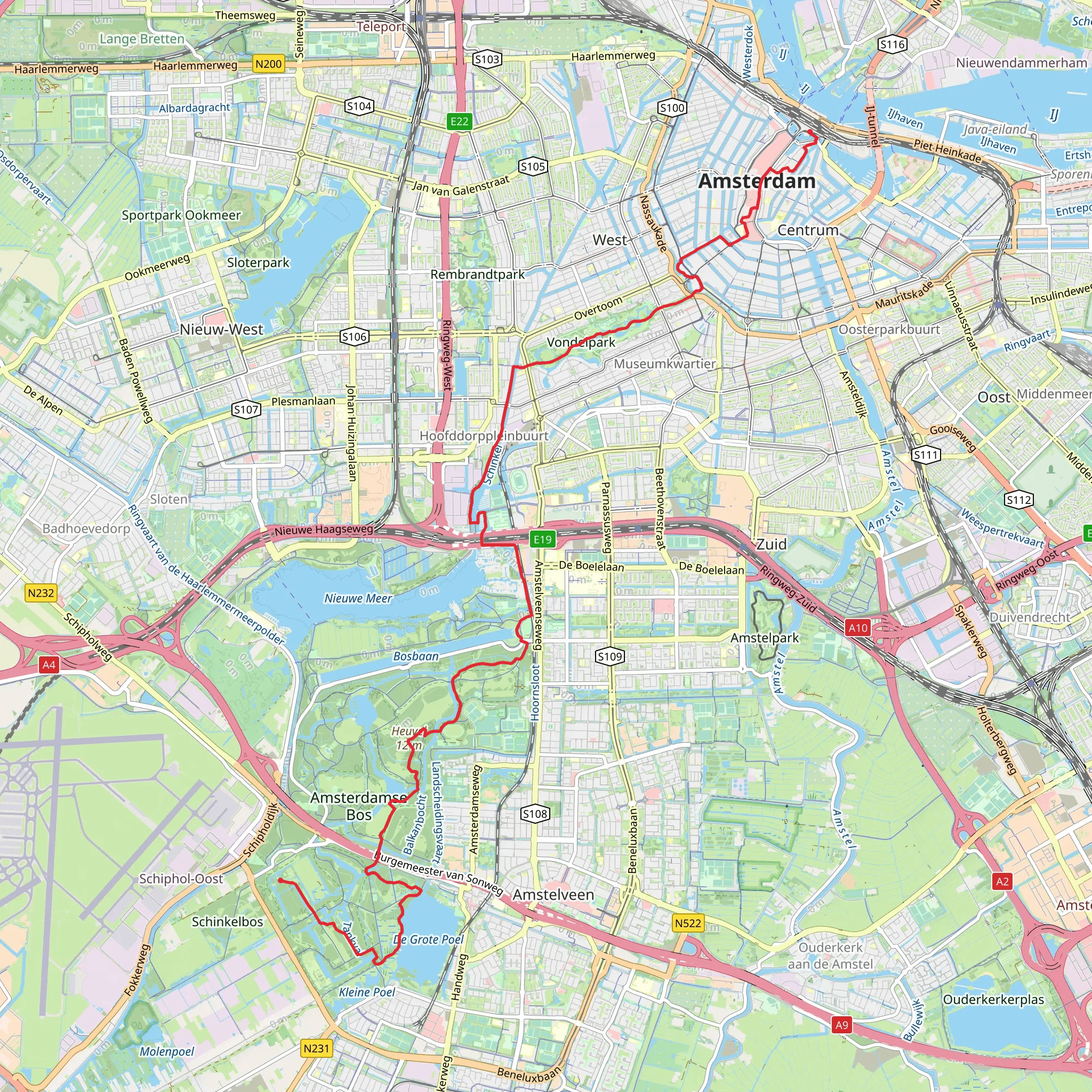
This is a mostly flat, city-to-park-to-city walk of about 18 km (11.2 mi) with essentially 0 m (0 ft) of climbing—ideal if you want an easy, steady day on foot that mixes quiet green space with classic Amsterdam neighborhoods. Expect paved paths, canal-side walking, and well-signed park routes, with a few busier road crossings as you transition between districts.
Getting to the start (Radarterrein area)
Because “Radarterrein” can refer to a few local spots, the most reliable way to pinpoint your exact start is to match it in HiiKER before you go. In Amsterdam, “Radarterrein” is commonly associated with the radar/aviation-related grounds near Schiphol/Badhoevedorp on the southwest side of the city. The nearest widely known landmark for that area is Amsterdam Airport Schiphol and the Badhoevedorp vicinity.
- By public transport: Aim for a bus/tram/metro connection that gets you to the Badhoevedorp / Schiphol-area stops, then walk to the trailhead shown in HiiKER. From central Amsterdam, this is typically a straightforward transit ride plus a short walk.
- By car: Navigate to the Badhoevedorp / Schiphol area and park where legal street parking or designated lots are available near the start point shown in HiiKER. Parking rules can be strict around Amsterdam—check signage carefully.
What the route feels like (surface, pacing, and effort)
With negligible elevation change, the challenge here isn’t hills—it’s distance and urban transitions. Plan for 3.5–5 hours of walking time depending on pace and stops. Footing is generally easy: asphalt, brick sidewalks, and compact park paths. After rain, some park sections can hold shallow puddles, but you won’t be dealing with technical terrain.
Bring: - Comfortable walking shoes (road/trail hybrid is perfect) - A light rain layer (weather can shift quickly) - Water and snacks (you’ll have options to buy food later, but not everywhere early on) - A small daypack; reflective/bright layer if you’ll be near roads in low light
From Radarterrein toward Amsterdamse Bos (first ~4–6 km / 2.5–3.7 mi)
The opening kilometers typically feel more suburban/edge-of-city, with wider roads, bike lanes, and occasional industrial or airport-adjacent infrastructure depending on the exact Radarterrein location. You’ll likely cross or parallel canals and drainage waterways—a hallmark of Dutch landscape engineering.
Key things to watch for: - Cyclists: Amsterdam’s bike traffic is fast and constant. Stay alert at crossings and on shared paths. - Road junctions: The route is easy physically, but attention is needed where paths meet larger roads. Use HiiKER to confirm turns and avoid detours.
Amsterdamse Bos (middle ~6–14 km / 3.7–8.7 mi)
Amsterdamse Bos is one of the most significant green spaces in the region—large, landscaped, and crisscrossed by paths, waterways, and wooded sections. The walking becomes calmer here, with long stretches away from traffic noise.
Nature and wildlife You’re moving through a managed forest-park mosaic: stands of trees, open lawns, and water features. Common sightings can include: - Waterfowl (ducks, geese, swans) along canals and ponds - Small birds in wooded areas (songbirds, woodpecker-like tapping in mature trees) - Rabbits and other small mammals in quieter edges and grassy clearings
Wildlife etiquette matters because the park is heavily used: - Keep distance from nesting birds near water - Don’t feed waterfowl (it disrupts natural behavior and water quality) - Expect off-leash dogs in designated areas—stay aware on narrower paths
Landmarks and atmosphere Amsterdamse Bos was developed as a major recreational landscape and is closely tied to the city’s 20th-century expansion and planning—part of the broader Dutch tradition of shaping land and water for public use. You’ll notice: - Long straight avenues and formal plantings in places - Bridges and canals that create frequent scenic pauses - A steady flow of locals: runners, families, cyclists, and rowers/canoeists where water access exists
Navigation inside the Bos It’s easy to drift onto parallel paths because many look similar. Keep an eye on: - Path junctions near water crossings - Any numbered/marked intersections (where present) - Your intended exit direction toward the city center using HiiKER
Leaving the Bos and heading to Centraal Station (last ~4–6 km / 2.5–3.7 mi)
As you approach central Amsterdam, the route becomes more urban again—more intersections, more bikes, and more pedestrians. The scenery shifts from parkland to canals, residential streets, and busier commercial corridors.
What to look out for: - Tram lines and crossings: Pay attention at intersections where trams run; cross only at designated points. - Crowds near the center: The closer you get to Centraal Station, the more foot traffic you’ll encounter, especially around peak commute and tourist hours. - Shared space etiquette: Many central areas blend walking and cycling space—hold a predictable line and avoid sudden stops.
Centraal Station arrival and nearby services
Amsterdam Centraal is a major hub with plentiful options immediately on arrival: - Food, groceries, cafés, restrooms - Trains, metros, trams, buses, ferries
AI Planner
Days planned around your pace, with somewhere to stay each night.
Surfaces
Unknown
Asphalt
Paved
Sand
Cobblestone
Ground
Dirt
Wood
Concrete
Grass
Comments and Reviews
User comments, reviews and discussions about the Radarterrein to Centraal Station via Amsterdamse Bos, Netherlands.
average rating out of 5
0 rating(s)


