Download
3D Flyover
Add to list
More
32.5 km
2 days
0 m
Multi Day
“A wind-swept river-and-polder loop of big skies, dikes, and village pauses—best savoured steadily.”
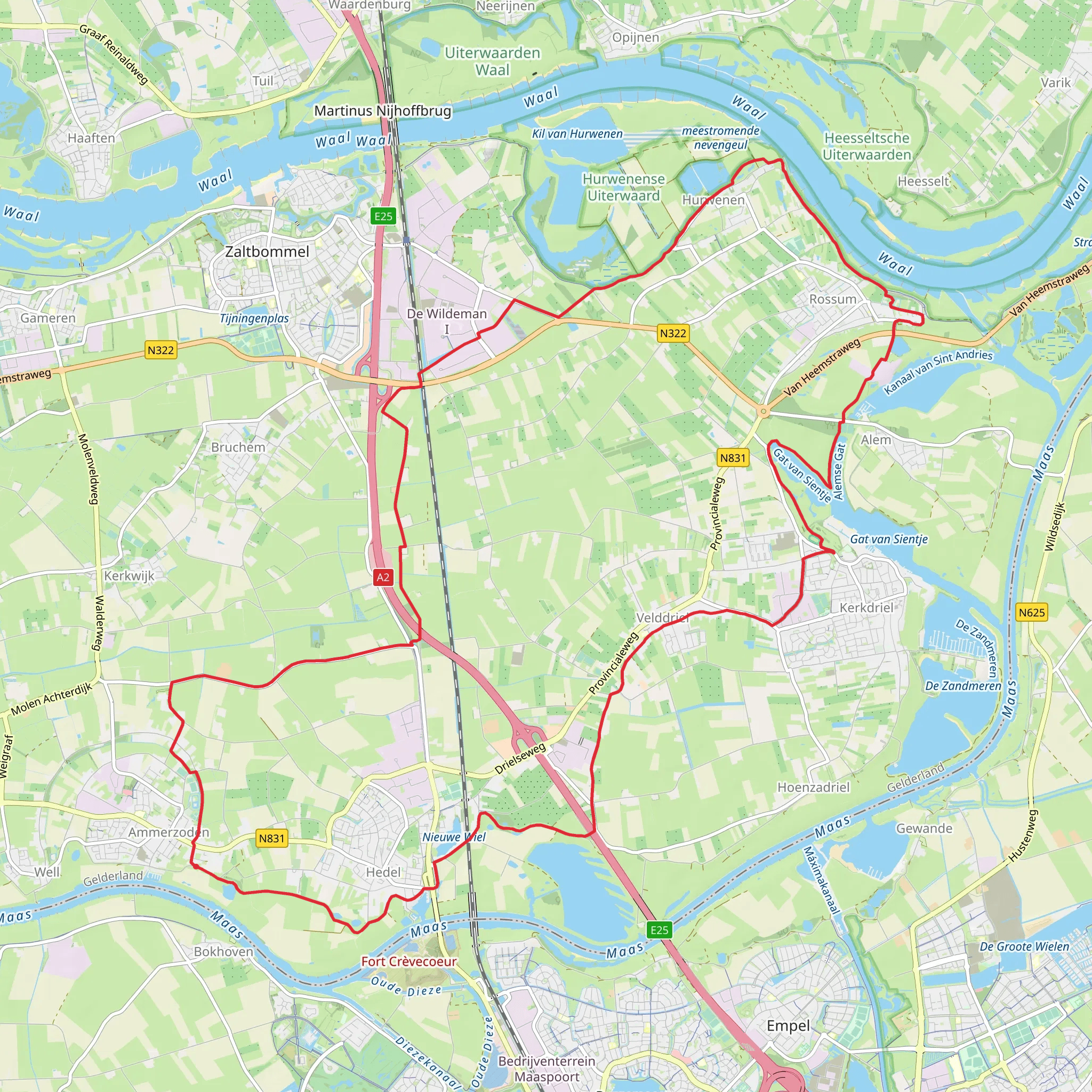
This is a long, low-lying river-landscape loop of about 33 km (20.5 mi) with essentially 0 m (0 ft) of climbing, built for steady, all-day walking rather than elevation. Expect a mix of dike-top paths, quiet farm lanes, canal-side tracks, and village streets, with big skies, wide water views, and frequent wind exposure. Underfoot is typically paved or hard-packed; after rain, some field-edge and riverside sections can be slick with mud or algae on bricks near the water.
Getting to the start (car + public transport)
Because “near” is incomplete, the most practical start for this loop is by the Waal river dike near Zaltbommel (Gelderland, Netherlands)—a logical access point to the Bommelerwaard area and common hub for long loops.
- Nearest major landmark / address-level reference: Zaltbommel railway station (Station Zaltbommel) is the easiest “pin” to navigate to, and it sits close to the dike network that threads the Bommelerwaard.
- By car: Drive to Zaltbommel and park near the station or in town-center public parking (look for signed “P” areas). From there, you can walk a short connector to the dike to begin the loop.
- By public transport: Take a train to Station Zaltbommel (well-connected on the Dutch rail network). From the station, you’re typically within 1–2 km (0.6–1.2 mi) of dike paths depending on the exact route variant you choose.
If you share the route’s lon/lat points (start/finish or key waypoints), I can convert them to the nearest named place/landmark and tailor the start instructions precisely.
What the terrain feels like over 33 km (20.5 mi)
With negligible elevation gain, pacing is about surface, wind, and distance:
- Dikes and embankments: Long, straight stretches with expansive views over the Waal and surrounding polders. These are often fully exposed—a headwind can make the day feel much harder than the “Easy” rating suggests.
- Polder lanes and canal edges: Quiet agricultural roads, drainage canals, and reed-lined ditches. You’ll pass orchards, pasture, and arable fields, with seasonal changes: blossom in spring, tall grasses and insects in summer, and open, far-reaching views in winter.
- Villages and hamlets: Short built-up interludes where you can refill water or grab food, then back out onto open dike country.
Plan on 6.5–8.5 hours of moving time for most hikers, plus breaks. Even though it’s “easy,” the distance makes it a full-day outing.
Landmarks, landscape character, and regional history
The Bommelerwaard is a classic Dutch river island/polder region shaped by the Waal and Maas river systems. The defining “landmarks” are often the landscape itself:
- River dikes and floodplains: These are not just paths—they’re major historical infrastructure. The Netherlands’ long history of water management is written into the dike lines, sluices, and drainage channels you’ll follow for much of the day.
- Old village cores and churches: Many settlements here grew on slightly higher ground near river bends and dikes. Even brief village passages can reveal older brick architecture, small squares, and church towers that historically served as navigation points across flat land.
- Working farmland and orchards: The Bommelerwaard is known for productive agriculture; depending on the exact loop, you may skirt fruit-growing areas and long, straight farm access roads.
If your “Hurwenensche” segment refers to the Hurwenen area (a small village in the Bommelerwaard), that portion typically feels especially rural—narrow lanes, ditches, and a strong sense of the polder grid.
Nature and wildlife to look for
This is a water-and-meadow ecosystem. Wildlife sightings vary by season and time of day, but common things to watch for include:
- Birdlife: Expect plenty of geese, ducks, coots, herons, and in open fields lapwings and other meadow birds (more likely in spring/early summer). Along the river and larger waters, keep an eye out for cormorants and raptors riding the wind.
- Reedbeds and ditch margins: Frogs and small fish are common; in warm months you’ll notice dragonflies and other insects along still water.
- Grazing animals: Cattle and sheep are common in pastures; occasionally you may pass areas managed for floodplain grazing.
Stay on marked paths around sensitive meadow-bird areas, especially in breeding season, and keep noise low when passing reedbeds.
Practical planning: water, food, and timing
- Water: Carry enough for long exposed stretches—at least 1.5–2 L in mild weather, more in heat. Villages can provide refills, but don’t assume frequent taps on dikes.
- Food: For 33 km (20.5 mi), plan lunch + steady snacks. Wind and cool temperatures can increase calorie burn even on flat ground.
- Footwear: Light hiking shoes or road-to-trail shoes work well on hard surfaces. If it’s wet, prioritize grip—brick and algae near water can be slippery.
- Sun and wind: Bring sun protection even on cool days; the open dikes offer little shade. A
AI Planner
Days planned around your pace, with somewhere to stay each night.
Surfaces
Unknown
Asphalt
Concrete
Gravel
Unpaved
Comments and Reviews
User comments, reviews and discussions about the Bommellerwaard and Hurwenensche Loop, Netherlands.
average rating out of 5
0 rating(s)