
Download
3D Flyover
Add to list
More
19.9 km
~3 hrs 58 min
0 m
Point to Point
“Follow winding dikes beneath vast skies, where canals, birdsong, and wind shape the polders.”
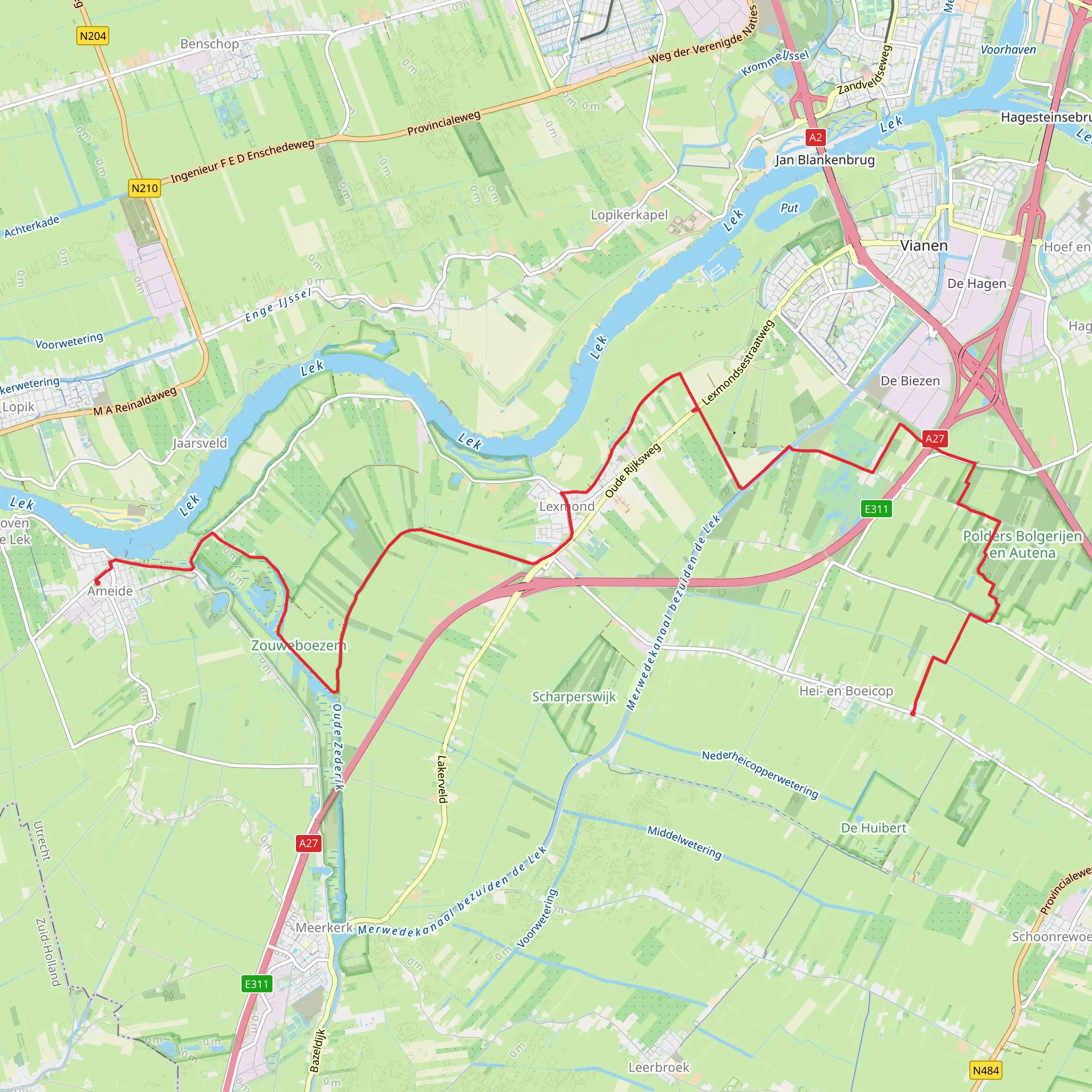
This is a classic lowland river-and-polder walk: long, level, and exposed in places, with big skies, drainage canals, and wide views across pastureland. At around 20 km / 12.4 mi with roughly 0 m / 0 ft of climbing, it’s physically straightforward, but the main challenges are wind, wet ground, and staying oriented on a web of dikes and farm lanes.
Getting to the start (Hoogwaard area)
Because “Hoogwaard” can refer to a small locality/area name rather than a single signed trailhead, the most reliable way to pinpoint the exact start is to open the route in HiiKER and navigate to the first waypoint. In this region, “Hoogwaard” is associated with the Vijfheerenlanden / Utrecht–South Holland border polders near Hei- en Boeicop and Lexmond.
- By car: Aim for parking near a prominent local landmark such as Hei- en Boeicop village area (around the church and village streets) or a public pull-in along a dike road where parking is clearly permitted. In HiiKER, use the start point and then choose the nearest legal parking spot along the approach roads.
- By public transport: The nearest practical hubs are typically Leerdam, Vianen, or Gorinchem (depending on the exact start pin). From there, expect a bus connection toward Lexmond / Hei- en Boeicop and a short walk to the start. Use HiiKER to align the start waypoint with the closest bus stop so you don’t add unintended distance.
What the route feels like underfoot (and why it’s “easy”)
You’ll mostly be on paved dike tops, compacted farm tracks, and grassy levees. The elevation profile is essentially flat, but don’t underestimate: - Wind exposure: With few trees, headwinds can make 20 km feel longer. - Soft verges: After rain, grassy edges can be slick; stay on the firm line of the track where possible. - Narrow dikes and bridges: Expect occasional pinch points where you’ll share space with cyclists, farm vehicles, and locals.
Plan on 4.5–5.5 hours of walking time for most hikers at an easy pace, plus breaks.
De Boezem: water management landscape up close
Early on, the route’s character is defined by water: boezem refers to a managed “storage” and distribution system for polder water—part of the Netherlands’ long tradition of reclaiming and protecting low-lying land. You’ll see: - Straight drainage canals and sluices/weirs controlling flow between polders. - Pump infrastructure (sometimes modern electric pumping stations, sometimes older structures nearby), reflecting how the region has evolved from wind-driven drainage to mechanized systems. - Reed fringes and wet margins where the canal edges haven’t been mown too tightly.
Wildlife is often most active along these waterways. Look and listen for: - Waterfowl (mallard, coot, grebes) and seasonal geese in the fields. - Herons and egrets hunting in shallow ditches. - In warmer months, dragonflies and damselflies along sunny, sheltered stretches.
De Verel and the long polder miles
As you transition toward De Verel, the walk becomes a rhythm of pasture, ditch, dike, and farmstead. The scenery can look uniform at first, but it rewards attention: - Field patterns: long, narrow parcels reflect historic land division and drainage logic. - Farm architecture: traditional lowland farmhouses and barns often sit on slightly raised ground, a subtle reminder that even “flat” landscapes have micro-high points chosen for safety. - Birdlife over open grassland: you may spot lapwing and oystercatcher in the right season, and raptors (like kestrels) hovering over verges.
This is also where navigation can get tricky: multiple parallel tracks can look “right.” Use HiiKER to confirm each junction, especially where a dike path meets a farm access road and the most obvious line may lead into private property. If you encounter gates, signage, or “no entry” notices, respect them and use HiiKER to rejoin the intended public right of way.
Hei en Boeicop: village edge and cultural context
Approaching Hei- en Boeicop, you’ll feel the shift from open polder to a more settled village edge—still rural, but with more houses, hedges, and local traffic. This area sits within a broader region shaped by: - Medieval and early-modern peat and clay landscapes, where drainage and cultivation steadily transformed wetlands into productive pasture. - Water boards (waterschappen) and cooperative water management—an important historical backbone of Dutch governance in low-lying areas.
If your route passes near a church or older village core, it’s a good place for a short pause: these centers often mark long-standing settlement on the most reliable ground.
Practical planning: what to bring and what to watch for
- Footwear: Light hiking shoes are usually enough, but choose something with grip for damp grass and muddy edges.
- Weather protection: Bring a windproof layer; in open polders, wind chill can be significant even when temperatures are mild.
- Food & water: Don’t assume frequent shops along the middle sections—carry enough for a half-day walk.
- Road awareness: Some dike roads
AI Planner
Days planned around your pace, with somewhere to stay each night.
Surfaces
Unknown
Grass
Asphalt
Dirt
Concrete
Gravel
Wood
Comments and Reviews
User comments, reviews and discussions about the Hoogwaard to Hei en Boeicop via De Boezem and De Verel, Netherlands.
average rating out of 5
0 rating(s)

