
Download
3D Flyover
Add to list
More
30.0 km
~6 hrs 7 min
70 m
Loop
“A long, gentle Twente loop through hush-quiet lanes, sandy woods and arboretum charm—best for steady-footed hikers.”
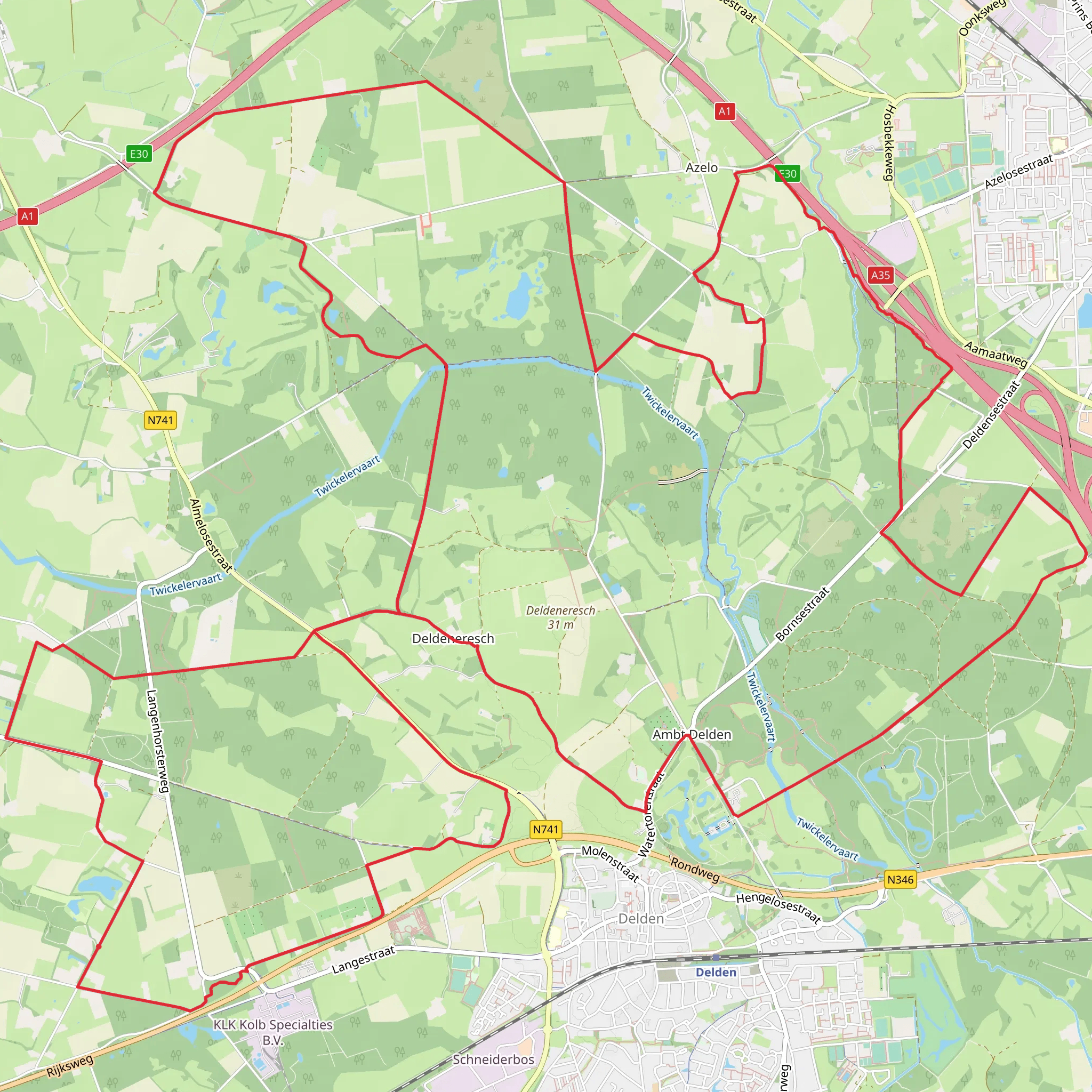
This is a long, low-relief countryside loop of about 30 km (18.6 mi) with roughly 100 m (330 ft) of total climbing—mostly so gentle you’ll feel it more as “rolling” than “uphill.” Expect a mix of quiet farm lanes, sandy/compact forest tracks, and well-kept paths through managed woodland and an arboretum area. With the distance being the main challenge, it suits hikers who are comfortable being on their feet for 6–8 hours at an easy pace with breaks.
Getting to the start (car + public transport)
Because the start point in your details is listed only as “near” (no coordinates or town provided), the best I can do is anchor this loop to the most likely hub suggested by the place names:
- Delden / Deldenerzijde points strongly to the Delden area in Overijssel, Netherlands, near Landgoed Twickel (a major estate with woods, farms, and historic buildings).
- Burensche Veld is a local field/heath/woodland name used in the same broader Twente region.
- An “arboretum” in this context is commonly associated with estate woodlands and curated tree collections around Twickel/Delden.
If you share a lon/lat (or a GPX), I can convert it to the nearest address/landmark precisely. For now, a practical “nearest known landmark” start to plan around is:
- Nearest significant landmark: Delden railway station (Station Delden), Delden, Overijssel and/or the Landgoed Twickel access points around Delden.
By train/bus:
- Take the train to Station Delden (regional services in the Twente corridor). From the station area, you can walk a short connector (often 0.5–2 km / 0.3–1.2 mi, depending on the exact trailhead) to reach the quieter lanes and estate paths.
By car:
- Drive to Delden and park near the town center or near common estate access points around Landgoed Twickel (look for signed public parking areas). Arrive early on weekends—estate-adjacent parking fills quickly on fair-weather days.
What the terrain feels like over 30 km
The route’s ~100 m (330 ft) of gain is spread out across small rises, embankments, and subtle undulations in forest and farmland. Underfoot, you’ll likely rotate through: - Paved or brick farm lanes (easy walking, but repetitive impact over 30 km) - Hard-packed forest track (fast, forgiving) - Sandy stretches (slower, can feel surprisingly tiring late in the day) - Short grassy or leaf-litter paths (can be slick when wet)
Even with “Easy” gradients, the distance makes foot care and pacing important—especially if you’re not used to 30 km days.
Landmarks, landscape character, and what to look for
You’re walking through a classic Twente mosaic: small fields, hedgerows, wooded estate blocks, and managed forest compartments. The “arboretum” portion typically means: - A more curated woodland feel: labeled or distinctive tree plantings, straighter paths, and occasional ornamental or specimen trees that stand out from the surrounding native mix. - Seasonal highlights: spring leaf-out and wildflowers; summer canopy shade; autumn color and fungi.
In the Deldenerzijde area, expect a rural edge-of-town atmosphere—farmsteads, long sightlines across pasture, and the kind of quiet lanes where you’ll hear birds long before you see them.
In and around Burensche Veld, the name suggests open “veld” character—often heath-like clearings, rougher grassland, or open woodland. These sections can feel more spacious and breezy than the denser forest blocks.
Wildlife and nature you’re likely to notice
This region’s wildlife is more “subtle and frequent” than “rare and dramatic,” but it’s rewarding if you keep scanning field edges and woodland margins: - Roe deer are common in estate woodlands—most often at dawn/early morning or near dusk. - Hares and rabbits in open fields and along grassy verges. - Woodpeckers (listen for tapping in mature stands), plus a steady mix of songbirds along hedgerows. - In wetter ditches and low spots: frogs and plenty of insect life in warm months.
Ticks can be present in grassy/brushy edges from spring through autumn—especially if you step off the main track for breaks.
Historical context (why the area looks the way it does)
Around Delden, the landscape is strongly shaped by historic estates (landgoederen)—large landholdings that combined agriculture, forestry, and designed landscapes. That legacy shows up as: - Straight, purposeful woodland tracks (forestry and estate access) - Shelterbelts and hedgerows dividing fields - Older farm complexes tied to estate management - Curated plantings and collections consistent with an arboretum or ornamental woodland tradition
Even when you’re not passing a single “big monument,” the pattern of woods, fields, and lanes is itself a historical artifact: a managed countryside rather than a wild one.
How the day typically breaks down (with distances)
Because this is a loop, you can think of it in thirds for planning:
- 0–10 km (0–6.2 mi): Settling in on lanes and easy tracks. This is where you want to keep
AI Planner
Days planned around your pace, with somewhere to stay each night.
Surfaces
Asphalt
Unknown
Sand
Ground
Gravel
Wood
Concrete
Comments and Reviews
User comments, reviews and discussions about the Deldenerzijde, Burensche Veld and Arboretum Loop, Netherlands.
average rating out of 5
0 rating(s)



