
Download
3D Flyover
Add to list
More
21.9 km
~4 hrs 26 min
35 m
Point to Point
“A wind-brushed loop from hushed woodland to big-sky dunes, best savoured at your own pace.”
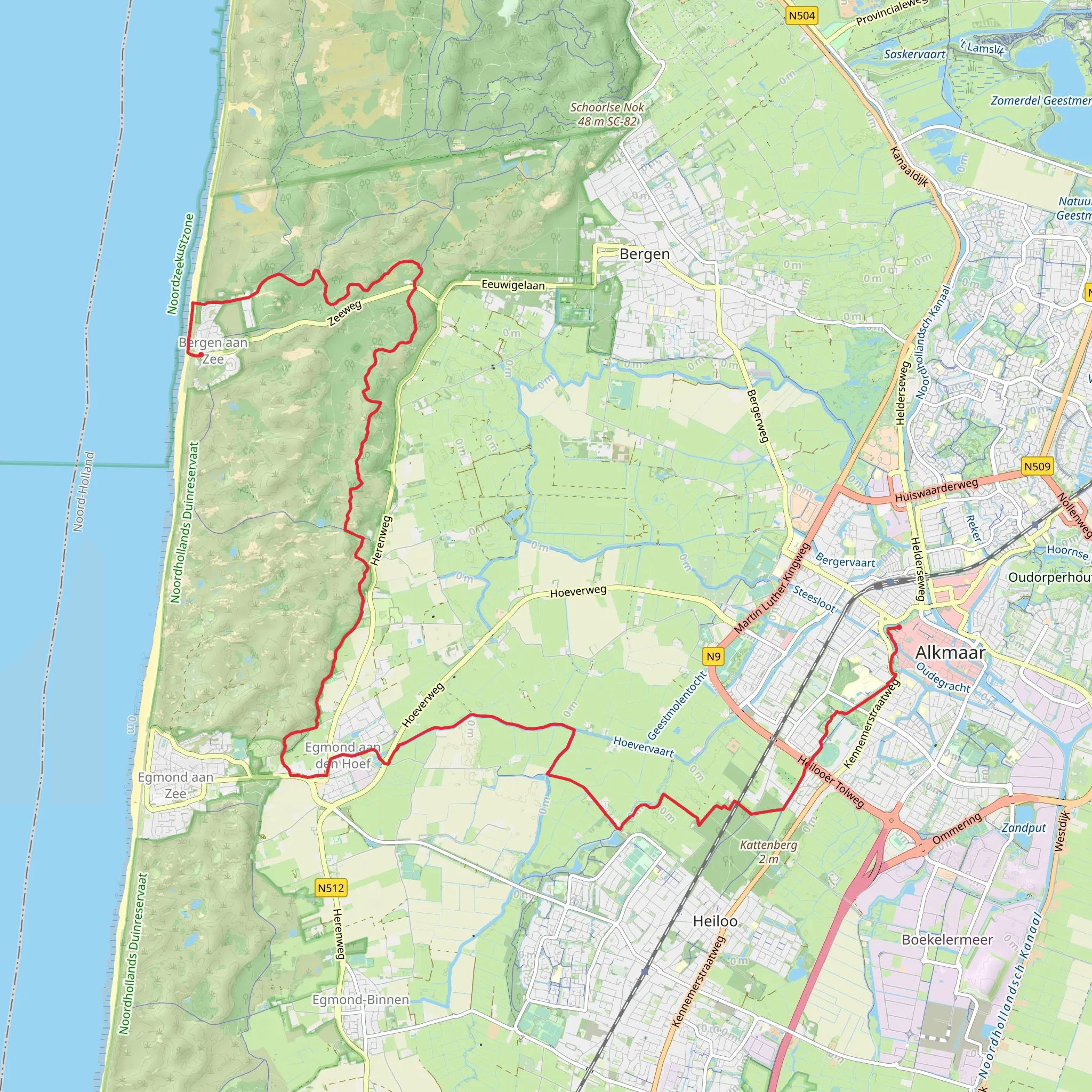
This is a mostly flat, lowland loop of about 22 km (13.7 mi) with roughly 0 m (0 ft) of elevation gain, linking quiet woodland, open dune landscapes, and coastal nature reserves around the Wimmenum / Schoorl–Bergen dune area in North Holland. Expect a mix of compact sand paths, forest tracks, and wide dune trails that can feel surprisingly exposed when the wind is up.
Getting to the start (public transport + car)
Because the hike head is listed only as “near” (no coordinates provided), the most practical, well-known access point for this route is the Wimmenum / Schoorlse Duinen edge, commonly reached via the Schoorl village area (a major gateway to the dunes) or the Bergen aan Zee / Wimmenum side depending on how you want to stitch the loop together.
- By public transport:
Use Dutch rail to Alkmaar (major hub), then take a regional bus toward Schoorl or Bergen. From either village center, you can walk to the dune/forest trailheads in minutes to start building the loop. Check the latest bus stop closest to your chosen trailhead (Schoorl centrum or Bergen centrum are typical anchors). - By car:
Aim for parking near Schoorl village center (common dune access) or on the Bergen/Wimmenum side if you want to start closer to the coastal reserve sections. Arrive earlier on weekends—this region is popular with walkers and beach traffic.
If you share the lon/lat for your intended start point, I can convert it to the nearest recognizable address/landmark and tailor the route flow precisely.
You’ll want HiiKER loaded before you set off: the dune/forest trail web can be dense, and it’s easy to follow a “nice-looking” sandy track that quietly bends away from your intended line.
What the terrain feels like (and why it’s still “easy”)
Even with negligible elevation gain overall, dunes create constant micro-undulation—short rises and dips that don’t add up to big climbing numbers but can still tire legs over 22 km (13.7 mi), especially on softer sand. Underfoot conditions typically rotate through:
- Firm forest paths (fast, easy walking)
- Sandy dune tracks (slower, more effort; shoes fill with sand if you’re not careful)
- Wide multi-use trails (watch for cyclists where permitted)
Plan on 4.5–6.5 hours depending on sand softness, wind, and how often you stop at viewpoints.
Route flow and key places you’ll pass
0–5 km (0–3.1 mi): Heiliieerbos woodland start
The opening section is usually the most sheltered. In mixed woodland you’ll notice a calmer microclimate—less wind, steadier footing, and more birdsong. Look for:
- Songbirds and woodpeckers in the trees
- Mossy groundcover and seasonal fungi in damper pockets
- Occasional deer sign (tracks and droppings) near quieter edges
Because the area is flat, navigation errors here tend to be “silent”: you can walk comfortably for 20 minutes and only later realize you’ve drifted onto a parallel track. Use HiiKER to confirm junctions.
5–12 km (3.1–7.5 mi): Wimmenum and the transition to dunes
As you move toward Wimmenum and the dune interface, the landscape opens. You’ll start to feel the coastal influence: more wind, brighter light, and sandier soils. This is where you’ll often see:
- Dune grasses stabilizing the sand
- Scrubby dune vegetation (hardy, low-growing plants adapted to salt and wind)
- Raptors or larger birds using the open airspace for hunting
If you’re hiking in spring/summer, bring sun protection even on cool days—open dunes can be deceptively intense.
12–17 km (7.5–10.6 mi): De Nollen and Schulpvlak—open reserve walking
These sections are typically the most “big-sky” feeling of the day: broad dune corridors, occasional viewpoints, and a sense of moving through a protected coastal system. Wildlife is often more visible here because the terrain is open:
- Rabbits are common; you may also spot foxes at quieter times
- Ground-nesting birds may be present seasonally—stay on marked paths to avoid disturbing them
- In wetter pockets, you can encounter insects and, depending on season, more bird activity around reedier edges
Wind is the main factor that changes the difficulty: a headwind across open dunes can make an easy route feel like steady work.
17–22 km (10.6–13.7 mi): Return through mixed paths back toward the woodland edge
The final stretch usually alternates between dune tracks and more sheltered forest lanes. This is a good place to manage pace: if you’ve spent time in soft sand earlier, your calves and feet may feel it now. Keep an eye out for:
- Subtle trail braids where multiple footprints create “false” options
- Cyclist crossings on shared routes
- Sandy patches that can cause ankle rolls—especially when tired
Landmarks, nature, and what makes this region significant
This part of North Holland is shaped by the long relationship between sea, sand, and human land management. The dunes are not just scenic—they’re a living coastal defense and an ecological zone that has historically helped buffer inland areas from storms
AI Planner
Days planned around your pace, with somewhere to stay each night.
Surfaces
Unknown
Unpaved
Grass
Asphalt
Sand
Paved
Concrete
Gravel
Cobblestone
Comments and Reviews
User comments, reviews and discussions about the Heiliieerbos, Wimmenum, De Nollen and Schulpvlak, Netherlands.
average rating out of 5
0 rating(s)

