Download
3D Flyover
Add to list
More
21.5 km
~4 hrs 17 min
0 m
Point to Point
“A flat, big-sky dike ramble from Alblasserdam into quiet wetlands—glorious, if the wind agrees.”
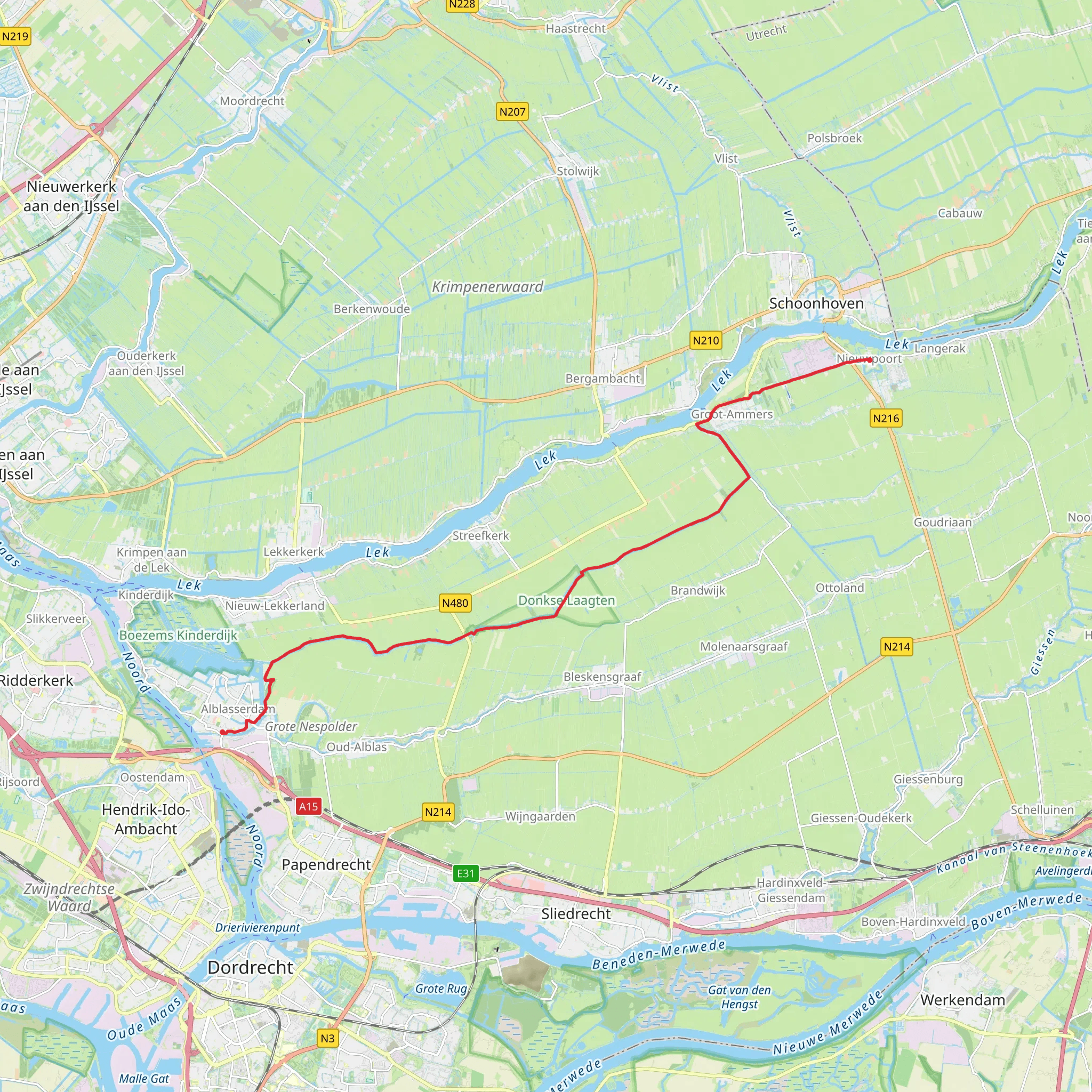
Expect a classic Dutch polder walk: ruler-flat (about 0 m / 0 ft of climbing), big skies, long dike lines, and a steady rhythm of canals, grazing meadows, and river views as you work from the built-up riverside of Alblasserdam into the open Alblasserwaard and on toward Langerak. Total distance is around 21 km (13.0 mi), best treated as an Easy hike physically, but with real exposure to wind and weather.
Getting to the start (Alblasserdam)
A practical, well-known start landmark is the Waterbus stop “Alblasserdam, Kade” (Kade, 2951 JC, Alblasserdam). (waterbus.nl)
- Public transport: The Waterbus is a straightforward way to reach Alblasserdam from the Rotterdam/Dordrecht corridor; “Alblasserdam, Kade” is a main stop on Waterbus services. (waterbus.nl)
- By car: Alblasserdam is easy to approach via the regional road network around the Noord river; plan to park near the town center/dike area and walk to the Kade.
Route character and what the terrain feels like
From Alblasserdam you’ll quickly leave the denser streets and settle into dike-top paths and farm tracks threading the Alblasserwaard. Underfoot is typically paved dike, compacted gravel, and grassy edges—rarely technical, but often narrow with steep canal banks beside you. After rain, the grassy margins can be slick, and some farm tracks can hold water.
Wind is the main “difficulty multiplier” here: with little shelter, a calm forecast can feel easy, while a headwind can make the same 21 km feel much longer. Bring a light shell even on mild days.
Donkse Laagten: the wild heart of the day
The standout natural section is Donkse Laagten, a small but important protected peat-meadow reserve in the Alblasserwaard, managed by Staatsbosbeheer and designated as a Natura 2000 bird area. (en.wikipedia.org) The landscape here is defined by wet grasslands, higher water levels, and the subtle “donk” (a sandy rise) that gives the area its name. (natura2000.nl)
Plan on slower, quieter walking through this zone—both because it’s beautiful and because it’s prime habitat:
- Birdlife: This is a noted area for meadow birds and waterfowl; it functions as feeding and roosting habitat for species such as the white-fronted goose (Kolgans), and it’s managed specifically with birds in mind. (natura2000.nl)
- Duck decoys (eendenkooien): Donkse Laagten is known for having duck decoys, a historically Dutch method of luring and catching waterfowl—today they’re part of the cultural landscape and conservation story. (en.wikipedia.org)
- Seasonal sensitivity: In spring and early summer, expect nesting activity; stay strictly on paths and keep noise down.
A quirky historical footnote: the reserve made national news in the early 2000s for sightings and later capture of a non-native snapping turtle. It’s not something you should expect to encounter, but it’s a reminder that these wetlands can host surprises—watch where you place hands/feet near the water’s edge. (en.wikipedia.org)
Navigation and wayfinding (keep it simple)
This is a low-relief landscape where it’s easy to feel “close” to your destination while still having many kilometers to
AI Planner
Days planned around your pace, with somewhere to stay each night.
Surfaces
Grass
Unknown
Asphalt
Gravel
Dirt
Concrete
Wood
Paved
Comments and Reviews
User comments, reviews and discussions about the Alblasserdam to Langerak via Donkse Laagten, Netherlands.
average rating out of 5
0 rating(s)