Download
3D Flyover
Add to list
More
680 m
~9 min
13 m
Out and Back
“Olive-shaded paths and tiered Ouzoud vistas, with slick steps and crowds best for steady feet.”
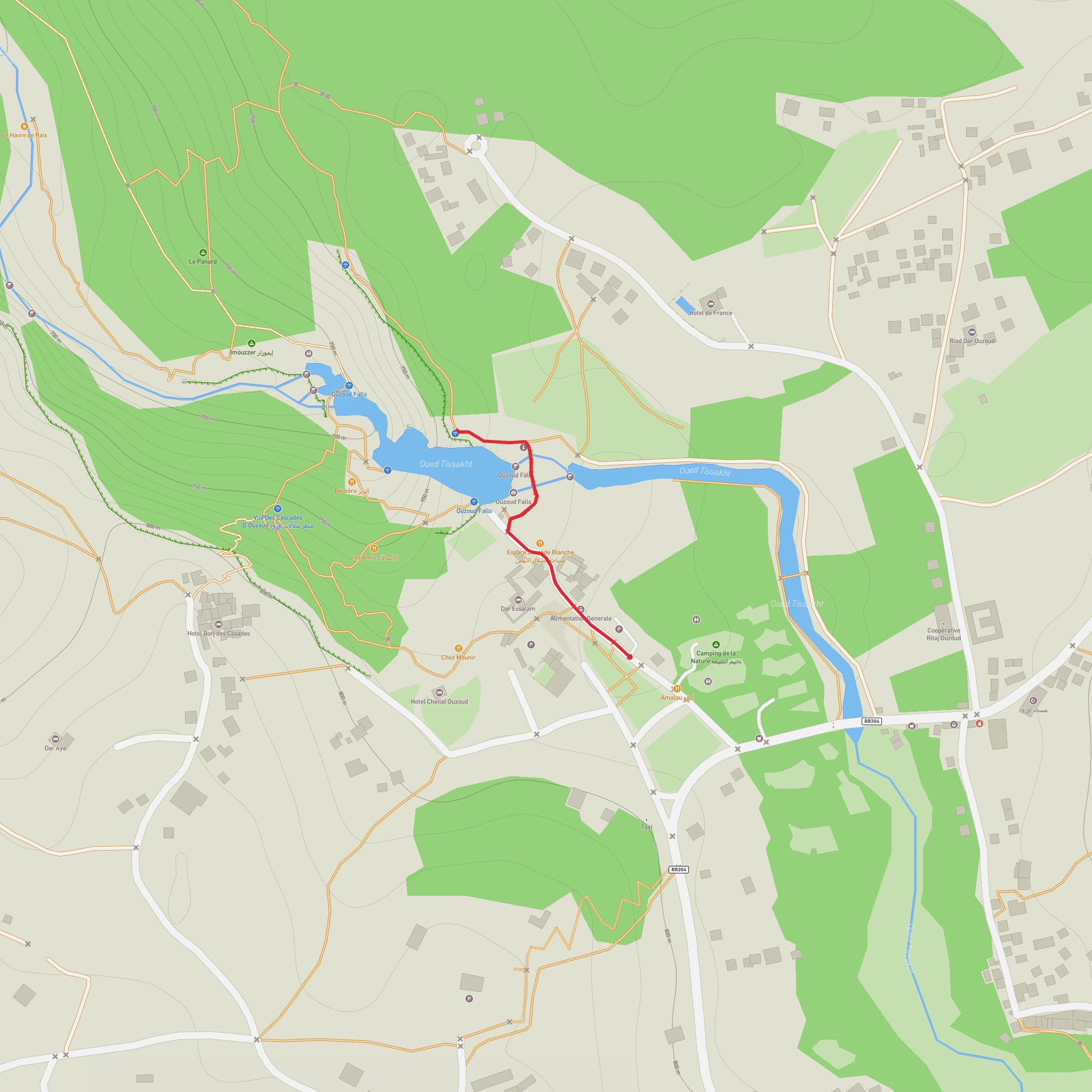
This is a short, landmark-packed walk around one of Morocco’s most famous cascades, with constant viewpoints, shaded olive groves, and a few steep, uneven stair sections that justify the “Medium” rating even though the distance is only about 1 km (0.6 mi) and the net elevation gain is roughly 0 m (0 ft). Expect a mix of compacted dirt paths, stone steps, and slick rock near the water—easy to follow, but you’ll want steady footing.
Getting to the start (car + public transport)
Most people begin near the main visitor approach above the gorge at Ouzoud Falls (Cascades d’Ouzoud) parking/entrance area, close to the cluster of cafés and viewpoints on the rim of the canyon. If you’re using a map pin (lon/lat), the nearest practical “address” to aim for is simply “Cascades d’Ouzoud, Tanaghmeilt, Azilal Province, Morocco”—that’s the recognized landmark used by drivers and local transport.
- By car/taxi: Drive to the Cascades d’Ouzoud parking areas near the top viewpoints. From there, you’ll immediately find signed footpaths and stairways dropping toward the river and the base of the falls. In busy periods, parking can spill into informal lots—keep valuables out of sight and confirm the price before leaving the car.
- By public transport: The usual pattern is to travel first to a larger hub town (often Marrakesh or Beni Mellal) and then continue by shared taxi/van toward Tanaghmeilt/Ouzoud. The final leg commonly drops you near the falls’ upper entrance area where the cafés and viewpoints begin. If you’re planning this without local help, check routes and stops in HiiKER ahead of time and allow extra time for transfers.
What the 1 km (0.6 mi) route feels like
Although the overall elevation change is minimal, the walk is “up-and-down” in short bursts: you’ll descend staircases into the gorge, traverse near the river, then climb back out (or reverse the same way). The effort comes from step height, uneven stone, and occasional crowding, not from sustained climbing.
- Upper viewpoints (first 0.2–0.3 km / 0.1–0.2 mi): You’ll start among olive trees and small terraces with immediate overlooks into the gorge. The sound of the falls grows quickly, and you’ll get your first wide-angle views of the multi-tiered cascade.
- Descent to the river (next 0.3–0.5 km / 0.2–0.3 mi): Stone steps and packed earth switchbacks lead down. Surfaces can be dusty and polished smooth in places—watch for loose gravel on the edges of steps.
- Base-of-falls area (variable distance depending on detours): Near the bottom, the air is cooler and more humid. Mist can make rocks slick, and the path may narrow where people stop for photos. If you add short spurs to viewpoints or riverside spots, your “1 km” can easily become 1.5–2 km (0.9–1.2 mi) of total wandering.
Landmarks, scenery, and what to look for
- The cascades themselves: Ouzoud is known for its broad, tiered drop into a green gorge. The most dramatic views are often from mid-level terraces where you can see multiple curtains of water at once.
- Olive groves and terraces: The surrounding landscape is heavily shaped by traditional agriculture—olive trees are the signature, and you’ll notice small plots and stonework that reflect long-term human use of the valley.
- Riverside pools and calmer channels: Away from the main plunge, the river can look deceptively gentle. Edges can be undercut, and algae on rocks is common—treat every wet stone as slippery.
Wildlife and nature notes
You’re likely to see birds using the gorge’s updrafts and vegetation, and you may encounter Barbary macaques in the area. They’re a major draw, but they’re also the most common “hazard” on this walk: - Keep food packed away and don’t feed wildlife—macaques can become bold and grabby. - Secure small items (snacks, sunglasses, phones) and keep a bit of space if a group is sitting on the path. In warmer months, insects increase near the water; a light repellent can make the stop-and-photo sections more comfortable.
Footing, exposure, and practical hazards (why it’s “Medium”)
- Steps and uneven stone: The stair sections can be steep and irregular. Trekking poles can help, but keep tips controlled around crowds.
- Wet, slick rock near mist zones: The closer you get to the spray, the more traction matters. Shoes with solid grip are worth it even on a short route.
- Crowds and pinch points: This is a marquee attraction; the “difficulty” often comes from navigating around groups on narrow steps and viewpoints.
- Heat and sun: Even with water nearby, the upper paths can be exposed. Carry water—short distance doesn’t mean low risk in hot conditions.
Navigation (keep it simple)
The paths are generally obvious because they funnel between the upper rim viewpoints and the base area, but there are multiple side tracks to cafés, overlooks, and riverside spots. If you want to keep the walk close to 1 km (0.6 mi) and avoid accidentally doubling it, load the route in HiiKER and use it to confirm which staircase
Surfaces
Unknown
Dirt
Comments and Reviews
User comments, reviews and discussions about the Ouzoud Falls, Morocco.
average rating out of 5
0 rating(s)