1.6 km
~21 min
18 m
Loop
“Meander the Red Trail’s gentle arboretum woods—easy-going paths, birdsong, and leaf-laced calm.”
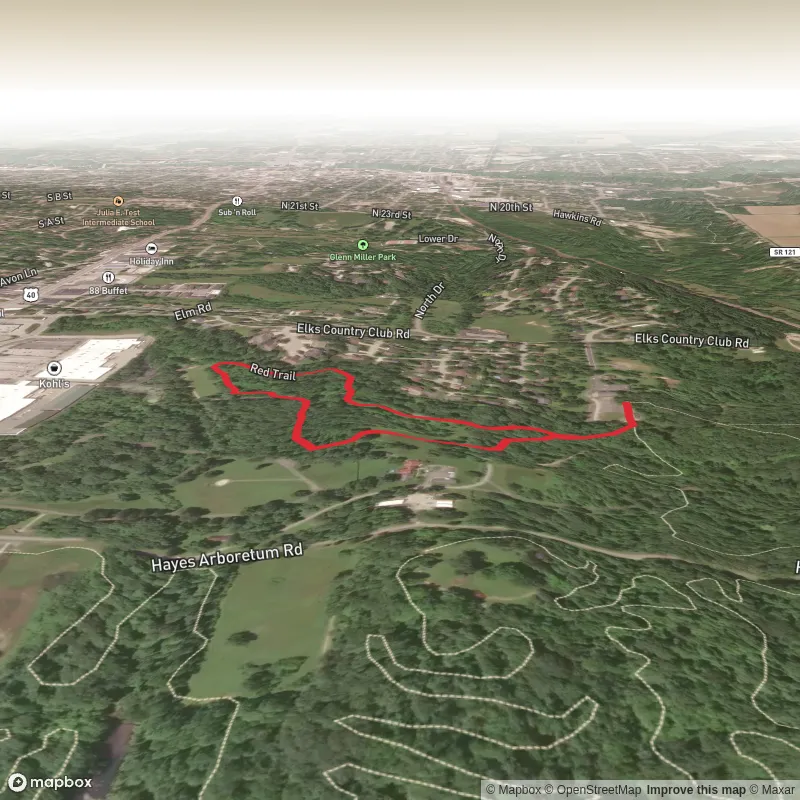
A short, mostly level woodland loop like this is ideal for a relaxed walk, a quick nature break, or a family-friendly outing. At roughly 2 km (1.2 miles) with about 0 m (0 ft) of climbing, you can expect an easy pace on well-used paths with only minor ups and downs from natural ground undulations.
Getting to the trailhead (car + public transport)
Because the hike start is listed only as “near” (no coordinates provided), the most reliable plan is to navigate to the main visitor access for Hayes Arboretum and then pick up the Red Trail from the primary trail network near the parking/entry area.
- By car: Drive to Hayes Arboretum (Richmond, Indiana) and use the main parking area by the visitor facilities/trailhead signage. Once parked, look for the trail kiosk and color-blazed markers for the Red Trail.
- By public transport: Regional transit options in this area can be limited. A practical approach is to take intercity service into Richmond, IN (if available from your origin), then use a local taxi/rideshare to reach Hayes Arboretum’s main entrance/parking area. If you share your starting city, I can outline the most realistic routing options.
If you can provide a lon/lat point for “Hike head: near …”, I can convert it to the nearest known address or landmark and tailor the directions precisely.
What the walk feels like underfoot and on the map
Expect a well-marked, easy-grade path through managed arboretum woodland. Surfaces are typically packed dirt with leaf litter, sometimes with short grassy or lightly graveled segments near busier connectors. After rain, low spots can hold water and leaf-covered sections can be slick, so shoes with modest tread are helpful even on an “easy” route.
For navigation, the simplest method is to open the route in HiiKER, then follow the red blazes/markers at junctions. Arboretum trail systems often have multiple color loops intersecting; the main “gotcha” is accidentally switching colors at a crossing—pause at each junction and confirm you’re staying on red.
Landmarks, nature, and what to look out for
Because this is an arboretum setting, the “landmarks” are often subtle and nature-focused rather than dramatic viewpoints:
- Tree collections and mature woodland: You’ll likely pass through stands of established hardwoods and curated plantings typical of Midwestern arboreta. Watch for interpretive signs or labeled specimens near junctions and wider paths.
- Seasonal wildflowers and understory plants: In spring and early summer, look along trail edges for ephemeral blooms and ferns; later in the year, the canopy and leaf color become the main attraction.
- Birdlife and small mammals: Expect common woodland birds (songbirds, woodpeckers) and the usual small mammals (squirrels, chipmunks). Early morning and late afternoon are typically the most active times.
- Insects and ticks: In warm months, ticks can be present in leaf litter and along brushy edges. Staying centered on the tread and doing a quick check afterward is wise.
- Poison ivy: Common along sunny edges and disturbed ground. If you’re not confident identifying it, avoid brushing against viney plants at the margins.
Even with minimal elevation gain overall, keep an eye out for: - Rooty patches where erosion exposes roots (easy to trip on when covered by leaves). - Short muddy stretches after rain, especially in shaded low areas. - Trail crossings where multiple loops meet—this is where most wrong turns happen.
Distance, timing, and pacing
At 2 km (1.2 miles), most hikers will finish in 30–60 minutes, depending on stops for signage, photos, or kids. Since elevation gain is near 0 m (0 ft), effort is driven more by footing and how often you pause than by climbing.
Historical context of the area
Hayes Arboretum sits in east-central Indiana, a region shaped by glacial history and later by 19th–20th century agricultural and industrial development typical of the Midwest. Arboreta in this part of the state often reflect a conservation-minded response to land-use change—preserving woodland remnants, restoring native plant communities, and creating educational collections. On the ground, that history shows up as a mix of mature forest, managed plantings, and well-defined trail corridors designed for public access and learning.
If you share either (1) the missing “near …” detail, or (2) a coordinate for the start, I can pinpoint the closest address/landmark and describe the exact first few turns and key junctions on the Red Trail so it’s nearly impossible to miss.

Surfaces
Dirt
Comments and Reviews
User comments, reviews and discussions about the Red Trail in Hayes Arboretum, Indiana.
average rating out of 5
0 rating(s)