Download
3D Flyover
Add to list
More
1311.3 km
55 days
11205 m
Multi Day
“A sweeping pilgrimage from Nantes to Schengen threads cathedral cities, river valleys, and quietly demanding days.”
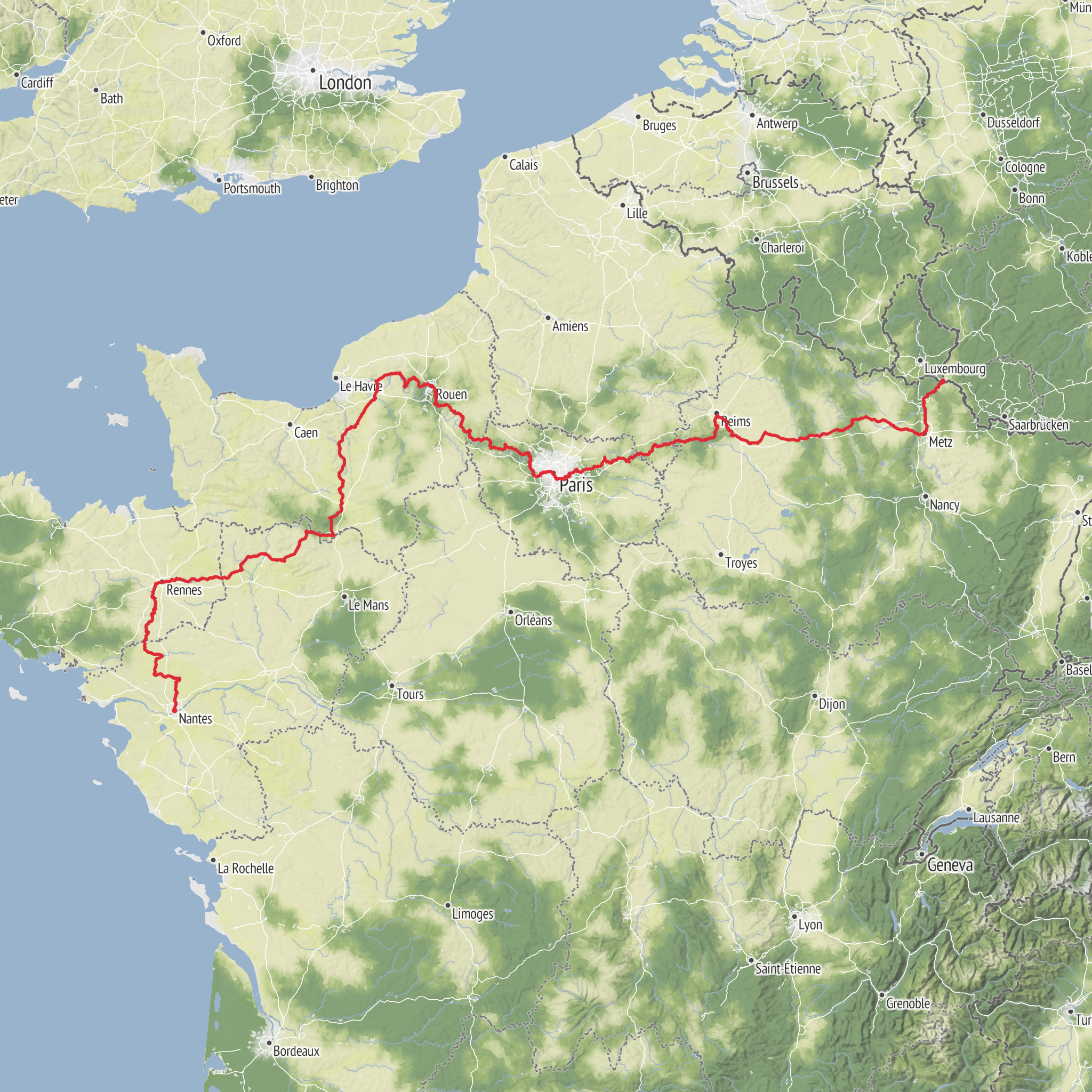
This long west-to-east crossing follows the escape route associated with Saint Columbanus after the failed deportation from Nantes in the early 7th century, linking Atlantic France to Schengen on the Moselle frontier. Expect roughly 1,309 km / 813 miles in total with about 11,500 m / 37,730 ft of cumulative ascent, which makes the overall undertaking substantial even though the day-to-day terrain is generally rated medium rather than mountainous. The route is more about endurance, consistency, changing landscapes, and urban-to-rural transitions than about steep alpine climbing. Its official cultural framing emphasizes the monk’s onward journey from Nantes through major historic corridors including Rennes, Rouen, Paris, Reims, and Metz before reaching Schengen. (thecolumbanway.org)
The walking is likely to feel most manageable when broken into multi-week sections. A typical stage rhythm on the Columban Way averages around the mid-20 km range, so many hikers will want to plan for 50-plus days on trail if following the full section at a moderate pilgrimage pace. Because the elevation gain is spread across a very long distance, the challenge comes from repeated rolling terrain, hard surfaces through towns and river corridors, and the logistics of accommodation, resupply, and navigation over a route that crosses several major regions rather than one compact wilderness area. The route’s historical identity is stronger than its remoteness: this is a cultural pilgrimage through lived-in landscapes, old river valleys, cathedral cities, farmland, woodland belts, and transport corridors. (thecolumbanway.org)
The start is in Nantes, with the most practical trailhead reference being the historic city center near Nantes Cathedral and the Château des Ducs de Bretagne, both close to the main rail and tram network and among the most recognizable landmarks for joining a long-distance route through the city. The official Columban material identifies Nantes as the key departure point for this section after Columbanus escaped embarkation there. (thecolumbanway.org)
Getting to the start
For public transport, Nantes station (Gare de Nantes) is the simplest arrival point for most hikers, with onward movement across the city available on the Nantes metropolitan network of bus, tram, river shuttle, and TER trains under the TAN system. If arriving by air, Nantes Atlantique Airport is connected to the city by TAN public transport. That makes it realistic to land, transfer into the center, and begin walking without needing a taxi. (metropole.nantes.fr)
By car, Nantes is straightforward to reach via the regional motorway network, but parking for a through-hike needs more thought than access itself. Long-stay parking is usually easier on the outskirts with a transit connection into the center than in the historic core. For a point-to-point walk ending near Schengen, many hikers will prefer rail or air travel at the start to avoid the complication of retrieving a vehicle from the far eastern end.
What the route feels like
From Nantes, the route heads away from the Atlantic-influenced lower Loire environment and begins a very long inland traverse. The broad pattern is one of river systems, plains, agricultural country, historic towns, and major cultural centers, rather than isolated mountain country. You should expect a mix of canal paths, levees, farm lanes, woodland tracks, village roads, and urban pavement. In wet periods, unsealed stretches can become muddy; in and around cities, the opposite issue appears—long paved sections that can be hard on feet and joints over time.
The modest overall difficulty rating makes sense if judged by technicality: there are no major scrambling sections implied by the route’s profile, and the ascent is spread thinly over the full distance. Still, 813 miles / 1,309 km is a serious undertaking. Consecutive 20 to 30 km (12 to 19 mile) days can become more demanding than the elevation statistics suggest, especially when carrying full kit or walking in summer heat across exposed farmland and river plains.
Landmarks, landscapes, and historical character
The strongest appeal of this section is its historical sweep. The Columban Way is built around the remembered travels of Saint Columbanus and his companions, Irish monks whose movement across Europe helped shape monastic, literary, and religious networks in the early medieval period. The official route presents this Nantes-to-Schengen section as the continuation of their escape and overland journey through some of the most important cities of northern France before turning toward the Moselle frontier. (thecolumbanway.org)
Starting in Nantes, hikers are in a city deeply tied to the Loire estuary and to the episode of Columbanus’s attempted forced return by ship. From there, the route’s historical atmosphere builds through a chain of places that may include or pass near Rennes, Rouen, Paris, Reims, and Metz, each adding a different layer of French history—ducal Brittany, Norman river trade,
AI Planner
Days planned around your pace, with somewhere to stay each night.
Surfaces
Unknown
Asphalt
Dirt
Ground
Gravel
Concrete
Grass
Unpaved
Cobblestone
Paved
Wood
Sand
Comments and Reviews
User comments, reviews and discussions about the The Columban Way in France - Section 3 from Nantes to Schengen, France.
average rating out of 5
0 rating(s)