
Download
3D Flyover
Add to list
More
2.8 km
~33 min
0 m
Loop
“Breezy clifftops, seabirds, and reclaimed grasslands make this a vivid coastal stroll with history.”
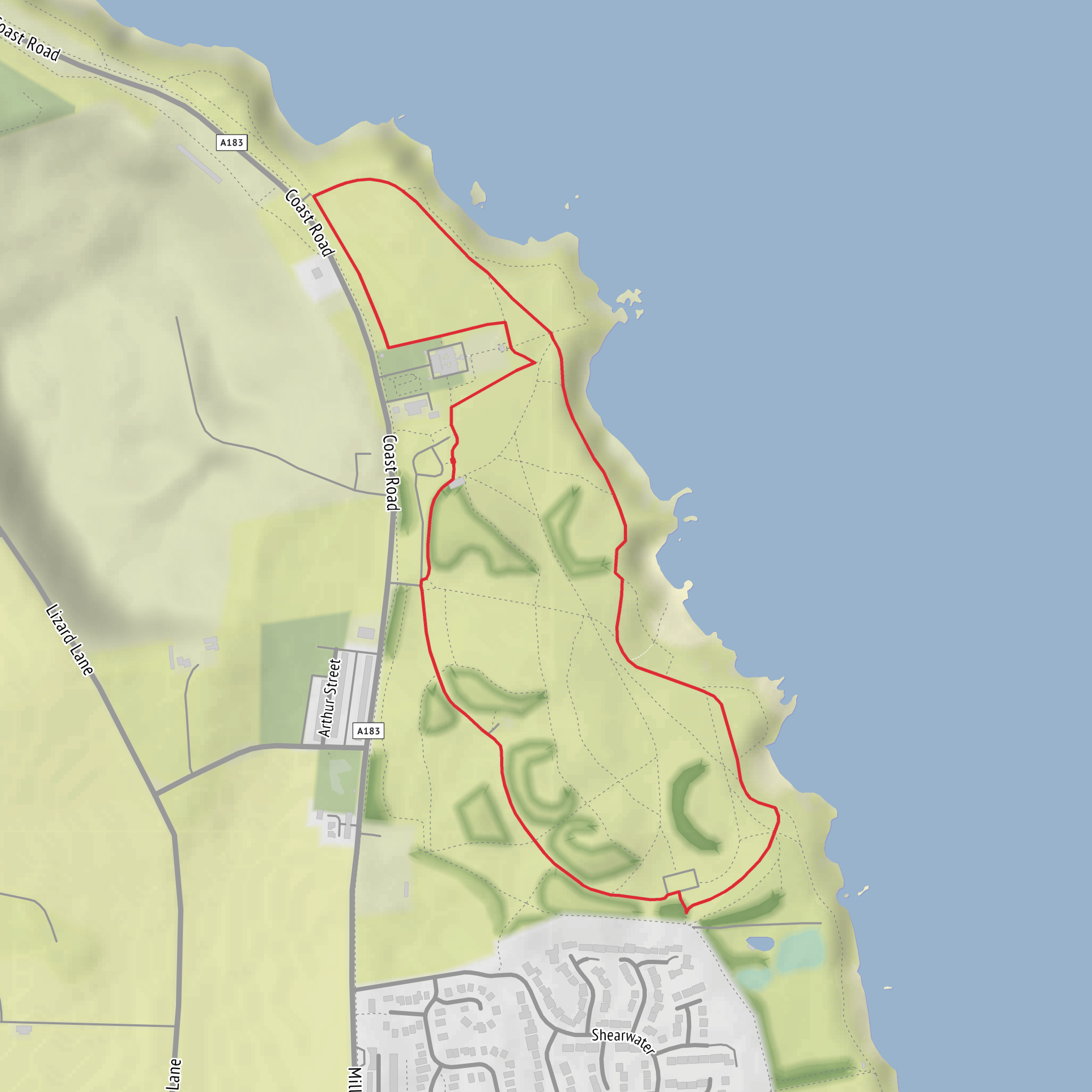
This easy coastal walk of around 3 km / 1.9 miles is a short, mostly level outing across the clifftop edge of Whitburn Coastal Park, linking Lizard Point with Potter’s Hole and returning through open grassland and coastal paths. With virtually no climbing—about 0 m / 0 ft overall—it suits families, casual walkers, birdwatchers, and anyone after a breezy seafront walk with wide views rather than a strenuous hike. The route sits beside the North Sea near Souter Lighthouse, Coast Road, Whitburn, Sunderland, Tyne and Wear SR6 7NH, which is the clearest nearby landmark and the most practical reference point for the start. (nationaltrust.org.uk)
From the start near Souter Lighthouse and Lizard Point, the path quickly opens onto exposed coastal ground where the walking is straightforward underfoot in dry weather, usually on a mix of paved path, compacted track, and short grass. The terrain is gentle, but the seaward edge deserves care, especially in strong winds, after rain, or when the cliff margins are slippery. Although the elevation gain is negligible, the openness of the site means weather can feel stronger than it looks on a map, so even for a short walk it is worth carrying a windproof layer. (nationaltrust.org.uk)
What to expect on the route
Lizard Point is one of the standout features early on, giving broad views north along the coast and south across Whitburn Sands toward Sunderland. The coastline here is known for rocky ledges, low cliffs, and small inlets, and the walk’s short distance means the scenery changes quickly without demanding much effort. Around 1 to 1.5 km / 0.6 to 0.9 miles into the outing, the route reaches the area around Potter’s Hole, where the coast becomes more broken and geologically interesting, with low cliff sections and bays shaped by erosion and older industrial-era coastal defenses in places. (sunderland.gov.uk)
Whitburn Coastal Park itself is reclaimed former colliery land, and that history explains the unusual contrast between open grassland, wetland habitat, and industrial heritage. What is now a wildlife-rich coastal park once formed part of the Whitburn Colliery landscape, and today the area includes footpaths, birdwatching spots, and habitat managed for both people and nature. This gives the walk a distinctive character: it is not a remote wilderness trail, but a compact coastal route where natural recovery and local history are closely tied together. (sunderland.gov.uk)
Nature and wildlife
Despite the short distance, this is a rewarding walk for wildlife. Whitburn Coastal Park and the adjoining reserve are known for grassland, wetland, and feeding areas that attract a variety of birds, including the locally notable tree sparrows mentioned by the National Trust. Depending on season, walkers may also see seabirds moving along the cliffs and shoreline, with the coastal edge and rockier sections offering good vantage points. In spring and summer, the reclaimed grasslands can hold wildflowers, while the wetter areas inland from the cliff edge add habitat variety unusual for such a small route. (nationaltrust.org.uk)
Because parts of this coastline are environmentally sensitive, it is best to stay on established paths, keep dogs under control where wildlife is present, and avoid disturbing birds near feeding or nesting areas. If you want help following the route precisely, HiiKER is the best tool to use for checking the line of the trail and your position along the coast. (sunderland.gov.uk)
Historical significance
The wider area around Whitburn, Marsden, and Souter is rich in maritime and industrial history. Souter Lighthouse is the dominant historic landmark nearby; it was built to warn ships off this hazardous stretch of coast, and although it takes its name from Souter Point, the lighthouse itself stands at Lizard Point because the higher ground offered better visibility. That detail alone says a lot about the dangers of this shoreline and the importance of navigation here in the age of heavy coastal shipping. (nationaltransporttrust.org.uk)
The landscape also preserves traces of much older human activity. A heritage statement for the area notes a Mesolithic site at Potter’s Hole, showing that people were using this coastline thousands of years before the industrial era. Later, coal mining reshaped the land, and Whitburn Coastal Park now occupies ground once associated with Whitburn Colliery
What to expect?
Surfaces
Grass
Asphalt
Unknown
Comments and Reviews
User comments, reviews and discussions about the Whitburn Coastal Park via Lizard Point and Potter's Hole, England.
average rating out of 5
0 rating(s)



