
Download
3D Flyover
Add to list
More
3.7 km
~44 min
0 m
Loop
“A tranquil Thames loop of meadows, grand estate views, and quietly layered history.”
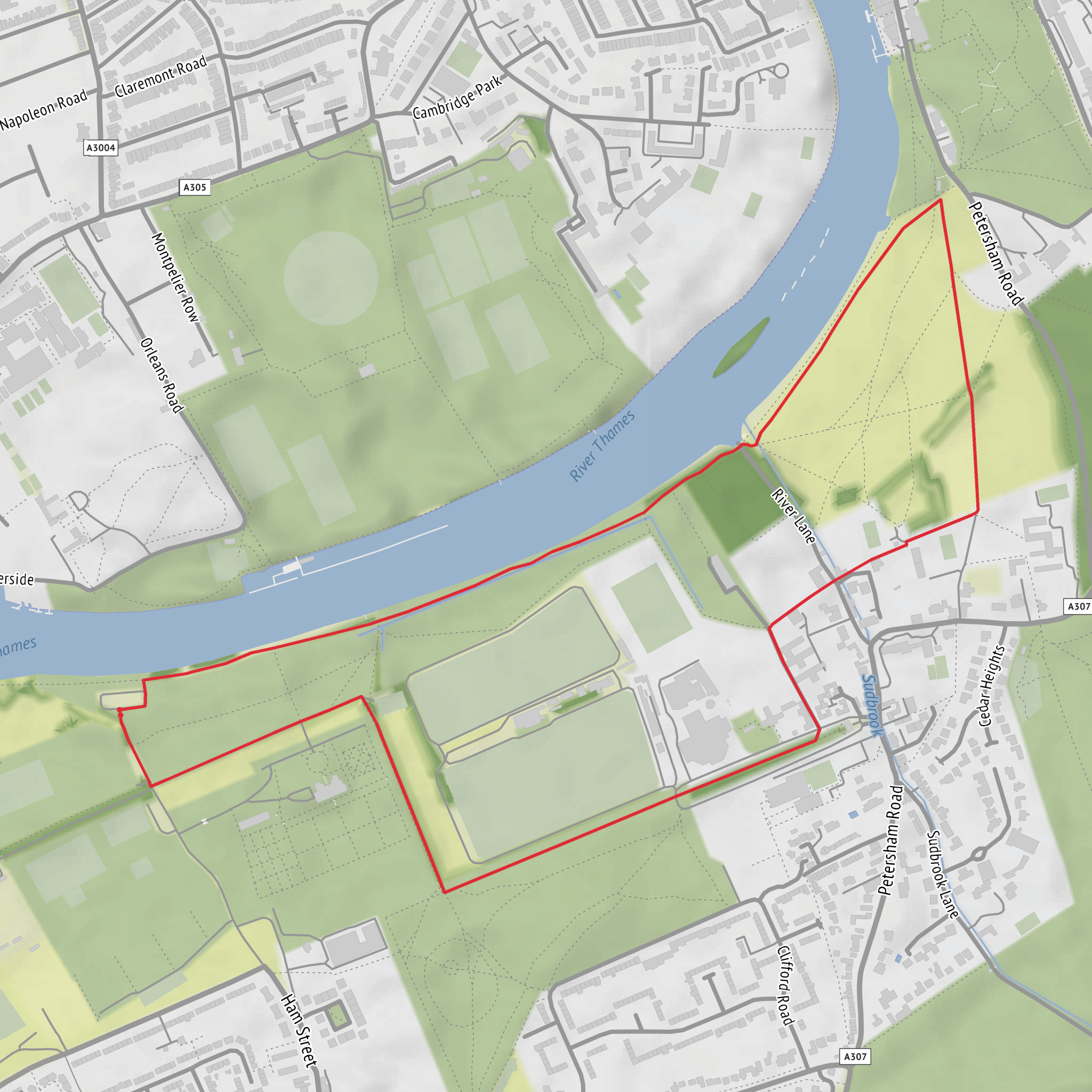
This easy riverside loop explores one of the most attractive stretches of the Thames in southwest London, linking the towpath, Petersham Meadows, and the grounds around Ham House. At roughly 4 km / 2.5 miles with almost no climbing—about 0 m / 0 ft of elevation gain—it suits families, casual walkers, and anyone looking for a short outing with plenty of scenery and history. The route is generally flat throughout, with wide paths and gentle walking beside the river. (nationaltrust.org.uk)
The walk is best understood as starting near Ham House and Garden, Ham Street, Richmond, Surrey TW10 7RS, the best-known landmark and practical trailhead for this loop. Ham House sits directly beside the River Thames and is reached easily from the Thames Path, making it the natural reference point for navigation and planning. (accessable.co.uk)
Getting to the start is straightforward. By public transport, the nearest major rail and Underground hub is Richmond Station, served by National Rail, the London Overground, and the District line. From there, local buses including the 65 and 371 serve the Ham and Petersham area, and Richmond is also close enough for a longer approach on foot if you want to extend the day. By car, parking is available in the area around Ham House, though spaces can be limited at busy times, especially on weekends and sunny afternoons. (richmond.gov.uk)
The character of the route is calm and open rather than rugged. Expect level riverside walking, estate views, meadow edges, and a mix of compacted paths, paved sections, and towpath surfaces that can become muddy after rain. Because the route follows the Thames and passes floodplain meadow, conditions can feel very different depending on the season: dry and easy in summer, softer underfoot in winter, and occasionally damp after periods of high water. (nationaltrust.org.uk)
What to expect on the route
From the Ham House side of the loop, the river is the main companion almost immediately. The Thames here feels greener and quieter than many central London stretches, with long views upstream toward Richmond and across the water to wooded banks and historic buildings. The towpath is shared space, so walkers should expect cyclists, runners, and the occasional busy patch near popular viewpoints. (nationaltrust.org.uk)
One of the standout landscape features is Petersham Meadows, a historic water meadow beside the river. This open ground gives the walk a spacious feel and is one of the reasons the route remains so scenic despite its short length. The meadows are part of a long-protected landscape and are closely tied to the historic setting of Ham House. (nationaltrust.org.uk)
Ham House itself is the major landmark. This 17th-century house is one of the most important surviving Stuart houses in England, with strong associations to the Murray and Lauderdale families. Even from outside the paid areas, the estate setting adds a strong sense of grandeur to the walk, and the relationship between house, river, meadow, and approach roads is a big part of what makes this loop memorable. (nationaltrust.org.uk)
Nature and wildlife
Although this is an urban-edge walk, it has a surprising amount of wildlife interest. The riverside corridor attracts common waterbirds and other birdlife associated with the Thames, while the meadow and tree-lined sections support seasonal variation in insects and songbirds. Because Petersham Meadows are part of a historic floodplain landscape, the area also has ecological value beyond its visual appeal. (nationaltrust.org.uk)
Walkers should keep an eye out for changing ground conditions near the meadow and river margins, especially after wet weather. Mud, puddles, and slick patches are more likely than steep or technical terrain to be the main challenge on this route. In warmer months, exposed sections can feel sunny with little shelter, so water and sun protection are worth bringing even for a short walk. The route is easy in difficulty, but it still benefits from basic preparation. (nationaltrust.org.uk)
Historical significance
This area is rich in layered history. Ham House dates from the 1600s and is nationally significant for its architecture, interiors, and political connections during the Stuart period. The surrounding landscape was designed to complement the estate, and the riverside setting remains central to its identity. (nationaltrust.org.uk)
Petersham Meadows also carry historical importance. They are protected open land and form part of a much-loved Thames landscape that has inspired artists, including J. M. W. Turner. The broader Richmond and Petersham area has long been valued for its views, royal associations, and
What to expect?
Surfaces
Unknown
Asphalt
Concrete
Grass
Dirt
Gravel
Comments and Reviews
User comments, reviews and discussions about the Ham House Loop via River Thames, England.
average rating out of 5
0 rating(s)
