
Download
3D Flyover
Add to list
More
5.5 km
~1 hrs 28 min
217 m
Loop
“Wild cliffs, jagged tors and whispering woodland make this short Exmoor loop feel thrillingly bigger.”
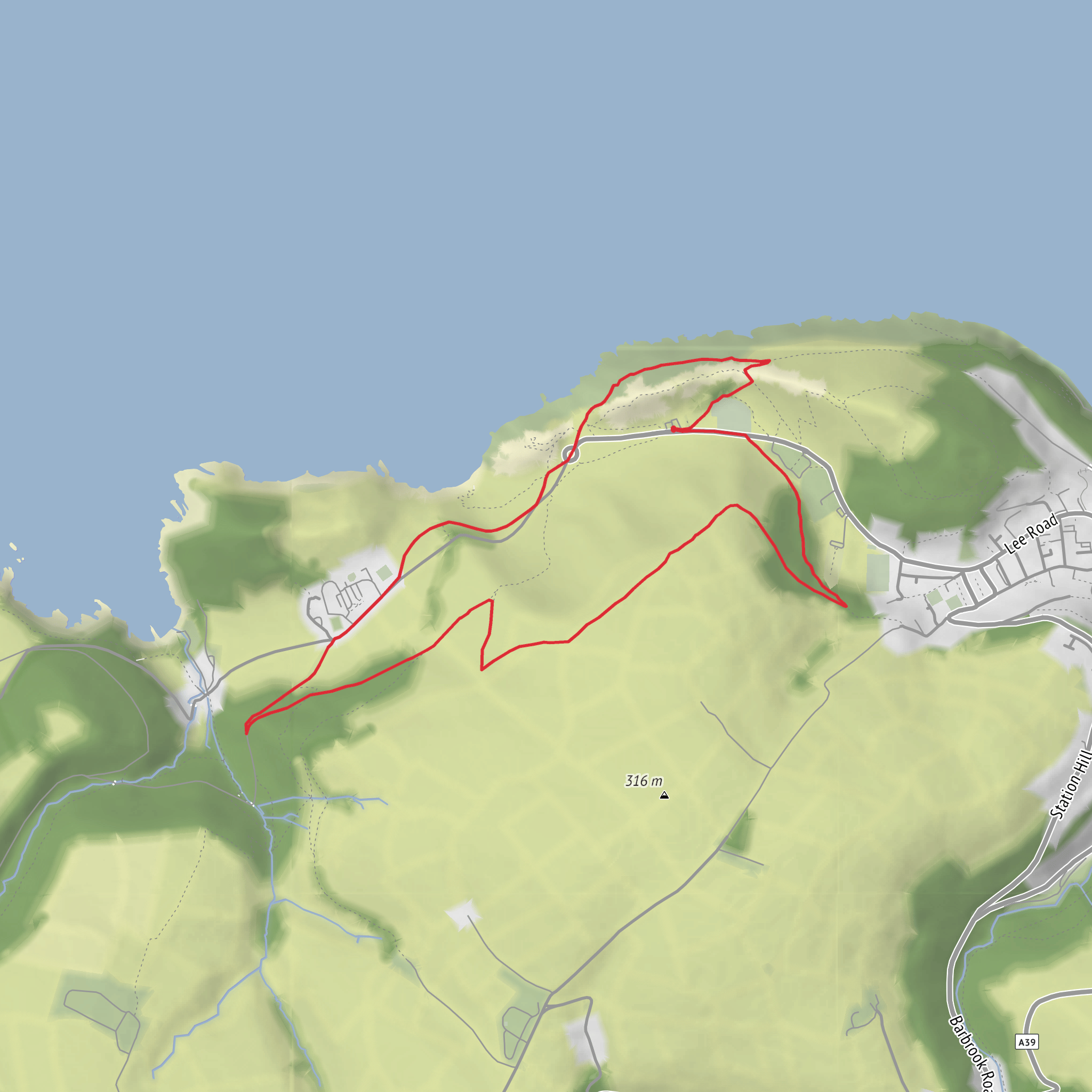
This roughly 6 km (3.7 mile) loop with about 200 metres (656 feet) of ascent packs a lot into a short outing: open moorland edge, dramatic coastal geology, woodland, and some of Exmoor’s most distinctive rock scenery. The route is generally best thought of as a moderate walk rather than a hard one, but the climbs, uneven ground, and exposed cliffside sections mean it feels more substantial than the distance suggests. The start is most sensibly placed at the Valley of Rocks car park near the public conveniences and Mother Meldrum Café, Valley of Rocks, Lynton, Devon EX35 6JH. Exmoor National Park also lists the lower car park here with postcode EX35 6JH. (exmoor-nationalpark.gov.uk)
From the outset, expect a landscape that feels unusually wild for such an accessible corner of North Devon. The Valley of Rocks is a dry valley running close and roughly parallel to the sea, with jagged Devonian rock formations rising above grassy slopes and the Bristol Channel opening out beyond. The terrain near the valley floor and the approach to Castle Rock can be comparatively gentle, but once the loop branches onto higher ground or woodland paths, gradients become more noticeable and footing can turn rougher, especially after wet weather. (visitlyntonandlynmouth.com)
The opening section usually gives walkers a chance to settle in before the route begins to climb in earnest. Castle Rock is the obvious early landmark, and even from below it dominates the valley with a fortress-like profile. Exmoor’s own route notes place the base of Castle Rock about 600 metres (0.4 mile) from the lower car park on an easier access route, which helps give a sense of scale for the first part of the walk. Around here, the walking is often on firmer surfaces or short grass, but once the loop commits to the broader circuit via higher ground and woodland, expect more undulation and a more varied underfoot feel. (exmoor-nationalpark.gov.uk)
What to expect on the route
The most memorable feature is the contrast between open coastal exposure and the more sheltered feel of Six Acre Wood. In the valley itself, the views are broad and airy, with rock tors such as Castle Rock and Rugged Jack creating a skyline that feels almost mountainous despite the modest elevation. The South West Coast Path section between Lynton and the valley is relatively level and surfaced in places, but side paths and loop variations can be steeper, narrower, and more uneven, particularly where they cross ridges or descend into woodland. (southwestcoastpath.org.uk)
With around 200 metres (656 feet) of climbing over 6 km (3.7 miles), the effort tends to come in shorter bursts rather than one long ascent. Hikers should be ready for a few punchier inclines, especially if the loop rises away from the valley rim before dropping through the trees. In damp or windy conditions, this route can feel significantly more serious: exposed edges, slick rock, muddy woodland patches, and strong coastal gusts all deserve respect. Good footwear is more important here than the mileage alone might suggest.
Navigation is usually straightforward in clear weather because the valley’s major landmarks are so distinctive, but mist and low cloud can flatten the landscape and make junctions less obvious on the higher ground. For route planning and live navigation, HiiKER is the best tool to use.
Landmarks, wildlife, and atmosphere
Castle Rock is the headline feature, but it is not the only one. Rugged Jack is another named outcrop often noticed on the approach from Lynton, and the whole valley has the feel of a natural amphitheatre of stone. The scenery is shaped by ancient geology and later landscape processes; one explanation recorded by the South West Coast Path is that the River Lyn once flowed through the valley before changing course toward Lynmouth, while other interpretations involve coastal erosion or Ice Age diversion. Visit Lynton & Lynmouth describes the valley as a rare dry valley beside the sea, formed during the last Ice Age and shaped within Devonian rocks. (southwestcoastpath.org.uk)
Wildlife is one of the biggest reasons people remember this walk. The feral goats are the valley’s best-known residents and are frequently seen on slopes and rocky ledges. They are completely wild, even if they appear accustomed to people, so give them plenty of room and
What to expect?
Surfaces
Grass
Unknown
Asphalt
Comments and Reviews
User comments, reviews and discussions about the Valley of Rocks Loop via Castle Rock and Six Acre Wood, England.
average rating out of 5
0 rating(s)

