
Download
3D Flyover
Add to list
More
5.1 km
~1 hrs 2 min
18 m
Loop
“A quietly magical moorland loop of ponies, soft horizons, and splashy paths after rain.”
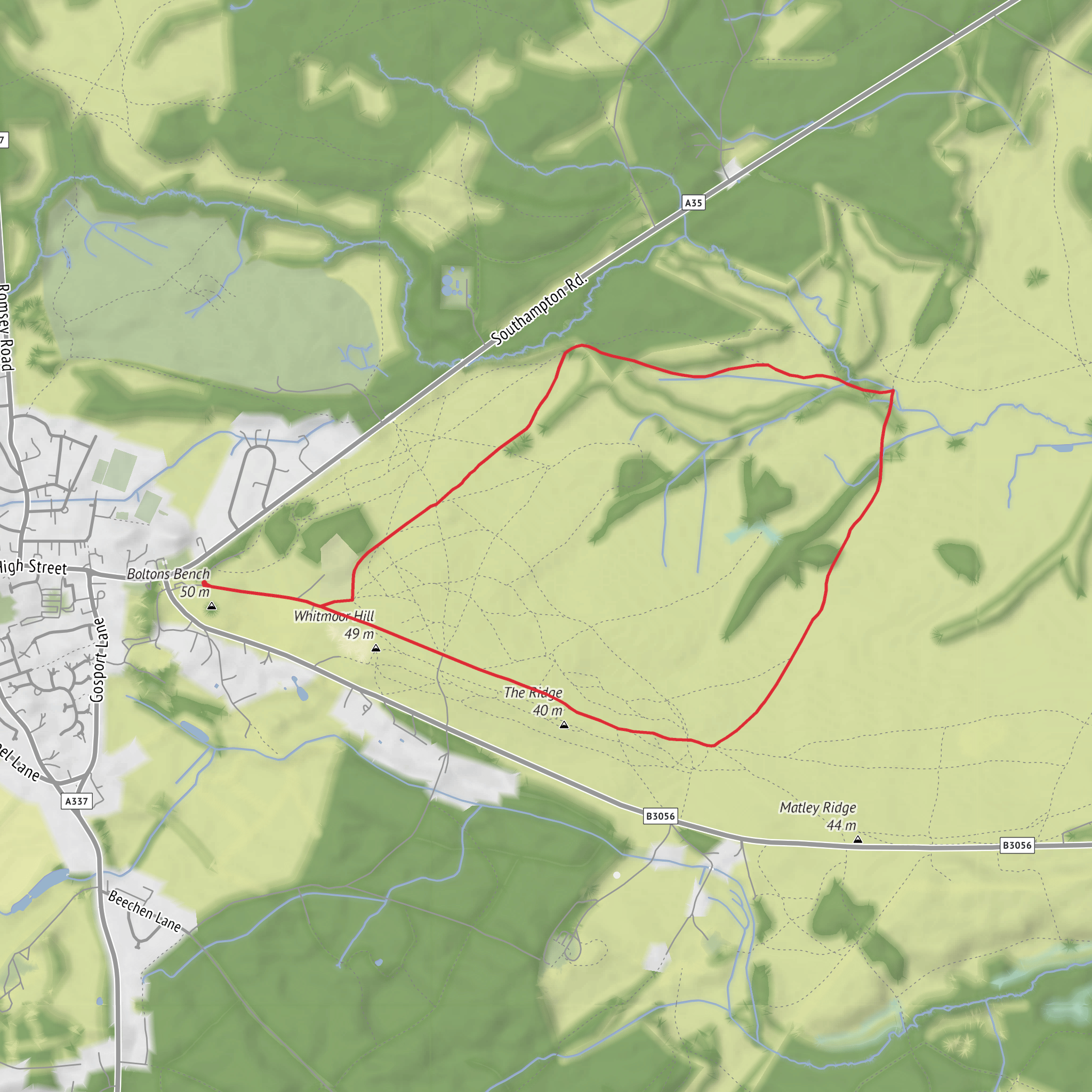
This easy loop crosses some of the gentlest open ground in the New Forest near Lyndhurst, linking White Moor and Foxhill Moor on a mostly flat outing of about 5 km / 3.1 miles with virtually no climbing. Expect broad, open heath-and-lawn scenery rather than a summit walk: low horizons, wet hollows, grazing ponies, and a network of sandy or grassy paths that can feel wonderfully spacious in dry weather and surprisingly boggy after rain. White Moor includes a trig point at about 49 m / 161 ft, one of the few obvious waymarks on this otherwise subtle landscape. (osmaps.com)
The nearest practical trailhead is the Bolton’s Bench area on the eastern edge of Lyndhurst, a well-known landmark beside the open forest. If you are arriving by car, Lyndhurst village car park is a reliable base with facilities nearby, and Bolton’s Bench is the usual visual reference for stepping out onto the moorland side of the village. If you are using rail, the nearest station is Ashurst New Forest station, Lyndhurst Road, Ashurst, Hampshire SO40 7AA, and from there you would normally continue by bus or taxi toward Lyndhurst rather than walk directly to the start. Public bus links into Lyndhurst are available, including the Bluestar 6 corridor between Southampton, Totton, Lyndhurst, Brockenhurst and Lymington. (newforestnpa.gov.uk)
Because the route is short and the elevation gain is negligible, the main challenge is not fitness but footing and navigation. The paths across White Moor and Foxhill Moor can be faint in places, with wet patches, shallow channels, and soft ground where water lingers. Some local route descriptions note small paths, water crossings, footbridges, and sections where you need to pay closer attention to line choice. Waterproof footwear is often the better choice outside prolonged dry spells, and gaiters can be useful in winter or after heavy rain. For navigation, it is worth loading the route in HiiKER before setting out, especially if mist, low cloud, or flat light is forecast. (osmaps.com)
What the walk feels like
From the Lyndhurst side, the route quickly leaves behind the village edge and opens onto classic New Forest terrain: rough grass, damp lawns, scattered scrub, and broad views that are more atmospheric than dramatic. White Moor is the more open-feeling half of the loop, with the trig point acting as a simple landmark and a good cue that you are on the right line. The ground here is nearly level, so the sense of progress comes from changing textures underfoot and the shifting pattern of wetland, heath, and tree line rather than from any real ascent. (komoot.com)
As the loop continues toward Foxhill Moor, the landscape becomes slightly more intricate, with wetter ground and drainage lines feeding the upper reaches of the Beaulieu River system. One description of White Moor notes wet lawn above alder carr draining into Foxhill Moor, which gives a good sense of the habitat transition here. You may cross small footbridges or skirt marshy patches depending on the exact line of the loop. In a dry summer this can feel like an easy ramble across open common; in a wet spell, the same ground can demand a bit more care with every step. (commons.wikimedia.org)
Wildlife, grazing animals, and seasonal interest
This part of the New Forest is excellent for noticing the quieter details. Free-roaming ponies are a signature feature of White Moor and the surrounding open forest, and cattle may also be present depending on the season and grazing patterns. Give all livestock plenty of space, keep dogs under close control, and never rely on animals moving off the path for you. The National Park specifically warns visitors not to feed ponies around Bolton’s Bench, where they can become pushy around people and food. (commons.wikimedia.org)
Birdlife varies with season, but the mix of wet ground, scrub, and open heath can support a good range of common moorland and woodland-edge species. In warmer months, the surrounding New Forest heaths and plains are also known for invertebrate life; a nearby Ashurst-area walk recorded large numbers of silver-studded blue butterflies on Matley Plain, which gives a sense of the ecological richness of the wider landscape around this loop. Botanically, White Moor and Fox
What to expect?
Surfaces
Unknown
Gravel
Asphalt
Comments and Reviews
User comments, reviews and discussions about the Foxhill Moor and White Moor Loop, England.
average rating out of 5
0 rating(s)

