
Download
3D Flyover
Add to list
More
2.8 km
~41 min
81 m
Loop
“Steeply rising above Corfe’s stone village, this compact loop delivers castle drama, airy ridges, and history-soaked views.”
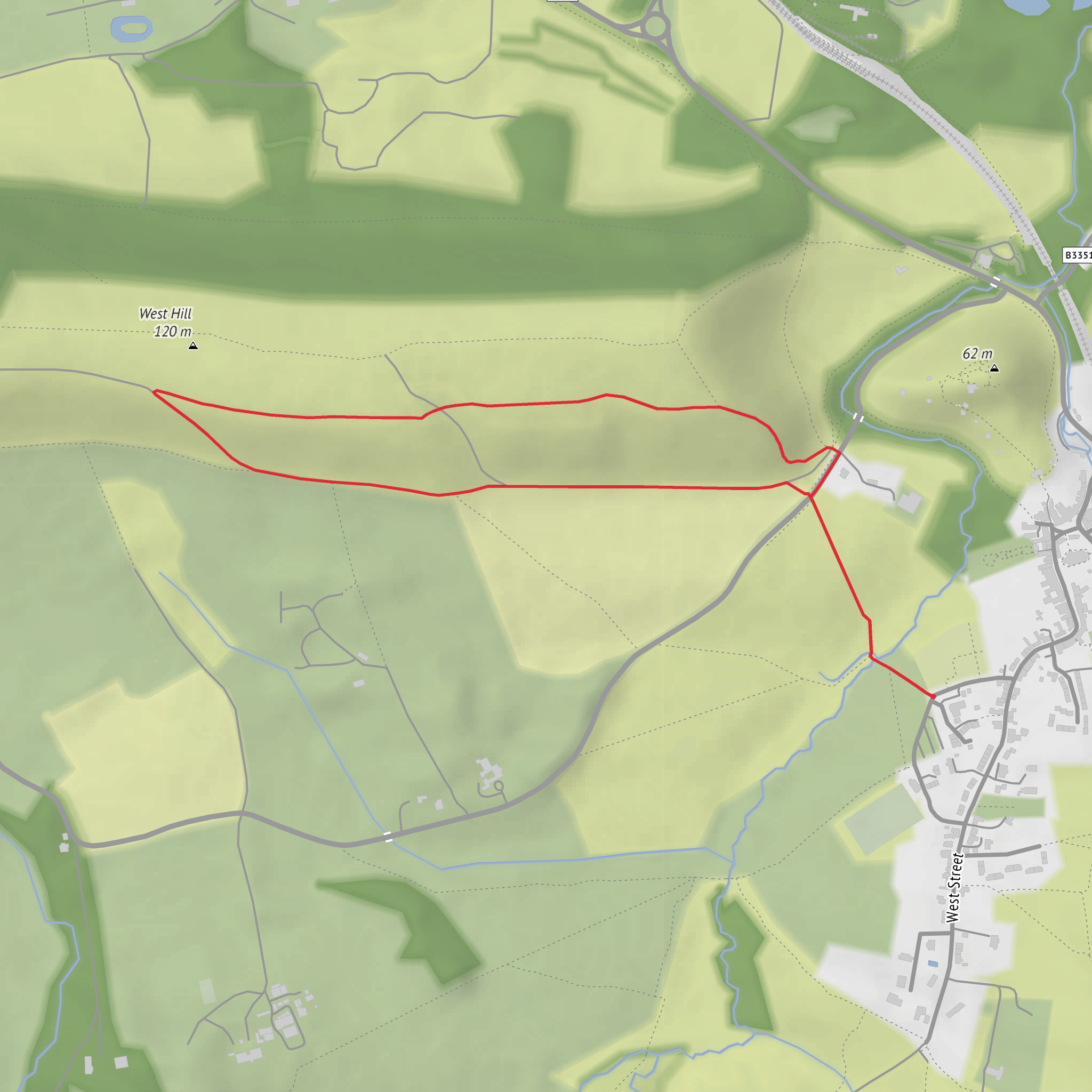
This short loop near Corfe Castle, Dorset, packs a surprising amount into roughly 3 km / 1.9 miles with about 100 m / 328 ft of ascent, making it a compact but fairly punchy outing for its length. The terrain and gradients justify the medium rating: although the mileage is modest, the climb onto West Hill is steep in places, and the paths can be uneven, grassy, chalky, or slippery after rain. The route is best suited to walkers who are comfortable with short ascents, stiles or gates, and exposed hilltop walking. Corfe Castle itself sits in a dramatic gap in the Purbeck Hills, with West Hill and East Hill rising on either side, so even a brief circuit here feels open, elevated, and full of big views. (southwestcoastpath.org.uk)
The most practical trailhead landmark is Corfe Castle village centre / The Square, Corfe Castle, Nr Wareham, Dorset, BH20 5EZ, beside the National Trust visitor area and close to the castle entrance. Another useful start reference is the Castle View Visitor Centre, Corfe Castle, BH20 5DR, which the National Trust uses as a main arrival point and car park access location. (nationaltrust.org.uk)
Expect the walk to begin on easier ground near the village before climbing onto the ridge west of the castle. As height is gained, the reward comes quickly: broad views over the stone-built village, the railway, the surrounding Purbeck landscape, and above all the striking silhouette of Corfe Castle itself. This is one of those routes where the scenery changes fast despite the short distance—village lanes and pasture give way to open hillside, then to a lofty viewpoint looking back across one of southern England’s most recognizable castle settings. Sources describing nearby ridge walks repeatedly note the excellent views from West Hill and the ridge west of Corfe. (walkingbritain.co.uk)
Terrain and what to expect
The climb is the main physical feature of the route. Around 100 m / 328 ft of ascent over such a short loop means some sections can feel sharper than the distance suggests. Chalk and grass underfoot are common in this area, and on damp days the slope can become slick, especially on descent. In dry weather, the exposed ridge can feel hot with little shelter; in windy conditions, the open hillside can feel much more serious than the map suggests. Good grip is more important here than heavy mountain gear, and walkers should allow extra care if rain, frost, or strong wind is forecast. The National Trust also notes steep slopes, steps, and uneven paths around Corfe Castle generally, which is useful context for anyone combining the loop with time around the castle grounds. (nationaltrust.org.uk)
Navigation is usually straightforward in clear conditions because the castle is such a strong visual reference point, but field-edge paths and intersecting rights of way can still cause hesitation. For route-finding, checking the line in HiiKER before setting out is sensible, especially if low cloud or poor visibility is expected.
Landmarks and historical significance
The standout landmark is, of course, Corfe Castle, a Norman royal fortress with around 1,000 years of history. It occupies a naturally strategic gap through the hills, controlling movement through the area, and its broken outline today is the result of deliberate destruction during the English Civil War in 1646. The castle’s position explains why this short walk feels so dramatic: the whole landscape was shaped by defense, surveillance, and control of the route through Purbeck. (nationaltrust.org.uk)
A particularly important feature on this loop is The Rings, a scheduled monument southwest of the castle. Historic England identifies it as a ringwork and bailey later reused as a Civil War battery, while the National Trust explains that the earthworks are associated with King Stephen’s siegeworks of 1139 during the civil war known as The Anarchy between Stephen and Empress Matilda. On the ground, The Rings may appear as low humps and banks rather than a towering ruin, so it helps to know in advance that this is an archaeological site rather than a dramatic standing structure. Its significance lies in what it represents: a rare surviving trace of medieval siege warfare focused on one of England’s most important castles. (historicengland.org.uk)
The village itself adds to the sense of place, with traditional Purbeck stone buildings and the heritage railway passing nearby. If timed well, the sight or sound of trains can add to the atmosphere. The Swanage Railway serves
What to expect?
Surfaces
Unknown
Gravel
Grass
Dirt
Wood
Asphalt
Comments and Reviews
User comments, reviews and discussions about the West Hill, The Rings and Corfe Castle Loop, England.
average rating out of 5
0 rating(s)



