
Download
3D Flyover
Add to list
More
4.4 km
~1 hrs 1 min
85 m
Loop
“A gentle Cartmel Fell loop weaves quiet lanes, pastoral textures, and a remarkable ancient church.”
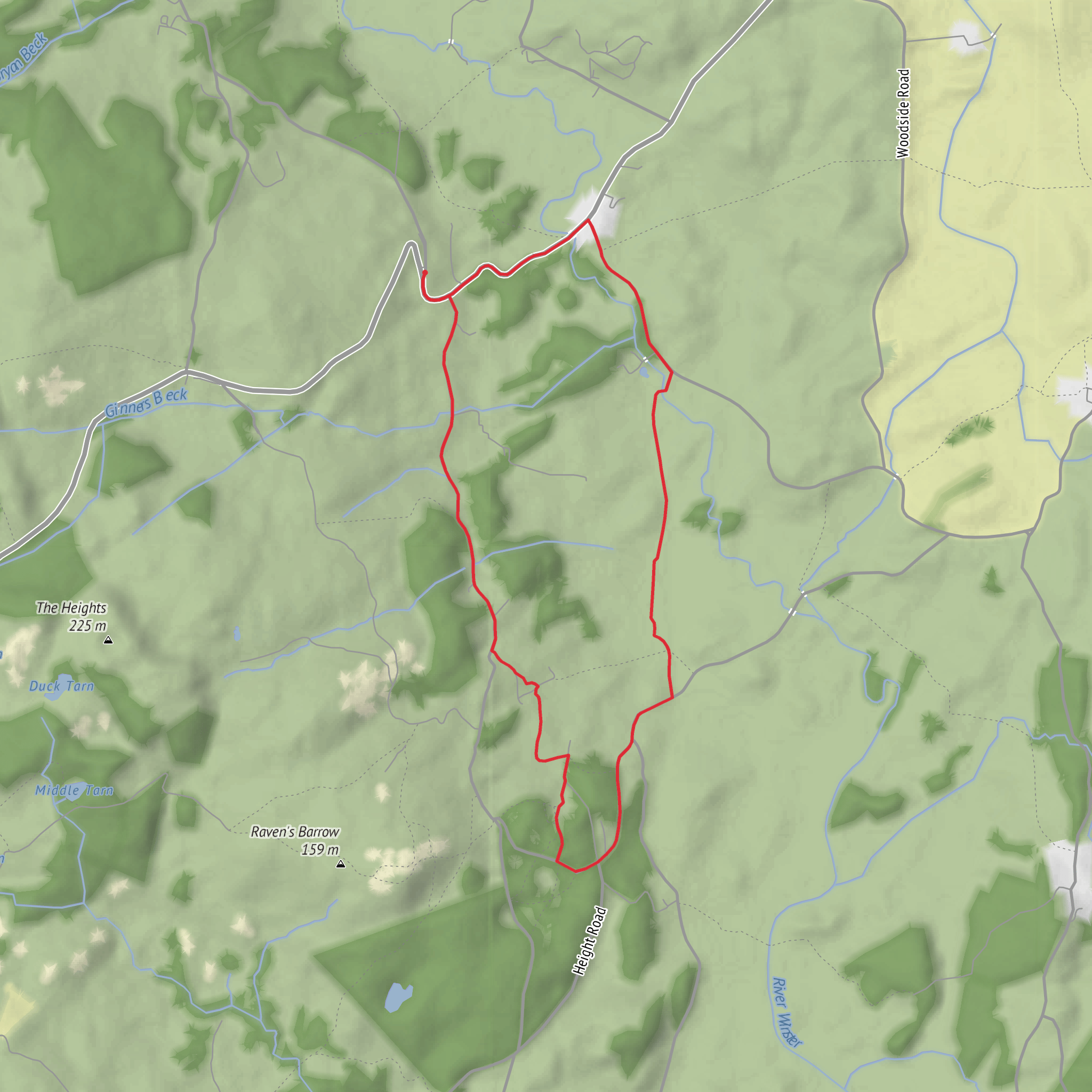
This easy loop on Cartmel Fell packs a surprising amount into around 4 km / 2.5 miles, with roughly 100 metres / 330 feet of ascent. It is a short outing, but it feels properly rural rather than like a quick village stroll, combining quiet lanes, field paths, gates, open fellside views, and one of the area’s most distinctive historic churches. The route is well suited to walkers looking for a gentle half-day ramble, families with some countryside walking experience, or anyone wanting a shorter Lake District walk without committing to a major climb.
The walk is centered on St Anthony’s Church, Cartmel Fell, a Grade I listed church in the Lake District National Park, in the civil parish of Cartmel Fell, Westmorland and Furness. Historic England lists it simply as the Church of St Anthony, and the church’s own information notes that it was built in 1504 as a chapel of ease so local residents no longer had to travel about 7 miles / 11 km to Cartmel Priory for communion. (historicengland.org.uk)
The start point commonly used for this loop is near St Anthony’s Church, Cartmel Fell, near Bowland Bridge, Cumbria LA11, with the church and parish hall serving as the most practical landmark for navigation and parking. The church confirms that parking is available near the Parish Hall. (achurchnearyou.com)
What to expect on the route
Expect a mixture of minor tarmac lanes, farm access tracks, grassy field-edge paths, gates, and short uneven sections where the ground can be lumpy or damp. Even though the overall difficulty is easy, the route is not completely flat. The climbing is spread out in short rises rather than one sustained ascent, so most walkers will find it manageable, but sturdy footwear is still a good idea, especially after rain when fields and gateways can become muddy.
A commonly described version of the walk begins near the Masons Arms area and heads along a quiet lane toward the church, passing scattered houses and turning into farmland before climbing gently to St Anthony’s Church. From there, the route continues on lanes and field paths around Hodge Hill and back through the surrounding countryside. The published route description includes landmarks such as Pool Garth, small rocky outcrops, the churchyard, the old school, and Hodge Hill. (visorando.com)
Because this is a short loop, the pacing is flexible. Many walkers will complete it in about 1 to 1.5 hours of moving time, but it is worth allowing longer if you want to pause at the church, look over the surrounding fell country, or spend time on navigation at field junctions.
Landmarks and historical character
St Anthony’s Church is the standout landmark and gives the walk much of its character. The church dates from about 1504, with later additions including a late 16th-century porch and probable 18th-century vestry, and it is listed at Grade I. Historic England describes roughcast stone walls, ashlar dressings, a slate roof, and a compact plan with west tower and south porch. (historicengland.org.uk)
Inside, the church is known for features that reflect the isolated farming history of Cartmel Fell. The church’s own notes mention enclosed family pews, a triple-decker pulpit remodelled in 1698, and fragments of older glass thought possibly to have come from Cartmel Priory after the Dissolution. The building was also carefully restored in 1910–11 under architect John Curwen. (achurchnearyou.com)
The surrounding landscape helps explain why the church mattered so much historically. Cartmel Fell is not a compact village center but a dispersed upland farming area of lanes, walls, pastures, and small holdings. This loop gives a good sense of that settlement pattern. Rather than dramatic mountain scenery, the appeal lies in the texture of the countryside: old farmsteads, hedgebanks, rocky knolls, churchyard walls, and glimpses across the southern Lake District.
Nature and wildlife
This is pastoral fell country, so the wildlife is more subtle than spectacular, but there is still plenty to notice. Expect sheep-grazed fields, hedgerows, mossy banks, and pockets of woodland habitat around farms and lanes. In spring and summer, birdsong is often one of the main features of the walk, with common countryside species using hedges and field margins. Damp ground and sheltered walls can also support ferns, mosses, and seasonal wildflowers.
Because the route crosses working farmland, walkers should be prepared for livestock in fields. Keep dogs under close control, leave gates as you find them, and be especially cautious during lambing season
Surfaces
Unknown
Asphalt
Grass
Gravel
Wood
Comments and Reviews
User comments, reviews and discussions about the St Anthony’s Church and Cartmel Fell Loop, England.
average rating out of 5
0 rating(s)
