
Download
3D Flyover
Add to list
More
6.6 km
~1 hrs 37 min
178 m
Loop
“A dramatic Cornish loop of turquoise bays, wind-whipped cliffs, Logan Rock, and Minack’s spellbinding sea-stage.”
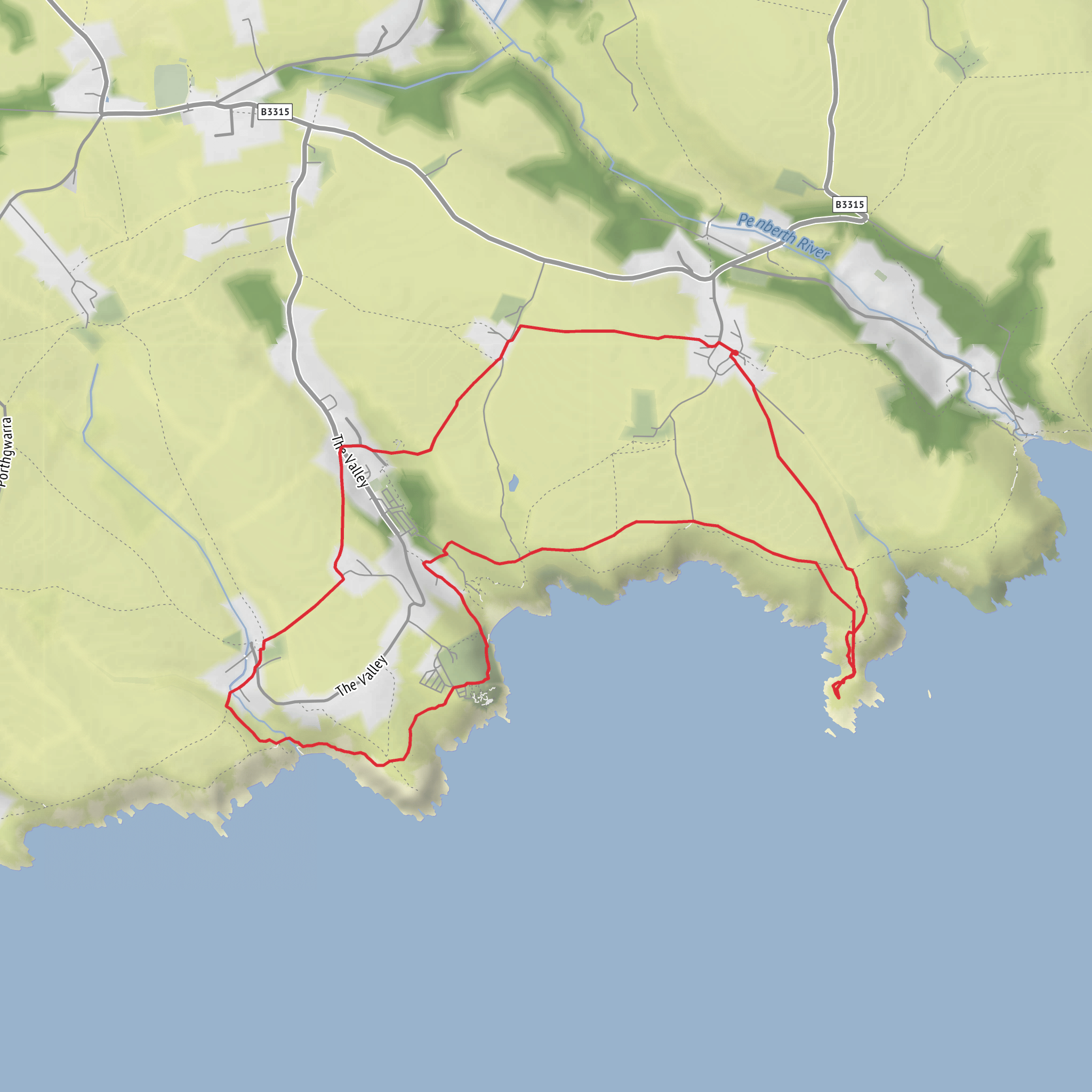
This roughly 7 km / 4.3 mile coastal loop near Porthcurno, Penzance TR19 6JU, by the Minack Theatre and Porthcurno Beach, packs a lot into a relatively short outing: dramatic granite headlands, open Atlantic views, steep cliff paths, a famous rocking stone, and one of Cornwall’s most distinctive cultural landmarks. Expect about 200 metres / 656 feet of ascent, mostly delivered in short, punchy climbs rather than one long haul, which is why the route feels solidly medium despite the modest distance. (minack.com)
The walk is usually done as a circuit from the Porthcurno/Minack area, using sections of the South West Coast Path and inland lanes or field paths to return. The terrain is varied: stone steps, uneven coastal trail, exposed cliff-edge sections, and occasionally muddy or slippery ground after rain. Good footwear matters here, and in windy weather the exposed stretches around the headland can feel much more serious than the mileage suggests. (nationaltrust.org.uk)
Getting to the start is straightforward by car or bus. If driving, follow the B3315 toward Porthcurno and the Minack Theatre, where parking is the main practical access point for this walk; the area can be busy, especially in holiday periods and on performance days. By public transport, the 300 and 1A bus services from Penzance run to Porthcurno, and there is a bus stop below the theatre with a short but steep uphill walk from the stop to the higher ground near the start. (minack.com)
What the route feels like
From the Porthcurno side, the route quickly delivers one of its signature features: a rising traverse above the bay with wide views back over the pale sand and intensely blue water. The climb is not huge, but it is enough to gain a proper cliff-top perspective. If you are planning with HiiKER, this is the kind of route where checking the profile in advance is useful, because the elevation comes in short coastal ramps and stair-like sections rather than a gentle gradient.
As the loop heads toward Logan Rock, the scenery becomes more rugged and more elemental. Granite outcrops dominate the skyline, the path narrows in places, and the coastline breaks into coves, ledges, and steep grassy slopes. The famous Logan Rock itself sits on the headland above the sea and is the landmark most walkers are aiming for. It is a naturally balanced granite boulder, long known as one of Cornwall’s curiosities. (en.wikipedia.org)
The return leg inland is typically quieter and more sheltered, passing through the softer side of the landscape: hedged lanes, small fields, and pockets of Cornish farmland. That contrast is part of what makes the loop satisfying. One half feels wild and exposed; the other feels rooted in the old agricultural pattern of west Cornwall.
Landmarks and historical interest
Logan Rock is the headline feature. The stone is famous not just for its precarious position but also for the story attached to it: in 1824, a group of Royal Navy seamen dislodged it while trying to prove they could move it, causing public outrage; it was later repositioned. Even if the stone no longer rocks as freely as it once did, it remains one of the best-known natural landmarks on this stretch of coast. (en.wikipedia.org)
Across the bay, the Minack Theatre is impossible to ignore. Built into the granite cliffs above Porthcurno, it is one of the most remarkable open-air theatres in Britain, with the sea as its backdrop. On this walk it serves both as a visual anchor and as a reminder that this coastline is shaped as much by human imagination as by geology. (nationaltrust.org.uk)
Porthcurno also has an unexpectedly global history. In 1870, the first international telegraph cable came ashore here, linking Britain with India; over time Porthcurno developed into one of the most important submarine telegraph stations in the world. That means this tiny valley was once a major communications hub of the British Empire. If you have extra time before or after the walk, the PK Porthcurno museum adds valuable context to the landscape you are crossing. (pkporthcurno.com)
There is also Second World War history in the area. The telegraph station’s importance led to wartime protection works and tunnels, and the museum preserves that side of the story as well. This gives the walk an unusual historical depth: prehistoric-feeling granite scenery, 19th-century communications history, and
Surfaces
Unknown
Grass
Dirt
Ground
Asphalt
Gravel
Wood
Comments and Reviews
User comments, reviews and discussions about the Logan Rock and Port Curno Loop, England.
average rating out of 5
0 rating(s)


