Download
3D Flyover
Add to list
More
13.7 km
~3 hrs 5 min
212 m
Loop
“From folklore-haunted caves to sweeping clifftops, this varied Runswick Bay loop feels vividly wild and storied.”
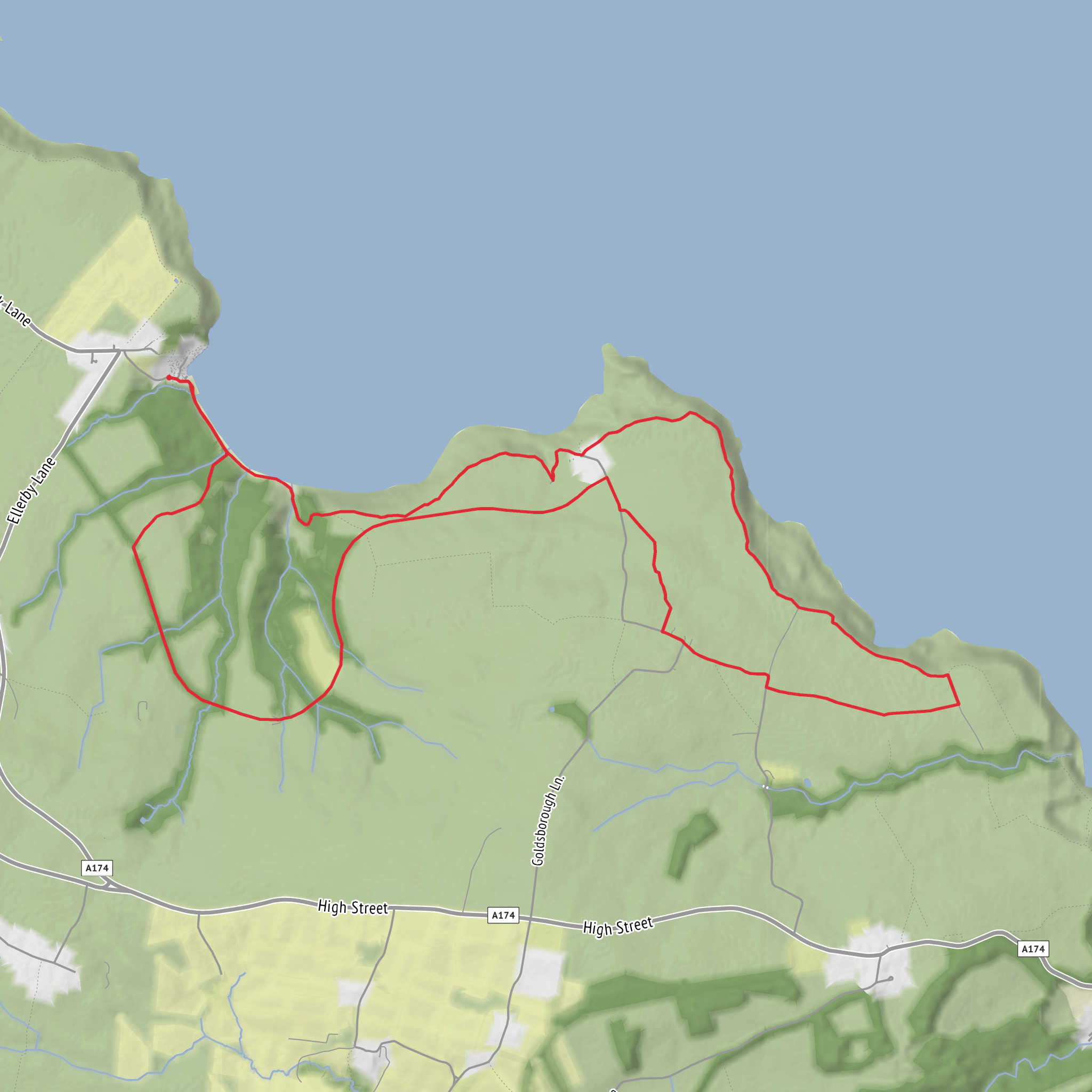
This easy coastal-and-country loop of about 14 km / 8.7 miles with roughly 200 m / 656 ft of ascent combines one of the prettiest bays on the Yorkshire coast with open clifftop walking, gentler inland fields, and the distinctive landmark of Hob Holes Cave. Expect a route that feels varied rather than strenuous: a short sharp climb or two from sea level, long easier stretches on grassy or compacted paths, and wide views for much of the day. The setting is within the North York Moors National Park and along the Cleveland Way corridor, so waymarking is often good, but coastal weather and eroding cliff edges mean it is still worth carrying the route in HiiKER and checking for any local diversions before setting out. The Cleveland Way itself is a 109-mile / 175 km National Trail and the coastal sections can be more demanding than the overall “easy” rating suggests when wind, mud, or wet steps are involved. (gov.uk)
The walk is best started near the village of Runswick Bay, with the most practical trailhead landmark being Bank Top Car Park, Runswick Bay, North Yorkshire, above the village. That gives straightforward access down into the bay and onto the coast path. If arriving by car, this is the usual place walkers aim for. If using public transport, the nearest practical connections are typically via Whitby or Loftus, then onward by bus on the coast road; Arriva’s X4 serves the Middlesbrough–Loftus–Whitby corridor, which is the key route to check for current times. There is no railway station at Runswick Bay itself, so most rail users connect through Whitby or another nearby town and continue by bus or taxi. (arrivabus.co.uk)
The opening part of the loop usually drops from the higher village approach down toward the shore, where the character of the walk changes immediately. Runswick Bay is known for its sweeping sandy beach, rocky scars, and constantly changing cliffs. The first 1 to 2 km / 0.6 to 1.2 miles are often the most atmospheric, with sea views opening across the bay and the village tucked into the slope behind. Underfoot, this section can alternate between firm path, stone steps, beach access tracks, and uneven rocky ground if the route goes close to the foreshore. After rain, the descent and any stonework can be slippery. On breezy days, the exposed bay can feel much cooler than inland sections. (northyorkmoors.org.uk)
Coast path, cave, and cliff scenery
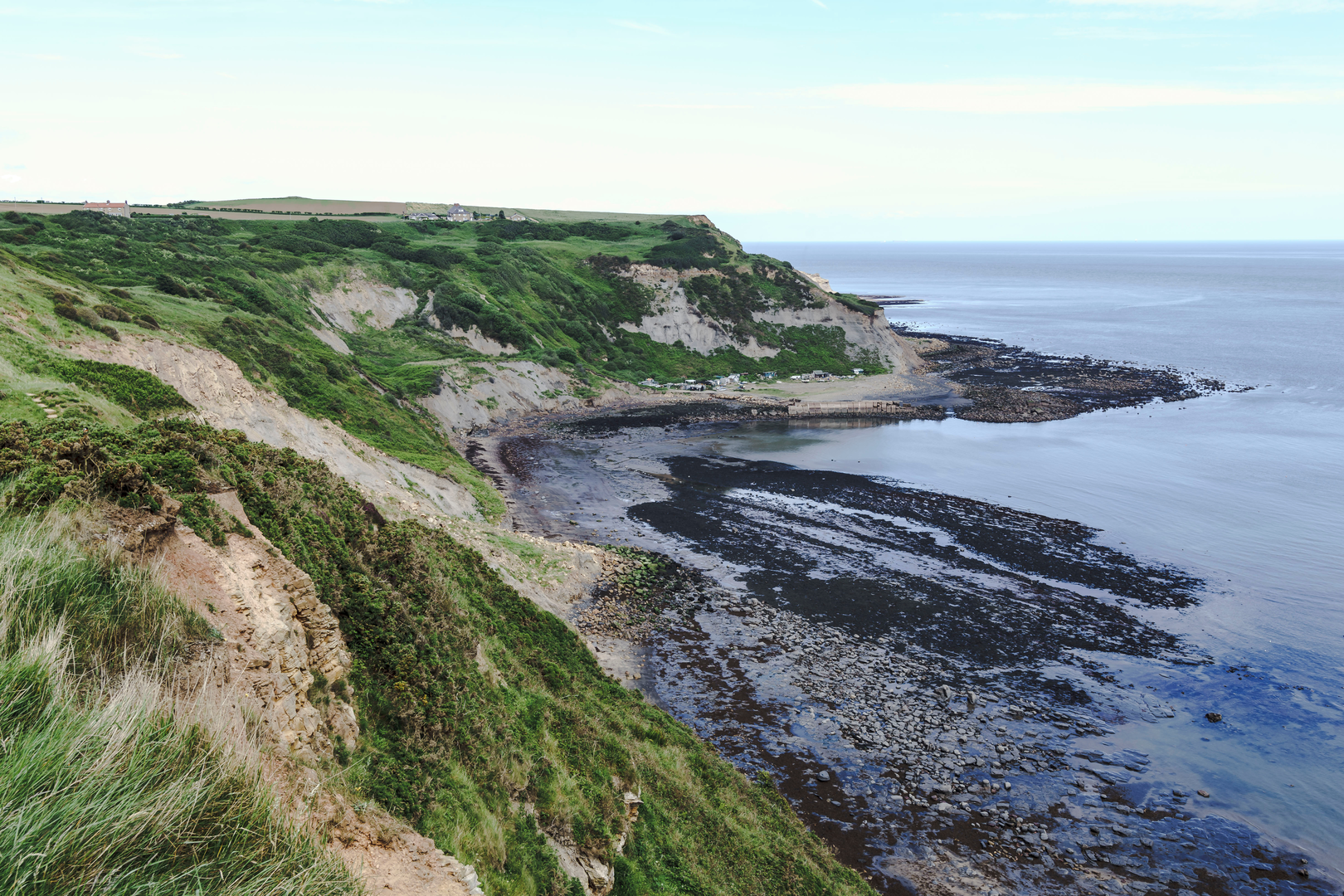
One of the standout landmarks is Hob Holes Cave, in the cliffs near the bay. The caves are closely tied to local folklore and to the area’s industrial past. Older accounts describe Hob Hole as a place where families once brought children suffering from whooping cough, appealing to the “hob,” a household or cave spirit from northern folklore. The cave system also reflects later disturbance from jet mining in the cliffs, linking the site to the Yorkshire coast’s long history of extracting jet, alum, and ironstone. This gives the walk more than just scenic interest: it passes through a landscape shaped by both superstition and industry. (visionofbritain.org.uk)
From the bay, the route’s coastal section typically climbs toward higher ground, gaining much of the day’s elevation in a relatively short distance. A rise of around 90 m / 295 ft from beach level to the clifftops is typical on this stretch, and although it is not especially long, it can feel like the hardest part of the loop. Once above the bay, the walking becomes more flowing, with broad views north and south along the Heritage Coast. On clear days, the cliffs around Kettleness and the curve of the shoreline become major visual features. Keep well back from cliff edges here, especially after wet weather or dry spells following erosion, as the coast is geologically active and sections can be unstable. (northeastbylines.co.uk)
Geologically, this is one of the most interesting parts of the Yorkshire coast. Runswick Bay is noted for Early Jurassic rocks, fossils, and landslip features, with bedrock exposures especially visible around the foreshore, rocky scars, Hob Holes, and the north side of the bay. Hikers with an interest in natural history should watch for the layered shales and sandstones that help explain why the coastline looks so broken and dramatic. The same geology that makes
Surfaces
Unknown
Paved
Unpaved
Comments and Reviews
User comments, reviews and discussions about the Runswick Bay, Tellgreen Hill and Hob Holes Cave Loop, England.
average rating out of 5
0 rating(s)
