Download
3D Flyover
Add to list
More
18.8 km
~4 hrs 4 min
186 m
Loop
“A varied loop through windswept vale, shady ridges, Tudor parkland, and a tranquil lakeside finale.”
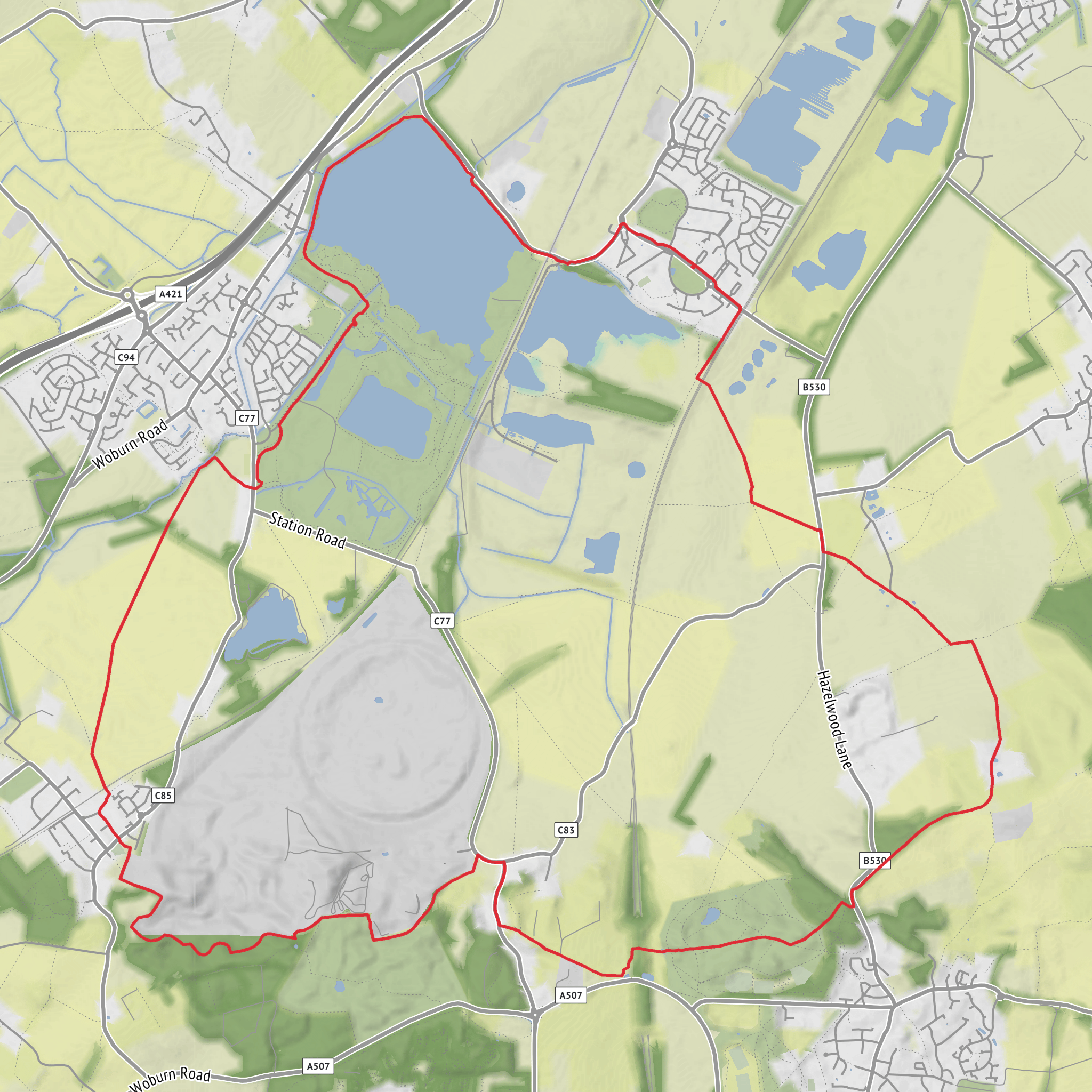
This easy loop of about 19 km / 11.8 miles with roughly 200 m / 656 ft of ascent links the broad open landscapes of the Marston Vale with wooded ridge walking, historic parkland, and a long waterside finish. The route is generally approachable for regular walkers, but it is long enough that it still needs a bit of planning, especially if the ground is wet or if you are walking in winter when some field sections can become muddy. The climbing is modest overall, though the gradients feel more noticeable around Jackdaw Hill and on the approach into Ampthill Park. The start is best understood as being near Marston Moretaine village, with the most practical nearby landmarks for access being Marston Moretaine Village Hall, Millbrook railway station, or Stewartby railway station, depending on how you arrive. (marstonmoreteyne-pc.gov.uk)
From Marston Moretaine, the route heads out through the low-lying vale where the walking is usually straightforward and the gradients are gentle. Early on, expect a mix of village edges, open fields, and tracks that give a good sense of the wider Bedfordshire landscape. This part of the county is known for its reclaimed and restored land within the Marston Vale, where former industrial ground has gradually been reshaped into green space, lakes, and wildlife habitat. Because the terrain here is relatively open, wind can be more of a factor than steepness, and after rain some paths can hold water or become slick underfoot. (ldwa.org.uk)
Climbing toward Jackdaw Hill and Ampthill Park
The middle part of the walk is where the route becomes more varied. Around Jackdaw Hill, the trail rises onto higher ground and into more wooded surroundings. This is where the day’s ascent is concentrated, and although the hike is still rated easy overall, these undulations can feel like the most energetic section of the loop. The reward is a change in character: instead of flat vale scenery, you get sheltered woodland, ridge-side paths, and broader views back across the Marston Vale. Local walking accounts of the Timberland Trail note that this stretch includes some of the steeper little climbs on the wider circuit and some of the best viewpoints of the day. (ldwa.org.uk)
Ampthill Park is one of the standout landmarks on the route. Today it is a public parkland landscape, but its history runs much deeper. Historic England records the site as a former deer park associated with Ampthill Castle, and the area developed from a medieval and later royal hunting landscape into the designed parkland seen today. The park is especially significant for its links to Henry VIII and Katherine of Aragon: Ampthill was one of the places associated with Katherine during the annulment period, giving the landscape an important Tudor connection. The present park also contains later estate history, including the 17th-century Ampthill Park House and later landscape improvements. (historicengland.org.uk)
As you cross the park, expect open grassy expanses, mature trees, and long views. This is a good place to pause, as the combination of elevation and open ground often gives one of the clearest panoramas on the loop. In warmer months, exposed sections here can feel surprisingly sunny, so water and sun protection are worth carrying even on an otherwise easy walk. If visibility is poor or paths are busy, route-checking with HiiKER is useful, particularly where multiple rights of way intersect around the park and adjoining woodland. (localoffer.bedford.gov.uk)
Stewartby Lake and the Marston Vale finish
After the higher ground, the route drops back toward the vale and eventually reaches Stewartby Lake, part of the Marston Vale Millennium Country Park area. This section changes the mood again, replacing woodland and parkland with open water, level paths, and a more leisurely finish. Stewartby Lake is one of the best places on the route for birdlife. Depending on season, walkers may see common waterfowl, gulls, grebes, and other wetland birds using the lake margins and surrounding habitat. The restored landscapes of the Marston Vale have become important for both recreation and nature, so this part of the walk often feels quieter and more spacious than the village sections. (alltrails.com)
Stewartby itself also has historical interest. The village is known as a planned model settlement created in connection with the brickmaking industry that once dominated this part of Bedfordshire. That industrial heritage shaped much of the Marston Vale, and even where the route now passes lakes, green corridors, and country parkland, the wider landscape has been heavily influenced by extraction, brickworks, and later restoration. That contrast between industry and regeneration is one of the defining features of the walk. (en.wikipedia.org
AI Planner
Days planned around your pace, with somewhere to stay each night.
Surfaces
Unknown
Gravel
Asphalt
Paved
Ground
Comments and Reviews
User comments, reviews and discussions about the Marston Moretaine, Jackdaw Hill, Ampthill Park and Stewartby Lake Loop, England.
average rating out of 5
0 rating(s)