
Download
3D Flyover
Add to list
More
14.5 km
~3 hrs
58 m
Loop
“Big skies, river meadows, and royal echoes make this a gentle wander through storied countryside.”
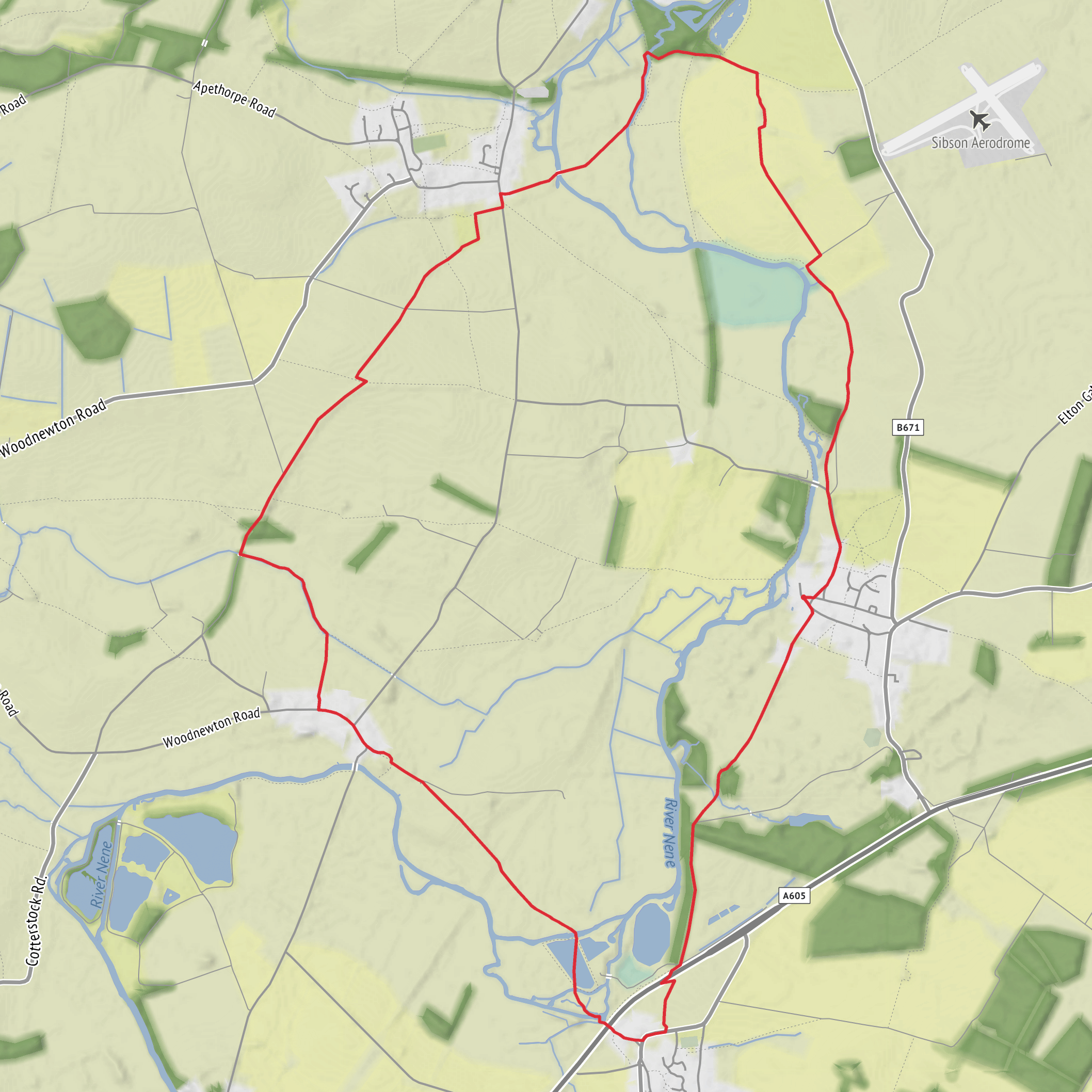
This easy loop of around 15 km / 9.3 miles with roughly 100 m / 330 ft of ascent is a gentle countryside walk built around big skies, riverside scenery, quiet lanes, and one of Northamptonshire’s most historically important villages. The route is centered on Fotheringhay, near the Church of St Mary and All Saints, Fotheringhay, Peterborough PE8 5HZ, which is the clearest significant landmark for the start area and the most practical point to navigate to. Fotheringhay sits beside the River Nene and is best known for the earthwork remains of Fotheringhay Castle, the birthplace of Richard III and the place where Mary, Queen of Scots, was imprisoned before her execution in 1587. The castle itself now survives mainly as a motte-and-bailey earthwork on the edge of the village, but it still gives the walk a strong sense of place. (her.northamptonshire.gov.uk)
The walking is generally straightforward and suits most hikers looking for a relaxed half-day or unhurried day out rather than a strenuous outing. Expect a mix of village lanes, field-edge paths, bridleways, and sections that can become muddy after rain, especially near gates, across arable fields, and on lower ground near the Nene. With only modest climbing, the route’s difficulty comes less from steepness and more from underfoot conditions, stiles or gates, and the need to stay alert where paths cross open farmland. HiiKER is the best tool to use for checking the line of the route and confirming field crossings or junctions before setting out.
What the route feels like
From Fotheringhay, the loop typically unfolds through open agricultural country and small settlements, with the landscape changing gradually rather than dramatically. Early on, the village itself sets the tone: stone buildings, the broad river setting, and the remarkable church tower rising above the meadows. The church is one of the great visual highlights of the day, and views back toward it from the bridge and surrounding fields are often among the most memorable on the route. The bridge over the River Nene is also a notable landmark, with especially fine views back toward the church and riverside setting. (peterboroughchurches.com)
As the loop heads out toward Eaglethorpe and the surrounding farmland, the terrain remains mostly rolling and easy-going. Eaglethorpe is a small hamlet with historic character of its own, and walkers may pass Eaglethorpe House, a building dating to 1607, which adds another layer of local heritage to what is otherwise a peaceful rural section. The paths here are often broad enough to feel relaxed, but because much of the route crosses working countryside, hikers should be prepared for uneven tractor ruts, cropped-field margins, and occasional wet patches. (essentially-england.com)
Landmarks, history, and atmosphere
Castle Hill is the historical heart of the walk. At Fotheringhay, “Castle Hill” refers to the surviving castle earthworks rather than a mountain or prominent summit, so this is a route where the elevation is subtle but the history is immense. The castle began as a 12th-century motte-and-bailey stronghold and later became closely tied to the House of York. Although little masonry remains today, the earthworks still make it easy to imagine the scale and strategic importance of the site above the river. (her.northamptonshire.gov.uk)
The church deserves time as well. St Mary and All Saints dominates the village and surrounding fields, and its Yorkist connections are central to understanding the area. Fotheringhay was deeply associated with the House of York, and the church was built and endowed as part of that dynastic landscape. Even hikers with only a passing interest in history usually notice that this is not an ordinary village church; it has a grand, almost collegiate presence that reflects the village’s former political importance. (britainexpress.com)
Beyond the headline history, the route also passes through a landscape shaped by former parkland, river meadows, and long-settled farming. Historic records note the presence of Fotheringhay’s Great Park and Little Park, once associated with the castle and lordship, and that older managed landscape still helps explain the broad, open feel of the countryside around the village
Surfaces
Unknown
Unpaved
Dirt
Comments and Reviews
User comments, reviews and discussions about the Fotheringhay and Eaglethorpe Loop via Castle Hill, England.
average rating out of 5
0 rating(s)

