
Download
3D Flyover
Add to list
More
3.1 km
~46 min
90 m
Loop
“A punchy climb through woodland to windswept Four Stones rewards prepared walkers with sweeping, history-soaked views.”
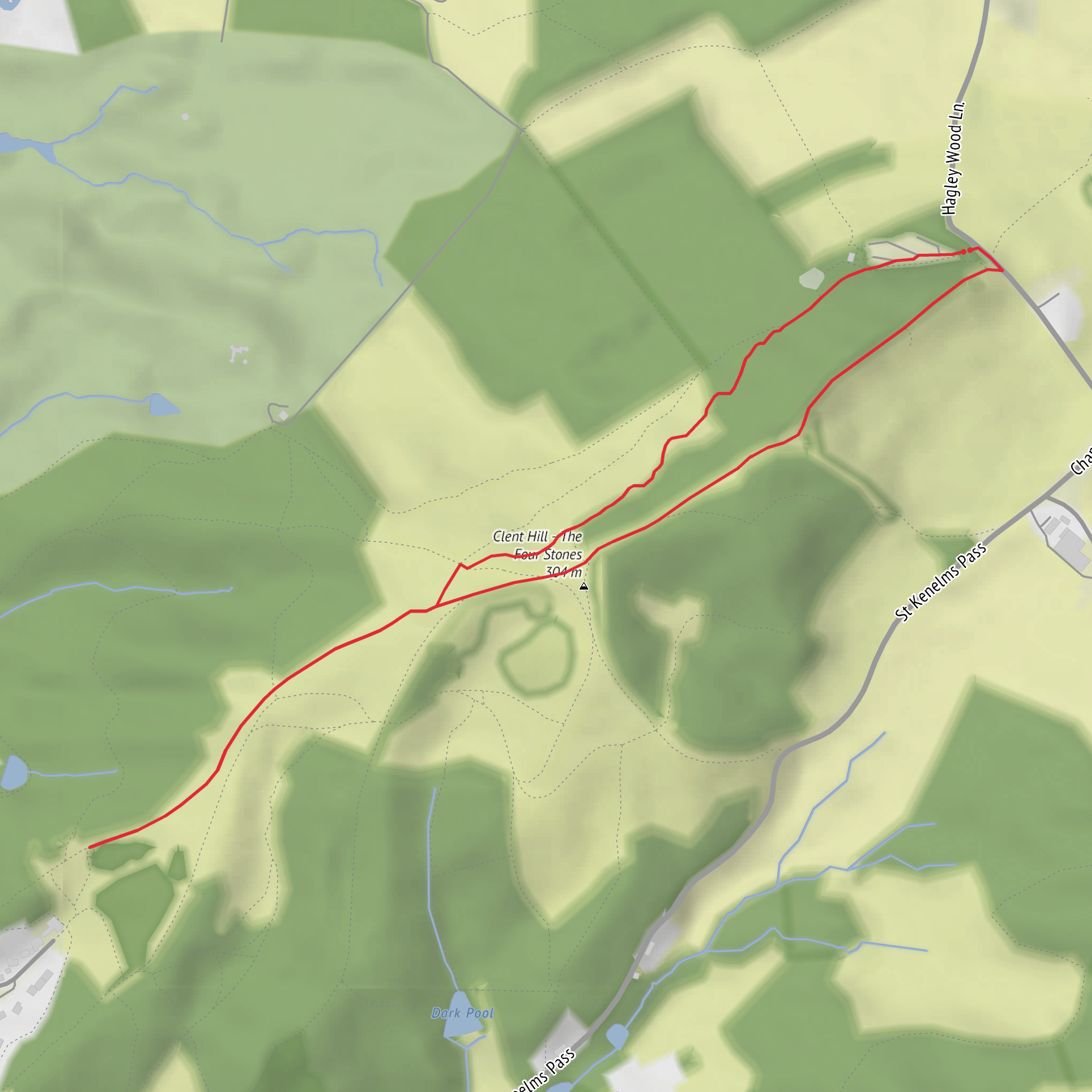
This short Clent Hills outing packs a surprising amount into roughly 3 km / 1.9 miles, with about 100 m / 328 ft of ascent. Although the distance is modest, the climb can feel punchy in places, especially if the ground is wet or the route heads up from the woodland side near Nimmings Wood. With an estimated medium difficulty, it suits walkers who want a brief hill walk with open views, a distinct summit landmark, and enough uneven terrain to feel like a proper outing rather than a flat park stroll. The usual starting point is the National Trust area at Nimmings Wood Car Park, Hagley Wood Lane, Romsley, Worcestershire, B62 0NL, which is the main access point for short walks to the Four Stones. (nationaltrust.org.uk)
The route typically begins among mixed woodland before climbing onto more open hillside. Expect a steady ascent rather than a long mountain grind: over only a few kilometres, 100 m / 328 ft of elevation gain means some sections are noticeably uphill. Paths can be earthy, stony, and occasionally slippery after rain, with exposed stretches higher up where wind can be stronger than it feels at the car park. Good walking shoes are usually enough in dry weather, but boots are a better choice in winter or after prolonged wet spells. Because the hill is open and elevated, conditions can change quickly, so an extra layer is sensible even for a short walk. For navigation, HiiKER is the best tool to use for checking the line of the paths and keeping track of junctions around the hill.
What the walk feels like
From the lower slopes, the trail rises through woodland and then breaks out onto open ground where the landscape starts to widen dramatically. This is where the walk becomes most rewarding: the Clent Hills stand high enough above the surrounding countryside to give broad views across Worcestershire and the West Midlands, and on a clear day the outlook can extend as far as the Welsh Black Mountains. The short National Trust summit walk to the Four Stones is a little over 4.3 km / 2.7 miles, so a 3 km / 1.9 mile version is best thought of as a compact variation focused mainly on the climb to the stones and back rather than a longer circuit. (nationaltrust.org.uk)
The Four Stones themselves are the defining landmark. Despite their ancient appearance, they are not prehistoric standing stones. They were created in the 18th century, in the 1770s, for Lord Lyttelton as a folly designed to be seen from the valley below. That gives the walk an interesting twist: hikers often arrive expecting a prehistoric monument, but what they find is a deliberately romantic landscape feature from the Georgian period, placed to enhance the drama of the hilltop. (nationaltrust.org.uk)
Around the summit area, the ground is more open and often grazed, with short grass, heath-like patches, and scattered scrub. This exposure means there is little shelter from wind, and in mist the hill can feel much bigger than the map suggests. Visibility can drop quickly, so even on a short route it is worth paying attention to path choices on the descent, particularly where multiple tracks branch across the hillside.
Nature and wildlife
Clent Hills combines woodland edge, open grassland, and hilltop habitat, so the wildlife interest changes as you climb. Lower down, expect common woodland birds and plenty of seasonal variation in leaf cover, fungi, and wildflowers. Higher up, the open slopes are better for scanning the sky and surrounding fields. The National Trust’s waymarked Buzzard Trail passes the Four Stones and highlights the area’s open views and woodland mix, which gives a good sense of the habitats walkers move through on this side of the hills. (nationaltrust.org.uk)
Buzzards are one of the birds people often watch for over the hills, using rising air above the slopes. In warmer months, butterflies and other insects are active in the grassier sections, while the woodland margins can be especially attractive in spring. If livestock are present, keep a respectful distance and control dogs carefully. The National Trust advises that dogs are welcome but should be kept on a lead in car parks and under close control in grazed areas. (nationaltrust.org.uk)
Historical setting
The wider Clent area has a long recorded history. Clent appears in the Domesday Book of 1086, and the hills later became part of a designed landscape culture associated with local estates and the taste for scenic viewpoints. The Four Stones are one of the clearest surviving expressions of that period, created not as an ancient ritual site but as an ornamental feature tied to 18th-century landscape design and the influence of nearby Hagley Hall and its estate culture. (clentparishcouncil.gov.uk)
That historical background adds depth to what is otherwise a short hill walk. The route is not just about reaching a viewpoint; it also passes through a landscape shaped by centuries of land use, estate planning, grazing, and recreation. The result is a hill that feels natural and open, yet also carefully framed by human history.
What to expect?
Surfaces
Unknown
Dirt
Asphalt
Comments and Reviews
User comments, reviews and discussions about the The Four Stones in Clent, England.
average rating out of 5
0 rating(s)



