
Download
3D Flyover
Add to list
More
19.2 km
~4 hrs 4 min
141 m
Loop
“A charming Berkshire ramble weaves commons, leafy woods, storybook villages and tranquil Thames paths.”
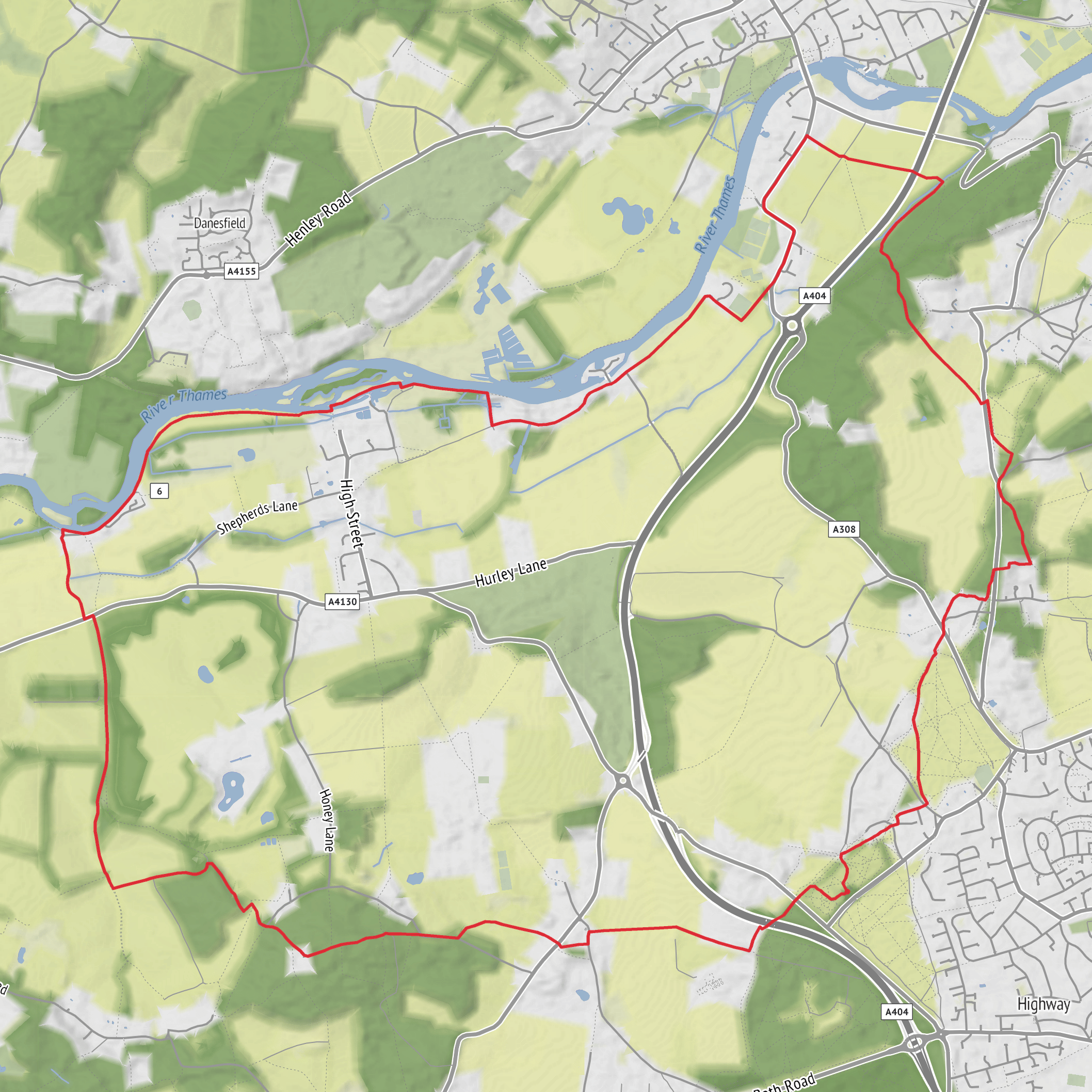
This easy loop of about 19 km / 11.8 miles with roughly 100 m / 330 ft of ascent links open common, quiet woodland, Thames-side walking and a handful of classic Berkshire villages. The terrain is generally gentle, with the climbing spread out in short rises rather than sustained hills, so it suits walkers looking for a longer but not especially strenuous day. Expect a mix of grassy common, compacted woodland tracks, field-edge paths, village lanes and flatter riverside sections, with the most noticeable undulations around Cookham Dean and the higher ground near Ashley Hill and Bisham Woods. (gps-routes.co.uk)
The route is best understood as starting near Pinkneys Green / Pinkneys Drive, Maidenhead, Berkshire SL6 6QD, the usual access point for the National Trust commons in this area and the most practical landmark for parking and navigation. Pinkneys Green itself lies west of Maidenhead and is a recognised access point for Maidenhead and Cookham Commons. (gps-routes.co.uk)
By car, the simplest approach is via Maidenhead, following the A308 toward Pinkneys Green and the National Trust commonland access around Pinkneys Drive. Free parking is commonly used at Pinkneys Green for walks on the commons, though spaces can fill on fine weekends. If arriving by public transport, Maidenhead is the main rail hub, with onward local taxi travel the most straightforward option to the start. Cookham can also work as an alternative rail access point if you are happy to add extra walking to join the loop from the north-east side. (nationaltrust.org.uk)
Early on, the walk usually feels broad and open. Around Pinkneys Green, the landscape is shaped by commonland and woodland edge, with easy gradients and wide paths that help you settle into the day. This area forms part of the Maidenhead and Cookham Commons, a National Trust landscape of commons, woods and heaths that gives the route much of its character. In dry weather, footing is usually straightforward; after rain, some woodland stretches and bridleways can become muddy and uneven, so waterproof footwear is worth considering even on an “easy” route. (nationaltrust.org.uk)
Through Cookham Dean Common and the higher ground
As the loop works north and west, it reaches Cookham Dean Common, where the scenery shifts toward a more enclosed, rural feel. Tracks here can be a little bumpier than the opening commonland, and there are several intersecting paths, so this is one of the sections where careful route-following matters most. If you are using a navigation app, plan around HiiKER before setting out and keep an eye on junctions through the woods and commons. Older route notes for this area specifically warn that navigation can be tricky around Cookham Dean. (saddlesafari.co.uk)
Cookham Dean itself is one of the most attractive parts of the outing. The village sits on higher ground above the Thames Valley, and the lanes and open edges can give wide views northward. The ascent here is not large in mountain terms, but it is where much of the route’s modest elevation gain is felt. Short climbs on lanes and bridleways are followed by easier stretches, so pacing is simple for most walkers. (gps-routes.co.uk)
This area also carries literary and cultural interest. The wider Cookham Dean and Bisham landscape is associated with Kenneth Grahame, author of The Wind in the Willows, and the National Trust highlights local walks that draw on that connection. The setting makes it easy to see why: wooded slopes, quiet lanes, river meadows and village greens all contribute to that classic Thames-side countryside atmosphere. (nationaltrust.org.uk)
River section, Hurley Lock and Ashley Hill
The middle to later stages bring you down toward the River Thames, where the route becomes flatter and more relaxed underfoot. Near Hurley Lock, the walk picks up one of its most distinctive landmarks: a historic Thames lock on a river long shaped by navigation, trade and leisure traffic. Hurley Lock dates to the eighteenth century in its pound-lock form, with earlier flash-lock use on the site, placing it firmly within the long working history of the Thames. (en.wikipedia.org)
The riverside stretch is often one of the easiest parts of the day physically, but it is worth watching for a few practical issues: tree roots on shaded paths, muddy patches after wet spells, cyclists on shared sections, and occasional flooding or soft verges in winter. The river corridor is also one of the best places on the loop for wildlife. Depending on season, expect to see swans, geese, ducks
Surfaces
Unknown
Asphalt
Grass
Dirt
Gravel
Ground
Unpaved
Concrete
Wood
Comments and Reviews
User comments, reviews and discussions about the Pinkneys Green, Cookham Dean Common, Hurley Lock and Ashley Hill Loop, England.
average rating out of 5
0 rating(s)

