
Download
3D Flyover
Add to list
More
8.7 km
~2 hrs 8 min
244 m
Loop
“From Zarok’s bright shore, this reflective valley walk rises to shrine views and storied stone sheepfolds.”
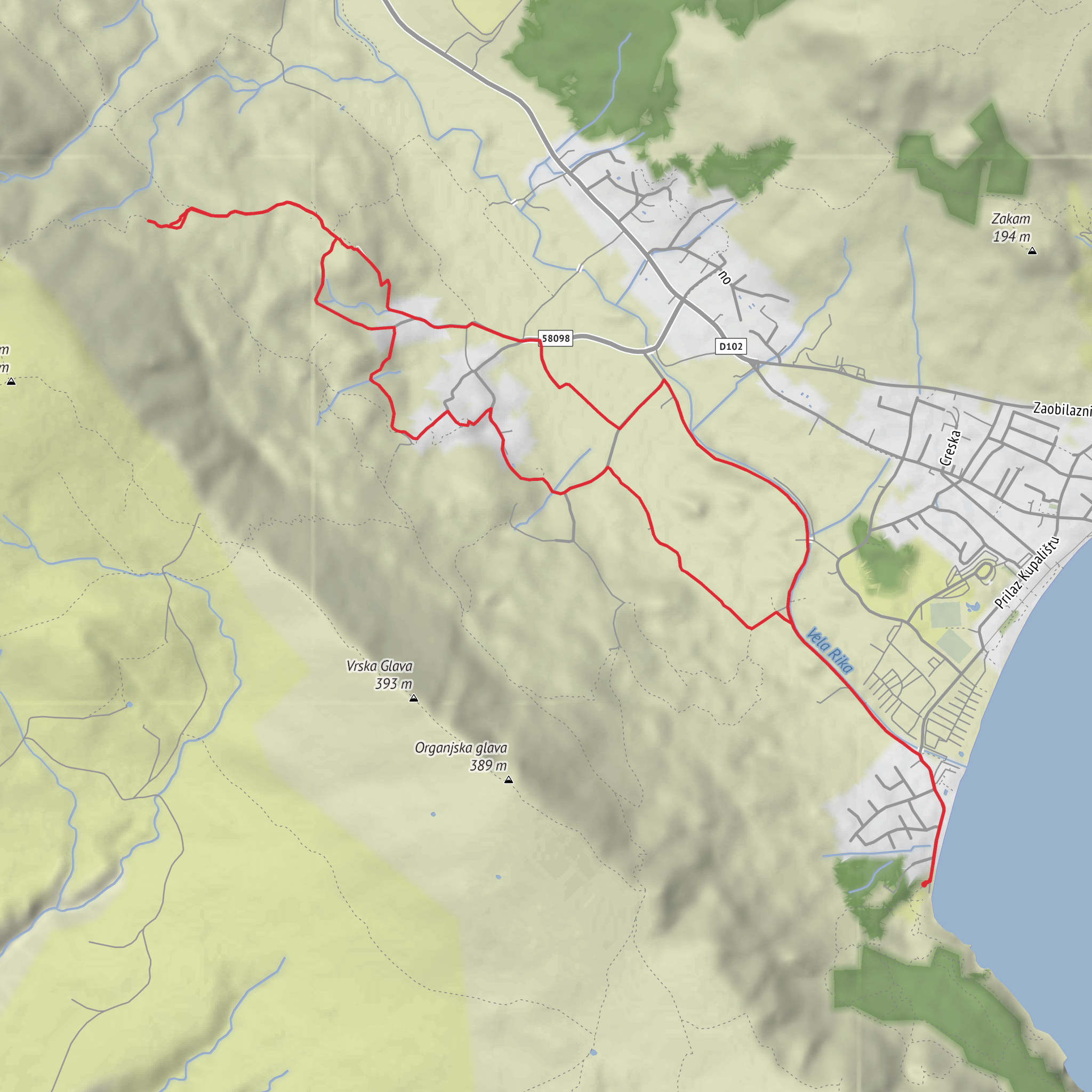
Starting near Zarok Beach in Baška, on the island of Krk, Croatia, this medium walk links the coast with the pastoral interior of the Baška valley, climbing from the seafront through the Vela Rika corridor toward Batomalj and the historic Shrine of Our Lady of Gorica, then continuing to the remarkable mrgari at Lipica/Jakosi—traditional dry-stone sheepfolds that are among the most distinctive cultural landmarks on Krk. Expect roughly 9 km / 5.6 miles overall with about 200 m / 656 ft of ascent, enough to feel like a proper half-day hike without becoming overly strenuous. (visitbaska.com)
The route is best understood as a valley-and-hillside walk rather than a mountain outing. Much of it follows established local paths used for both recreation and access between settlements, with a steady but manageable climb once you leave the flatter ground near Zarok. The terrain typically alternates between gravel, compact earth, stone-paved or rocky sections, and village lanes. Because this is coastal Krk, exposed stretches can feel much hotter than the distance suggests, especially in summer, and the pale stone reflects heat strongly. Good footwear matters more than the elevation profile alone would imply. (visitbaska.com)
Getting to the start
The practical trailhead is Zarok, Baška, near the beachfront area at the southeastern end of Baška. For drivers, the easiest landmark is the Zarok parking area on Kralja Zvonimira, 51523 Baška, one of the official beachside parking zones. Another useful option is Gruh parking by the Baška bus station, especially if you want a simpler arrival point and don’t mind a short walk to Zarok. (visitbaska.hr)
By public transport, the most useful arrival point is Baška bus station at Gruh parking. From there, walk through Baška toward Zarok to reach the coastal start. There is also a local bus stop in Batomalj, on the county road before the turnoff for the shrine, which can be useful if you want to shorten or adapt the walk. (visitbaska.com)
What the route feels like
From Zarok, the opening section is gentle and scenic, moving away from the beach and into the broad floor of the Baška valley. This part is valuable for orientation: sea behind you, open karst slopes around you, and the green ribbon of the Vela Rika watercourse guiding the line inland. The educational trail through this area is specifically known for introducing walkers to Baška’s geology, hydrology, and traditional land use, so even the easier early kilometers carry a lot of local character. (visitbaska.hr)
After about 2 to 3 km / 1.2 to 1.9 miles, the route reaches Batomalj, a small settlement above the valley. This is where the walk begins to feel more historical and rural. You pass orchards, olive trees, pastureland, and old stone features that reflect the long agricultural life of the area. Batomalj itself dates back centuries, and the wider Baška area is deeply tied to the island’s medieval and ecclesiastical history. (krk-outdoor.hr)
The main climb comes on the approach to the Shrine of Our Lady of Gorica via the well-known 237 votive steps. That staircase concentrates much of the route’s elevation gain, so this is the section where pacing helps most. It is not especially long, but in warm weather it can feel demanding. Once above, the views widen over the Baška valley, the sea, and the surrounding limestone slopes. (visitbaska.com)
Beyond the shrine, the route continues toward the mrgari near Jakosi/Lipica, the dry-stone sheepfold complexes that are one of the most culturally significant landmarks on this walk. These circular and compartmented enclosures were built to manage communal sheep grazing and sorting, a practice that shaped everyday life in the Baška, Jurandvor, and Batomalj area for generations. They are not just photogenic ruins; they are evidence of a highly organized pastoral system adapted to the island’s rocky terrain and limited resources. (krk-outdoor.com)
Landmarks, nature, and wildlife
One of the most distinctive natural features near the start is the Zarok sandstone area, which stands out in a landscape otherwise dominated by
Surfaces
Unknown
Asphalt
Dirt
Concrete
Cobblestone
Ground
Unpaved
Comments and Reviews
User comments, reviews and discussions about the Zarok to Batomalj and Margari na Jakosi, Croatia.
average rating out of 5
0 rating(s)


