
Download
3D Flyover
Add to list
More
7.1 km
~1 hrs 39 min
141 m
Loop
“A gently rolling wander through sunlit fields and woodland, crowned by ivy-draped Salatići Castle.”
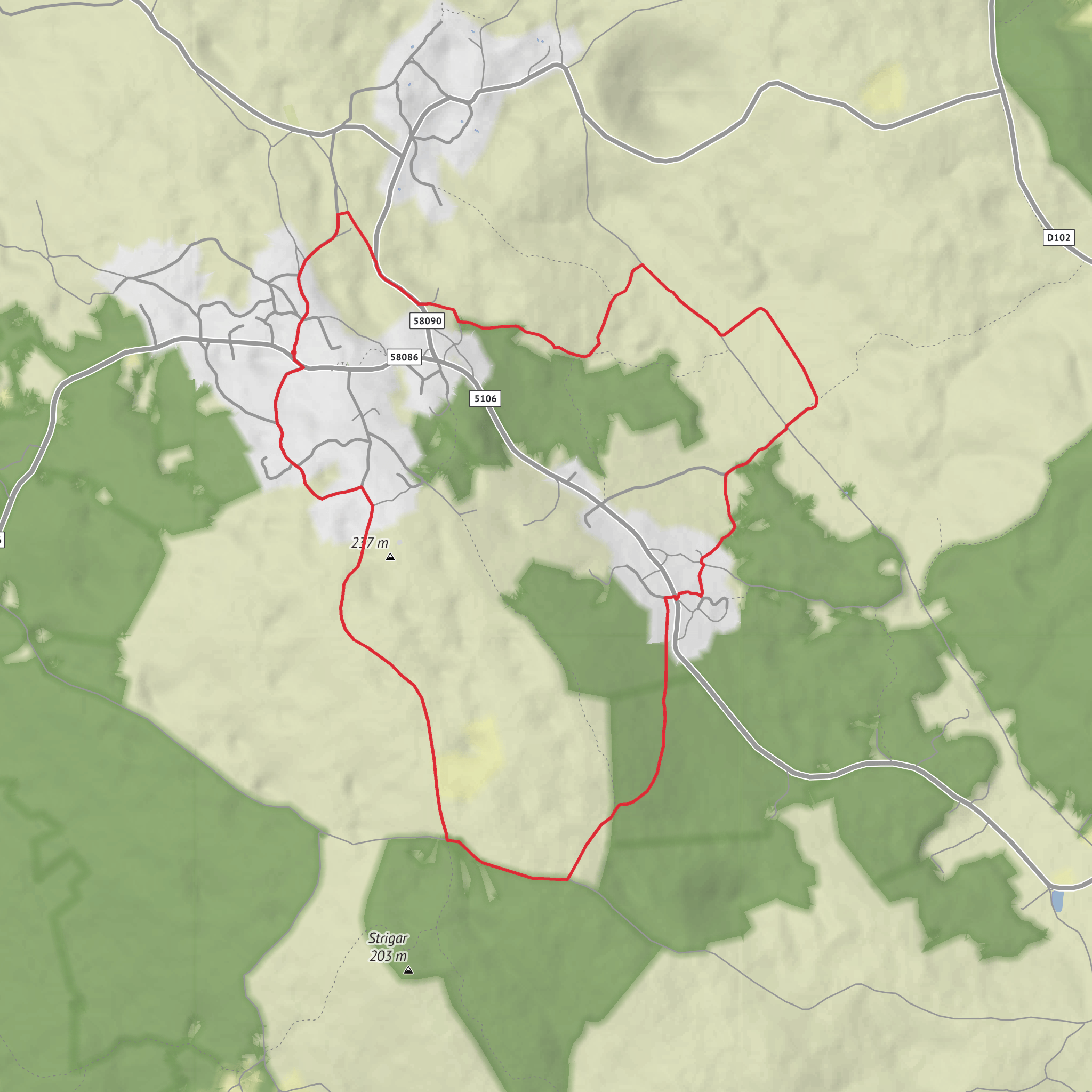
This easy loop explores the inland side of Krk Island around Vrh, combining quiet village lanes, farm tracks, low woodland, and open agricultural ground with a notable historic ruin at Salatići Castle. The route is about 7 km / 4.3 miles overall, and while your brief lists roughly 100 m / 328 ft of ascent, local trail information for this circuit is often given closer to 165 m / 541 ft, so hikers should expect a gently rolling walk rather than a completely flat one. (krk-outdoor.hr)
The walk starts and finishes in Vrh, with the signed trailhead associated with Busilak Street in the village. For practical navigation, the nearest clear landmark is the Parish Church of St. Michael in Vrh, 51500 Krk, which sits near the heart of the settlement and makes a sensible meeting point if you are arriving independently. (visitkrk.city)
From the outset, expect a rural landscape rather than dramatic mountain terrain. This is a mostly easy circular route through the Kaštel field and the settlement of Salatići, linking cultivated land, olive-growing country, patches of forest, and old stone-built hamlets. The footing is typically a mix of paved village surfaces, gravel or macadam farm tracks, and earth paths, so lightweight hiking shoes are usually enough in dry weather, though after rain some sections may feel slick or uneven. (visitkrk.city)
What the route feels like
The first part of the loop leads out through and beyond Vrh, a village in the inland area behind Krk Town. The terrain is gentle and open, with broad views over fields and low stone boundaries rather than sustained climbing. Because the elevation gain is modest, this is a good choice for families, casual walkers, or anyone wanting a shorter half-day outing. Even so, the exposed agricultural stretches can feel hot in summer, so carrying water and sun protection is important. (visitkrk.city)
As the route continues, it passes the remains of the Brajde hamlet and reaches the most distinctive landmark on the circuit: Salatići Castle. This large stone structure is almost entirely wrapped in ivy and stands out sharply against the surrounding farmland. Not much is definitively known about it, but local tourism sources describe it as a former country residence or estate building connected with Krk’s noble families. It is one of those landmarks that gives the walk a stronger sense of place than the mileage alone would suggest. (visitkrk.city)
Beyond the castle, the trail continues through Salatići and then into a more wooded section before returning toward Vrh. This middle-to-late part of the loop offers a little more shade and a change in texture after the open fields. The gradients remain mild, but hikers should still watch for loose stones, shallow ruts, and occasional rougher patches where farm and foot traffic have worn the surface. Using HiiKER to follow the loop is helpful, especially where tracks intersect near fields and village edges.
Landmarks, nature, and wildlife
The main visual highlights are the agricultural mosaic of the Kaštel field, the old hamlet remains near Brajde, and the ivy-covered Salatići Castle. Vrh itself also has cultural interest, especially around the Parish Church of St. Michael, which anchors the village and reflects the long-settled character of this part of Krk. (visitbaska.hr)
Nature here is subtle rather than wild. Expect olive groves, vineyards, fig trees, dry-stone boundaries, scrub, and pockets of woodland typical of the island’s inland Mediterranean environment. Birdlife is often the most noticeable wildlife, especially around field margins and quieter wooded stretches, while lizards and insects are common in warmer months. Because much of the route passes through cultivated and semi-cultivated land, hikers should stay on marked paths, leave gates as found, and be mindful of farm activity.
Historical significance of the area
This walk is a good introduction to the inland heritage of Krk, where agriculture, noble estates, and village life have shaped the landscape for centuries. Salatići Castle is the clearest historic feature on the route and is generally thought to have served as a rural residence or estate center for Krk nobility. That fits the broader history of the island, where aristocratic families, church institutions, and farming communities all left their mark on the land. (visitkrk.city)
Vrh and the surrounding settlements are also tied to Krk’s food heritage. Local sources highlight the area for olives, wine, and especially Krk prosciutto, a product with protected status at
Surfaces
Unknown
Asphalt
Gravel
Ground
Comments and Reviews
User comments, reviews and discussions about the Vrh and Salatic Castle Loop, Croatia.
average rating out of 5
0 rating(s)

