
Download
3D Flyover
Add to list
More
6.7 km
~1 hrs 47 min
263 m
Loop
“A rugged Krk coastal loop threads turquoise coves, sun-bleached rock, and haunting traces of mining history.”
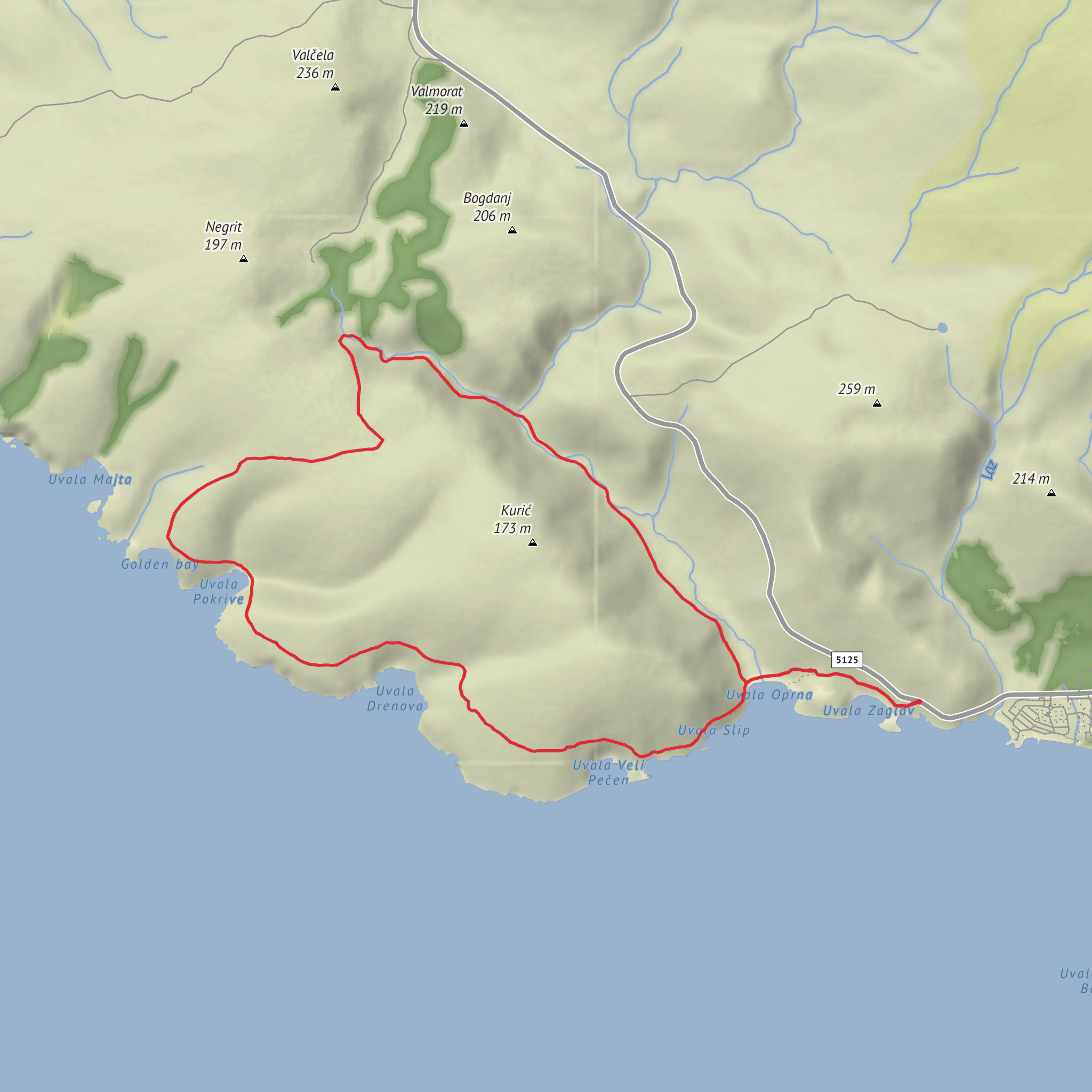
This medium-rated coastal loop on the southwest side of Krk Island packs a lot into roughly 6.6–7 km / 4.1–4.3 miles, with about 300 m / 984 ft of elevation gain. The route is commonly described as starting at Škrila Campsite near Stara Baška, Croatia, then looping out toward Oprna Bay, a string of smaller coves, the old bauxite workings above the coast, and the panoramic high point at Velo Čelo before returning toward the start. (krk-outdoor.hr)
The first part of the walk heads toward Oprna Beach (Uvala Oprna), one of the best-known coves on Krk. Expect a steep, rocky descent early on, with loose stone, low scrub, and very little shade. Although the mileage is modest, the terrain makes the outing feel more serious than the numbers suggest, especially in heat or after rain when polished rock can become slippery. Good footwear matters here, and hikers should be prepared for short sections where careful foot placement is more important than pace. (krk-outdoor.hr)
Terrain, route character, and what to expect
After Oprna, the loop continues along a rugged stretch of coast toward smaller coves including Mali Pečen, Veli Pečen, Drenova, Pokriva, and Lišičak. This is a distinctly karst landscape: pale rock, sparse Mediterranean vegetation, steep slopes above clear water, and repeated sea views across the Kvarner Gulf. The path alternates between narrow coastal tread, rocky traverses, and climbing sections that gain height above the bays. Because the route is exposed, sun protection and extra water are essential even outside midsummer. Spring and autumn are generally considered the best seasons for this trail. (krk-outdoor.hr)
The climb to Velo Čelo is the main uphill effort of the day and the point where the route’s total ascent is most noticeable. From there, the trail opens to broad views over the Adriatic, the indented coastline near Stara Baška, and the stark cliffs dropping toward the sea. On a clear day, this section feels much bigger than a short loop because the terrain is so open and the sea horizon so dominant. (krk-outdoor.hr)
Navigation should be straightforward for prepared hikers, but this is not a stroll on manicured paths. Carry the route in HiiKER, and allow extra time for photo stops, slower movement on loose rock, and possible beach detours. Even strong walkers may move more slowly than expected on the descent and on the rougher coastal sections.
Landmarks, nature, and wildlife
The standout landmarks are the coves themselves and the old bauxite mine cavities visible in the rock above the coast. These remnants give the route its identity and break up the beach-and-cliff scenery with something more unusual and historically layered. Oprna is the most famous stop, but many hikers find the lesser-known pebble coves just as memorable because they feel more secluded and wilder. (krk-outdoor.hr)
Vegetation is typical of a dry Adriatic coastal slope: low shrubs, hardy grasses, and scattered patches of scrub adapted to wind, salt, and sun. Wildlife is usually more subtle than dramatic, but hikers should watch for seabirds riding the thermals, lizards warming on stone, butterflies in the warmer months, and occasional goats or sheep in the broader Baška–Stara Baška landscape, where pastoral traditions have long shaped the terrain. The open rock also means very little shelter from bora winds when they blow, so conditions can feel harsher than the forecast suggests.
Historical significance of the area
This loop is especially interesting because it combines coastal scenery with traces of Krk’s mining past. Local historical sources describe bauxite extraction here around the time of World War I, and records cited by the Krk outdoor trail authority note that more than 250 islanders worked in the mines. In a period of economic hardship, the mines were an important source of income for local families; accounts also note that the workforce included not only men, but women and children. Those details give the abandoned openings above the coves a sobering context and make this more than just a scenic beach walk. (krk-outdoor.hr)
More broadly, the route sits within the long cultural landscape of Krk Island, one of the historic islands of the northern Adriatic, with deep links to Croatian heritage, maritime life, dry-stone pastoralism, and the nearby Baška area’s famous Glagolitic tradition. The wider Baška region is particularly important in Croatian cultural history because of the Baška Tablet and the
Comments and Reviews
User comments, reviews and discussions about the Bauxite Mines Loop via Uvala Oprna and Golden Bay, Croatia.
average rating out of 5
0 rating(s)

