
Download
3D Flyover
Add to list
More
62.3 km
2 days
497 m
Multi Day
“A windswept ribbon of dunes, beaches, and big sky, rich in wild texture and quiet contrast.”
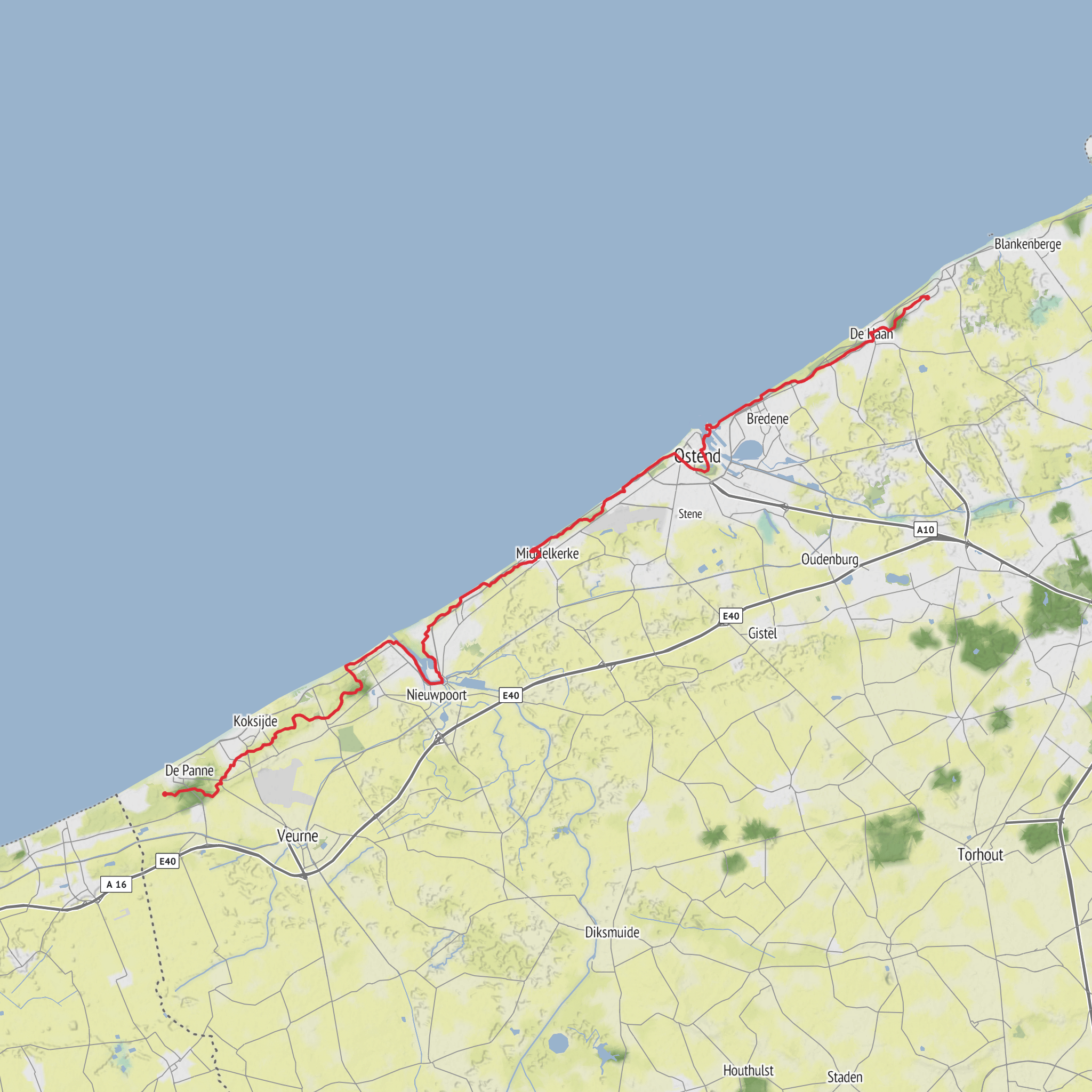
This 62 km / 38.5 mi stretch of the E9 in Belgium is a coastal long-distance walk through the dune country of De Panne and the western Belgian shore, where the landscape is defined less by steep climbing and more by wind, sand, open sky, and long undulating terrain. Although you’ve listed the elevation gain at around 500 m / 1,640 ft, that fits the feel of the route better than some online track files that appear to overcount short dune rises; on the ground, hikers should expect frequent small climbs and descents rather than any sustained ascent. The route is generally considered easy in technical terms, but the distance makes it a full-day challenge or a comfortable 2-day outing for most walkers. The Belgian E9 is part of the much longer European Coastal Path, which follows the Atlantic, North Sea, and Baltic coasts across Europe. (groteroutepaden.be)
The most useful start landmark for planning is De Panne, on Belgium’s far western coast near the French border. One commonly referenced access point for the dune section is the Duinpanne Visitor Centre, Olmendreef 2, 8660 De Panne, Belgium, which sits beside the Westhoek dune reserve and is a practical place to orient yourself before setting out. Some route listings also describe this Belgian E9 segment as beginning from or around De Panne and treat it as a coastal section of roughly 62.2 km / 38.7 mi. (depanne.be)
What the walk feels like
Expect a route of broad contrasts rather than dramatic mountain scenery. One hour you may be crossing open beach or firm promenade, the next weaving through dune hollows, scrub, and sandy tracks where progress slows noticeably. The highest ground is modest by any standard, but the repeated dune rollers add up over the day. In dry weather, loose sand is the main energy drain; in windy weather, exposure becomes the bigger factor. Even on an “easy” route, 62 km / 38.5 mi beside the North Sea can feel much harder if there is a headwind for long stretches.
The western end around De Panne is one of the most natural-feeling parts of the Belgian coast. Here the trail passes through or beside extensive dune systems, with a more rugged and spacious character than the built-up resort sections farther along the shoreline. As you continue, the route alternates between protected nature areas, coastal settlements, sea walls, beaches, and access paths linking one section of coast to the next. That mix makes the walk logistically friendly, but it also means surfaces can change often: compact sand, loose sand, paved seafront, boardwalk, and dirt path can all appear in the same day. (visit.depanne.be)
Landmarks, nature, and wildlife
The standout natural landmark is De Westhoek Nature Reserve in De Panne, a 340-hectare protected dune landscape and the oldest nature reserve in Flanders, established in 1957. It contains foredunes, mobile dunes, parabolic dunes, dune slacks, grey and white dunes, dune grassland, and calcareous marsh habitat, which gives this section far more ecological variety than many hikers expect from a coastal route. Archaeological remains from the Iron Age to the early Middle Ages have also been found here, adding real historical depth to what might otherwise seem like pure scenery. (visit.depanne.be)
Another notable feature near the start is Calmeynbos, a dune woodland planted in the early 20th century. It was part of an effort to stabilize drifting sand near the coast, and today it creates a striking contrast with the open dunes: more shelter, more birdsong, and a softer, greener feel underfoot. (depanne.be)
Wildlife is typical of North Sea dune and marsh environments. Hikers should watch for shorebirds, gulls, waders, and smaller songbirds in scrub and woodland edges. In wetter dune slacks and marshy pockets, amphibians and invertebrates are common, while rabbits are often among the most visible mammals in dune country. Seasonal wildflowers can be excellent in the dune grasslands, especially when the grey dunes are at their most botanically rich. Because these are sensitive habitats, staying on the marked line is especially important in reserve sections. The local authorities also note that dogs are not permitted in some protected areas along the coastal GR/E9 corridor, including parts of Westhoek, Noordduinen,
AI Planner
Days planned around your pace, with somewhere to stay each night.
Comments and Reviews
User comments, reviews and discussions about the E9 Belgium, Belgium.
average rating out of 5
0 rating(s)


