
Download
3D Flyover
Add to list
More
94.5 km
5 days
1004 m
Multi Day
“Stitch together gentle days through Mallorca’s quiet east—almond groves, dry-stone walls, and welcoming villages.”
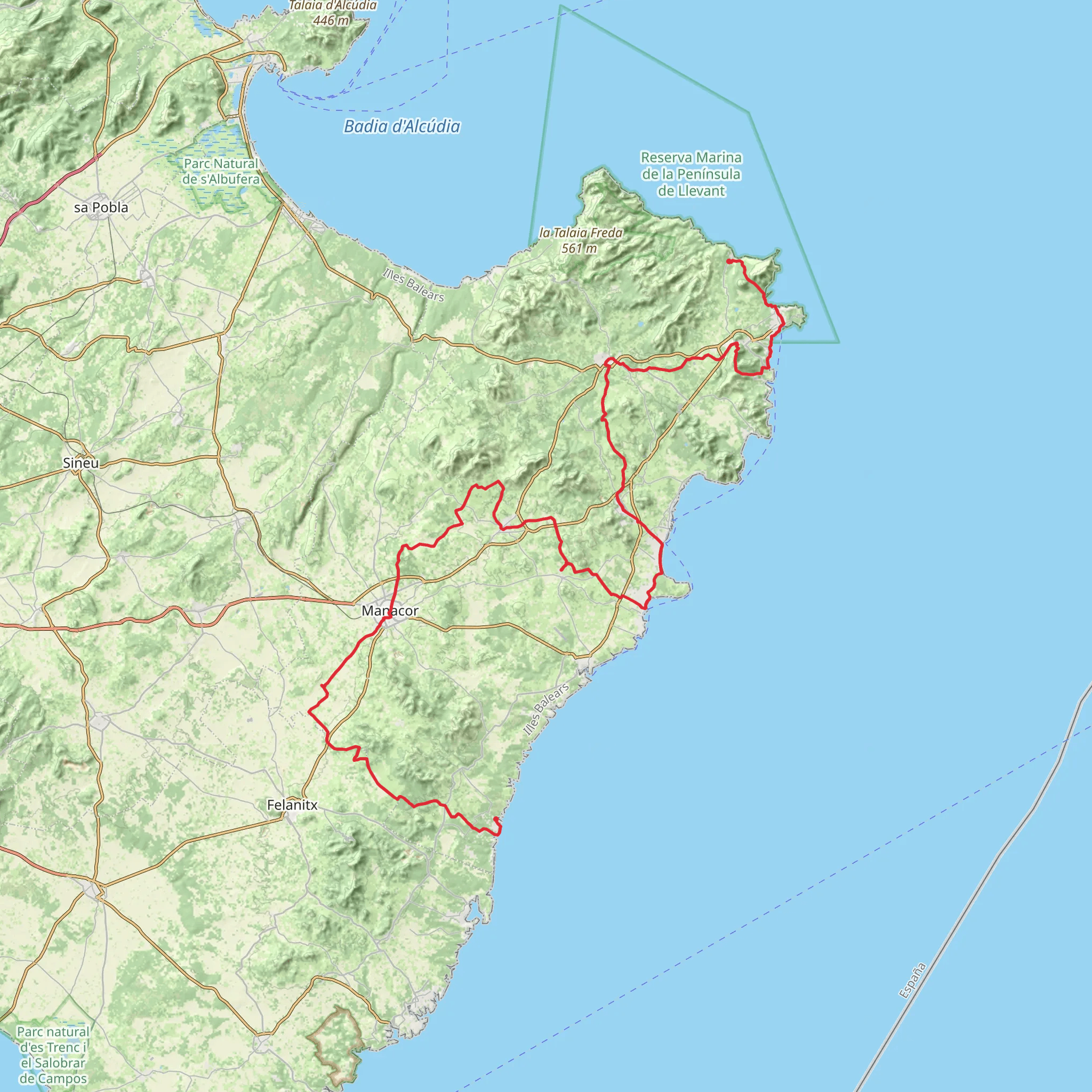
This is a low-commitment, mostly low-gradient long-distance walk across the quieter, rural side of Mallorca, linking small towns, agricultural valleys, and low hills rather than the island’s high Serra de Tramuntana. Over roughly 94 km (58 mi) with about 1,000 m (3,280 ft) of total ascent, expect a route that feels more like a sequence of comfortable day-walks stitched together—often on farm tracks, quiet lanes, and historic footpaths—with frequent opportunities to resupply in villages.
Because the start point in your details is listed only as “near” (with no coordinates), I can’t convert a lon/lat to a specific nearby address or landmark yet. If you share the start lon/lat (or the first town/waypoint), I’ll pin it to the nearest recognizable place (e.g., a station, church square, or trailhead landmark) and tailor the “getting there” directions precisely.
Getting to the start (general, Mallorca)
By public transport (most common approach): - Mallorca’s bus network (TIB) connects Palma with most towns on the east side. A typical strategy is to travel to the nearest major town on the route (often places like Manacor, Artà, Son Servera, Sant Llorenç des Cardassar, or Capdepera, depending on the exact alignment) and then use a local bus/taxi for the final hop if the trailhead is outside the center. - If your start is near a rail-served town, Mallorca’s train network runs from Palma Intermodal Station toward the central/eastern corridor (with transfers to buses for many coastal/east destinations).
By car: - From Palma, the fastest access to the east is usually via the Ma-15 toward Manacor and onward on local roads. Parking is generally easiest if you leave the car in a larger town (more long-stay options) and use public transport to return at the end, rather than trying to arrange a point-to-point car shuffle.
If you tell me your intended start and finish towns, I can suggest the cleanest “car at one end, bus back” plan.
What the walking is like (underfoot, gradients, and pacing)
With an “Easy” feel overall, the challenge here is less about steepness and more about distance management and sun/wind exposure. The east of Mallorca tends to give you: - Long, steady sections on compacted dirt, gravel farm roads, and occasional paved lanes. - Short, punchy rises over low ridges rather than sustained climbs. - Frequent gates and property boundaries typical of Balearic countryside—expect to slow down a bit for opening/closing gates and staying on the correct line.
A comfortable plan for many hikers is 3–5 days, averaging:
- 19–31 km/day (12–19 mi/day)
Daily ascent often feels modest, roughly 150–350 m/day (490–1,150 ft/day) depending on how the stages break.
Navigation is usually straightforward, but don’t rely on “it’s easy so I can wing it.” Use HiiKER to keep an eye on junction density near towns and to confirm you’re on the correct farm track when multiple parallel lanes appear.
Landscapes, landmarks, and the feel of the region
Eastern Mallorca is defined by dry-stone walls, almond and carob groves, fig trees, and broad agricultural plains broken by low hills and occasional wooded patches. You’ll pass through a lived-in landscape—fields, fincas, and small settlements—where the “landmarks” are often cultural rather than dramatic peaks.
Depending on the exact alignment of GR 226 you’re following, significant points commonly include: - Traditional villages and parish churches anchoring town centers—useful for water, shade, and a predictable place to regroup. - Dry-stone architecture: boundary walls, terraces, and old track engineering that reflect centuries of land management in a water-limited environment. - Historic estates (possessions) and rural lanes that often trace older movement corridors between communities.
Nature and wildlife to look out for
Wildlife sightings are usually subtle rather than spectacular, but rewarding if you’re attentive: - Birdlife is the standout: kestrels and other raptors over open fields; small songbirds in hedgerows; and, near wetter pockets, occasional waders. - Mediterranean scrub (maquis/garrigue) appears on poorer soils and hillier sections—aromatic plants and hardy shrubs adapted to heat and wind. - In warmer months, reptiles (small lizards) are common on sunny walls and tracks.
Be mindful that much of the east can feel exposed—shade can be scarce between towns, and wind can increase dehydration even when temperatures feel mild.
Historical significance (what you’re walking through)
Mallorca’s countryside is layered with history, and even when the trail isn’t explicitly “archaeological,” you’re moving through a landscape shaped by: - Long-term agriculture: terraces, wells/cisterns, and field boundaries reflect generations of water capture and soil conservation. - Settlement patterns: towns spaced at practical walking distances, historically tied together by footpaths and cart tracks—many modern routes still follow these older lines. - Coastal defense and watchfulness (where the route nears the coast): parts of Mallorca’s history include periods of maritime threat, which influenced where people lived and how they moved between inland and shore.
If you share the exact towns/waypoints on your GR 226 variant, I can call out the most relevant local
Surfaces
Unknown
Asphalt
Gravel
Ground
Sand
Concrete
Cobblestone
Wood
Dirt
Unpaved
Comments and Reviews
User comments, reviews and discussions about the East Mallorca GR 226, Spain.
average rating out of 5
0 rating(s)



