Download
3D Flyover
Add to list
More
866.7 km
47 days
22261 m
Multi Day
“From rolling Borders to Cape Wrath’s wild cliffs, this epic trail weaves Scotland’s landscapes and legends.”
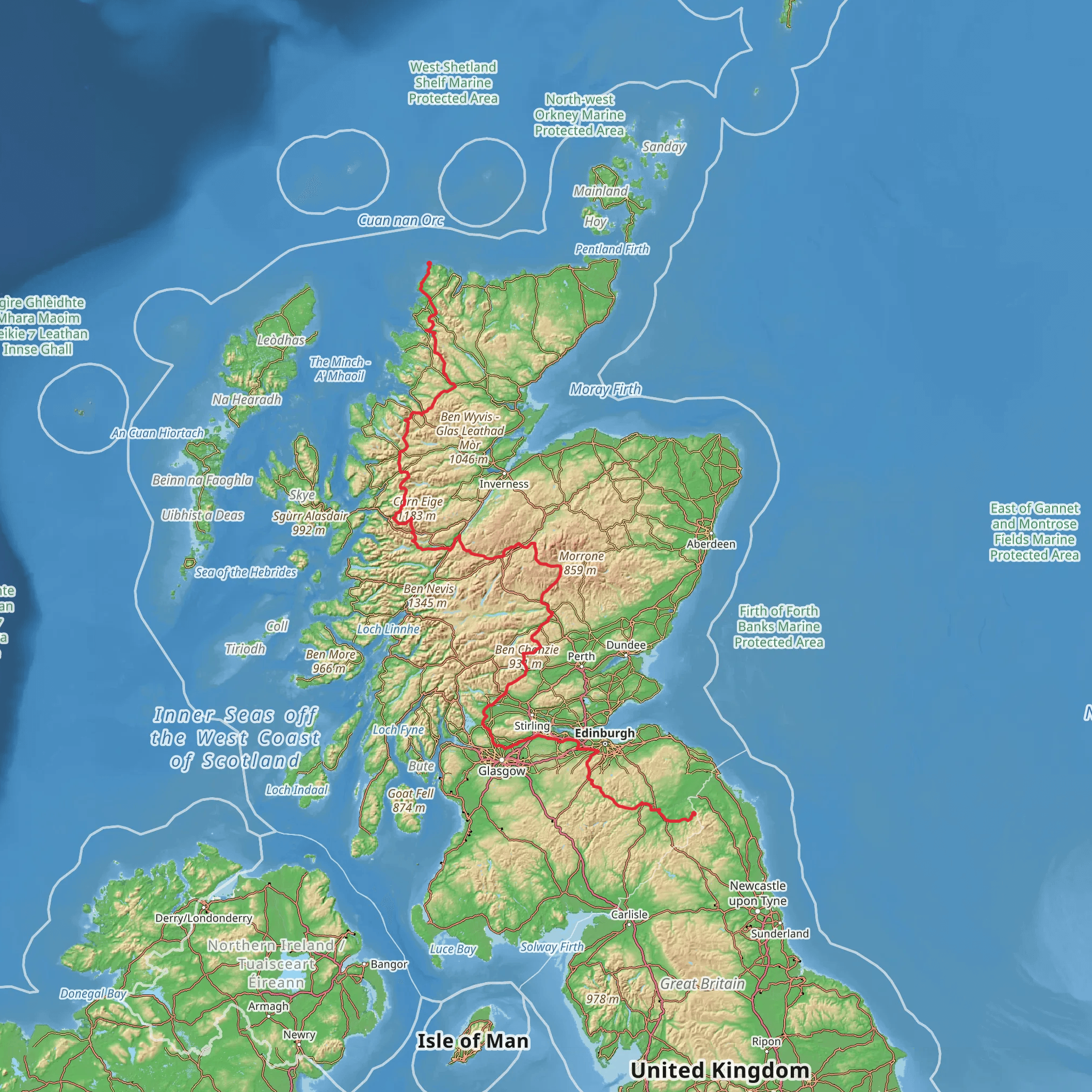
Starting near Kirk Yetholm, a small village in the Scottish Borders, the journey northward covers approximately 867 km (539 miles) with a total elevation gain of about 22,300 metres (73,160 feet). The route is a point-to-point adventure, ending at Cape Wrath, the remote northwestern tip of mainland Scotland. The trail is estimated to be of medium difficulty, but the sheer length and varied terrain demand solid preparation and stamina.
Getting There
Kirk Yetholm is accessible by public transport from Edinburgh or Newcastle. Take a train to Berwick-upon-Tweed, then a local bus to Kelso, and finally a taxi or local bus to Kirk Yetholm. For those driving, parking is available in the village, but arrangements for return transport from Cape Wrath are essential, as it is extremely remote.
Trail Overview and Key Sections
The route traverses a diverse range of landscapes, from rolling farmland and river valleys in the Borders, through the dramatic peaks and lochs of the Highlands, to the wild, windswept coast at Cape Wrath. Early sections follow the River Tweed, passing through Melrose, home to the historic Melrose Abbey, a burial site of Scottish kings and the heart of the Borders’ medieval history.
Loch Lomond and The Trossachs National Park
Around 240 km (150 miles) into the journey, the trail enters Loch Lomond and The Trossachs National Park. Here, hikers encounter ancient woodlands, sparkling lochs, and rugged hills. The path skirts the eastern shore of Loch Lomond, offering views of Ben Lomond and the Arrochar Alps. Wildlife is abundant—red deer, ospreys, and pine martens are commonly spotted. The terrain becomes more challenging, with steep ascents and rocky paths, especially near the loch’s northern reaches.
Cairngorms National Park
At approximately 500 km (310 miles), the trail enters Cairngorms National Park, the UK’s largest national park. This section is characterized by vast heather moorlands, ancient Caledonian pine forests, and high mountain plateaus. The route passes close to Aviemore, a well-known outdoor hub, and continues through remote glens and over high passes, including the Lairig Ghru, a dramatic mountain pass flanked by granite peaks. Weather can be unpredictable, with snow possible even in late spring, so proper gear is essential.
Navigation and Safety
The trail is not always waymarked, especially in the more remote northern sections. Reliable navigation is crucial—download detailed maps and GPX files from HiiKER before setting out. Mobile signal can be patchy, particularly in the Highlands and near Cape Wrath, so carry a compass and know how to use it.
Historical and Cultural Highlights
The route is steeped in Scottish history, passing sites such as the ruins of Ruthven Barracks near Kingussie, built after the Jacobite uprising, and the battlefield of Culloden near Inverness. Traditional villages like Pitlochry and Blair Atholl offer a glimpse into Highland culture, with opportunities to visit distilleries and sample local whisky.
Final Stages to Cape Wrath
The last stretch from Kinlochbervie to Cape Wrath is among the wildest in Britain. The path crosses peat bogs, moorland, and rugged cliffs, with the Atlantic Ocean in view. The Cape Wrath Lighthouse marks the end of the journey, accessible only by a seasonal ferry and minibus, or on foot. This remote headland is a haven for seabirds, including puffins and fulmars, and offers dramatic views over the sea.
Wildlife and Nature
Throughout the trail, expect encounters with Scotland’s iconic wildlife—red squirrels, golden eagles, and, in the far north, the elusive Scottish wildcat. Heather blooms in late summer, painting the hills purple, while autumn brings vibrant foliage and rutting deer.
Preparation and Logistics
Given the length and remoteness of the trail, careful planning is vital. Resupply points are spaced far apart in the Highlands, so plan food and water carefully. Accommodation ranges from hostels and B&Bs in villages to wild camping in remote areas—Scotland’s right-to-roam laws allow responsible wild camping. Weather is highly variable; waterproofs and warm layers are essential year-round.
The Scottish National Trail offers a unique journey through the heart of Scotland, blending natural beauty, wildlife, and centuries of history.
AI Planner
Days planned around your pace, with somewhere to stay each night.
What to expect?
Comments and Reviews
User comments, reviews and discussions about the Scottish National Trail, Scotland.
4.45
average rating out of 5
20 rating(s)