
Download
3D Flyover
Add to list
More
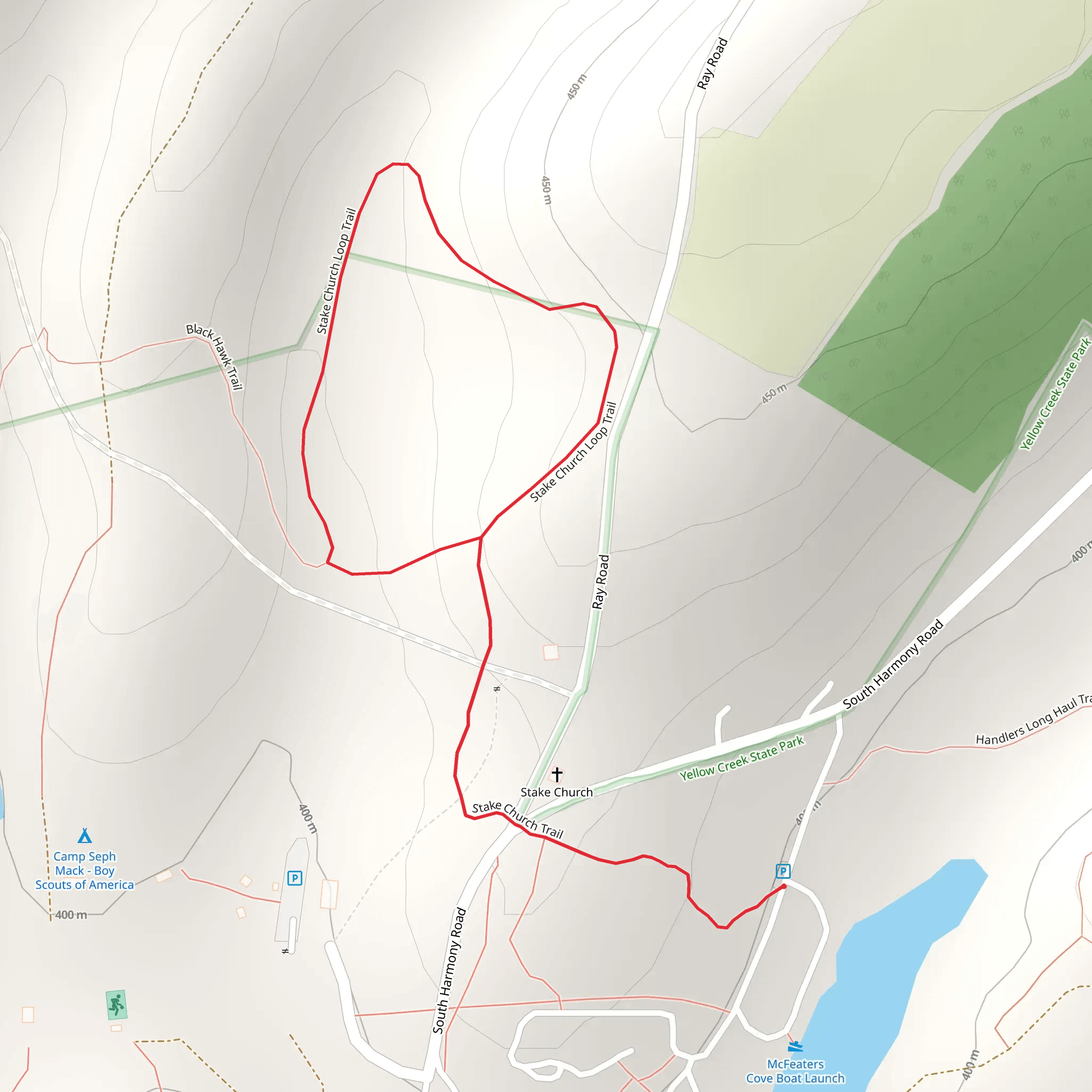
2.1 km
~31 min
63 m
Loop
“A short, punchy loop to a churchside high point—stone, birdsong, and a climb that bites.”
I’m missing a few key specifics to make this accurate (there are multiple “Stake Church” places/trails worldwide), and you didn’t include the coordinates after “near”. Paste either a lon/lat for the trailhead (or a HiiKER link), and I’ll convert it to the nearest known address/landmark and tailor the route description precisely.
In the meantime, here’s a planning-grade description for a ~2 km / ~1.2 mi loop with ~100 m / ~328 ft gain that you can use as a template—once you send the location, I’ll replace the access, landmarks, hazards, and history with the correct local details.
You’re looking at a short loop that feels “medium” because the climbing is concentrated: ~100 m (328 ft) over ~2 km (1.2 mi) means you’ll hit at least one sustained pitch where the grade noticeably bites, especially if the trail is rocky, rooty, or muddy. Most hikers will take 45–90 minutes depending on stops and footing.
Expect the route to start gently for the first 0.3–0.5 km (0.2–0.3 mi) as you leave the parking/approach area and settle into the main path. The climb typically builds through the middle of the loop, then you’ll get a short high point (often a viewpoint, ridge, or open patch near the church/heritage feature), followed by a quicker descent back to the start.
What the terrain usually feels like on a 2 km / 100 m loop
- Underfoot: commonly a mix of compact dirt, short rocky steps, and occasional slick sections (leaf litter, pine needles, or clay). If it’s a church/heritage loop, there’s often a stone path, old track, or worn footway near the landmark.
- Steep bits: the “medium” rating usually comes from one of these:
- a short, steep pull of 0.2–0.4 km (0.1–0.25 mi) gaining most of the elevation, or
- a rolling profile with repeated little ramps that add up.
- a short, steep pull of 0.2–0.4 km (0.1–0.25 mi) gaining most of the elevation, or
- Trail width: often narrow singletrack with brief wider sections where old access tracks or maintenance paths exist.
Landmarks and points of interest you’ll likely encounter
If this loop is named for a church, the route usually includes at least one of the following: - The church itself or its grounds (active church, historic chapel, or ruins). These areas can have uneven stonework, low walls, and old grave markers—watch footing and be respectful of boundaries. - A viewpoint or open clearing near the high point (common where churches were placed for visibility or on slightly raised ground). - Old boundary features like stone walls, stiles, or hedgelines that hint at historic land division.
Once you provide the location, I’ll add the specific historical context (e.g., settlement patterns, parish boundaries, local building stone, or any notable events tied to the site).
Nature and wildlife to watch for
This depends heavily on where “Stake Church” is, but on short heritage loops you commonly see: - Birdlife: songbirds in hedgerows/wood edges; raptors if there’s open country nearby. - Mammals: deer in wooded margins; rabbits/hares in open grass; foxes more often at dawn/dusk. - Seasonal hazards: ticks in long grass and bracken; wasps around stone walls in late summer; slippery algae on shaded rock/stone in damp seasons.
If you share the region, I’ll tailor this to the exact local species and any protected habitats.
Navigation and wayfinding (using HiiKER)
Because short loops often have multiple intersecting footpaths, plan to: - Download the route in HiiKER before you arrive (offline if coverage is patchy). - Watch for the mid-loop junction where many hikers accidentally take the wrong spur—this is usually around 0.8–1.2 km (0.5–0.75 mi) into a 2 km loop. - If the loop can be walked either direction, choose the direction that puts the steepest section uphill (more secure than descending steep, loose ground).
What to pack for a “short but punchy” medium loop
- Footwear: shoes/boots with solid tread—100 m (328 ft) of gain can mean slick, stepped climbing.
- Layers: even on a short hike, wind at a small high point can feel sharp.
- Water: at least 0.5 L (more if warm/humid).
- Rain plan: a light shell; short trails can still be miserable if you’re exposed and wet.
- If it’s a church/heritage site: consider that paths may be stone-set, polished, or muddy from foot traffic.
Getting to the start (car + public transport)
I can’t give accurate directions without the trailhead location, but here’s how I’ll format it once you send lon/lat: - By car: nearest drivable access point, typical parking situation (formal lot vs roadside pull-in), and any common restrictions (gates, limited spaces, seasonal closures). - By public transport: nearest bus/train stop, approximate walk distance to the trailhead, and any “last-mile” considerations (no sidewalks, narrow lanes, etc.).
Converting lon/lat to a nearby address/landmark
Send the coordinates in any of these formats and I’ll convert them to the nearest known address or significant landmark:
- 41.40338, 2.17403
- `lat 41
Surfaces
Dirt
Unknown
Comments and Reviews
User comments, reviews and discussions about the Stake Church Loop Trail, Pennsylvania.
average rating out of 5
0 rating(s)
