
Download
3D Flyover
Add to list
More
13.6 km
~2 hrs 43 min
0 m
Loop
“Drift through Dutch polder lanes—reeds whispering, birds wheeling, and wide skies inviting unhurried pauses.”
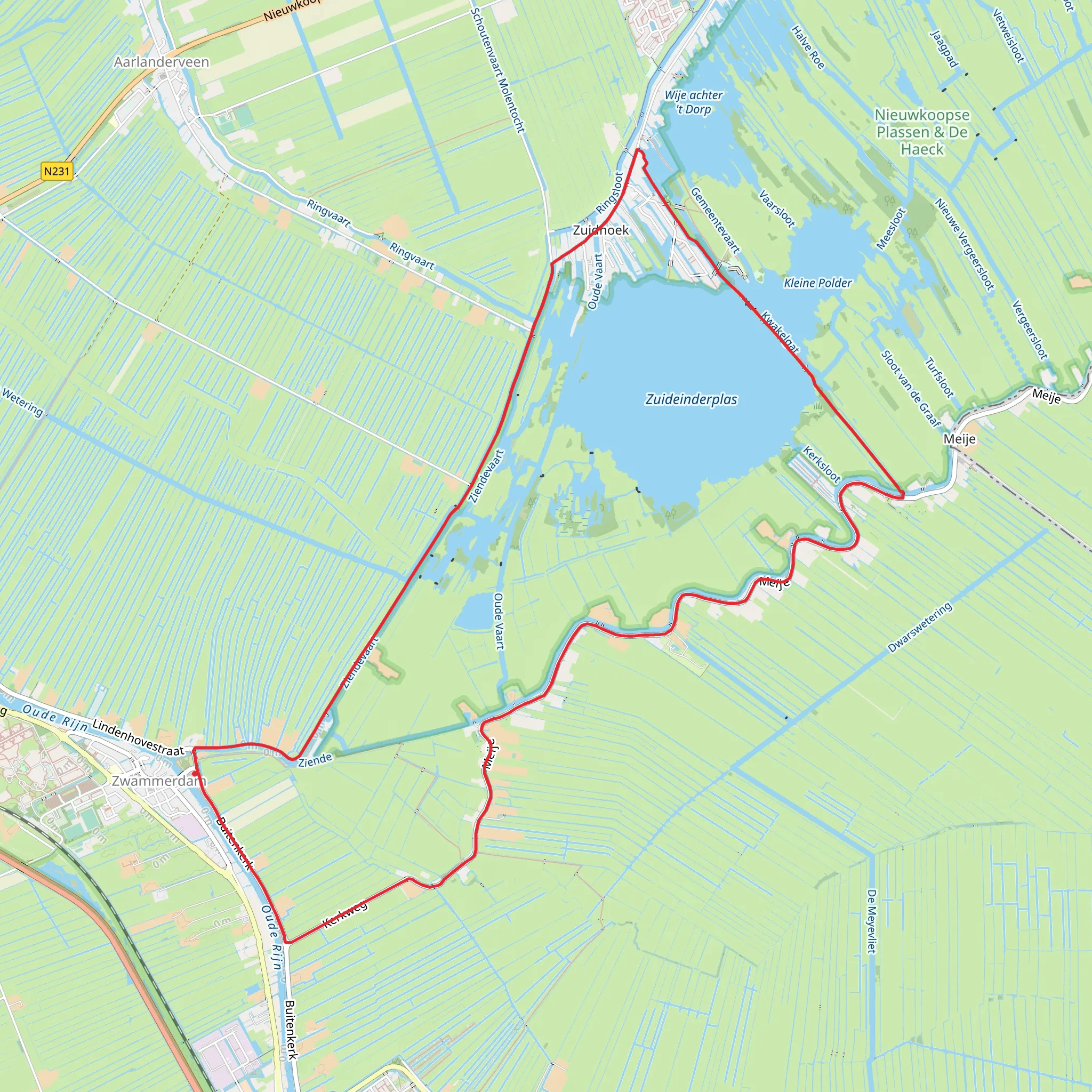
A relaxed, mostly level loop through classic Dutch polder scenery that links quiet farm lanes, reed-fringed water, and open skies. At roughly 14 km / 8.7 mi with about 0 m / 0 ft of climbing, it’s well-suited to a steady half-day walk, with plenty of spots to pause near the water and watch birds.
Getting to the start (public transport + car)
Because the start point is only given as “near” (no town, coordinates, or trailhead name beyond the route title), the most reliable way to plan transport is to anchor your start at a recognizable access point close to Zuideinderplas and the Meijepad corridor. If you share a lon/lat (or a HiiKER link), I can convert it to the nearest known address/landmark and tailor the directions precisely.
- By car: Plan to park near a formal access point to Zuideinderplas (look for signed recreation/parking areas by the water). In this region, parking is often in small designated lots rather than roadside pull-offs; arrive earlier on weekends if the lake is a popular local spot.
- By public transport: The most common pattern in the Netherlands is train to the nearest station serving the surrounding villages, then a short bus ride and/or walk to the lake access. When you identify the exact start landmark (parking area, beach access, or a named trail entrance), you can use that as the destination for route planners and then confirm the final approach on HiiKER.
What the route feels like underfoot
Expect a mix of: - Paved and brick farm roads (easy footing, but more exposure to wind) - Gravel or compacted paths along water edges and through reedbeds - Occasional narrower track sections where vegetation can lean in during the growing season
With essentially no elevation change, the main “effort” comes from distance, wind, and surface variety rather than hills. If it has rained recently, the softer edges of paths near reeds and drainage ditches can be slick—especially where the ground transitions from firm track to grassy verge.
Navigation and wayfinding (keep it simple)
This is the kind of landscape where everything looks deceptively similar—straight lines, canals, and parallel tracks—so it’s easy to take the “right-looking” lane that runs in the wrong direction. - Use HiiKER to keep an eye on junction spacing and to confirm you’re on the correct side of any canal or drainage channel. - Watch for bridges and culverts as key decision points: in polder terrain, the correct route often hinges on crossing at the right place rather than following the most obvious straightaway.
Along the water: Zuideinderplas character and wildlife
As you approach and trace the edges of Zuideinderplas, the scenery typically shifts from open agricultural views to a more sheltered lakeside feel: - Reedbeds and wet margins that act as nurseries for fish and amphibians - Open water that draws waterfowl and waders - Willow and low scrub in places, offering pockets of shade and calmer air
Wildlife you’re likely to notice (season-dependent): - Waterfowl such as ducks, geese, and coots; in migration periods, numbers can increase dramatically. - Marsh and reed-edge birds—listen for calls from within the reeds even when you can’t see the birds. - Raptors (often seen quartering fields) taking advantage of the open terrain. - In warmer months, expect insects near still water; a light layer and repellent can make breaks more comfortable.
If parts of the shoreline are managed for habitat protection, you may encounter seasonal restrictions or requests to stay on the main path—these are common around sensitive nesting areas.
The Meijepad section: quiet lanes and polder geometry
The Meijepad portion typically delivers the “Dutch lowland” essentials: - Long, straight sightlines - Drainage ditches and canals defining field boundaries - Farm activity and occasional local traffic
Even on an easy walk, this is where you should be most alert: - Cyclists and e-bikes can be fast and quiet on shared paths. - Farm vehicles may use narrow lanes; step onto the verge only where it’s firm (ditch edges can crumble). - Wind exposure can be significant—on a breezy day, the return leg can feel longer than the distance suggests.
Landmarks and regional context (why the landscape looks like this)
The broader area around lakes like Zuideinderplas and the surrounding polders reflects centuries of Dutch water management—drainage, dikes, and controlled water levels shaping where people could farm and settle. Many “plas” lakes in the Netherlands are tied to historical land use (often peat extraction or sand/gravel winning in some regions) and later became recreation and nature areas. The result is a landscape where human engineering and wetland ecology sit side by side: straight canals and field grids next to reedbeds and open water that support birdlife.
Practical planning: what to bring and what to watch for
- Time on feet: 14 km / 8.7 mi is commonly 3–4 hours of walking time depending on pace and stops.
- Footwear: Light hiking shoes or sturdy walking shoes are ideal; consider something with decent grip if you expect muddy edges near reeds.
- Wind/rain layers: With little shelter in open polder sections, a packable shell matters more than you’d think for an “easy” route
Surfaces
Unknown
Concrete
Asphalt
Comments and Reviews
User comments, reviews and discussions about the Zuideinderplas via Meijepad, Netherlands.
average rating out of 5
0 rating(s)


