Download
3D Flyover
Add to list
More
14.5 km
~2 hrs 55 min
15 m
Loop
“Drift around Doldersum’s big-sky heath and whispering pines on a gentle, sandy loop.”
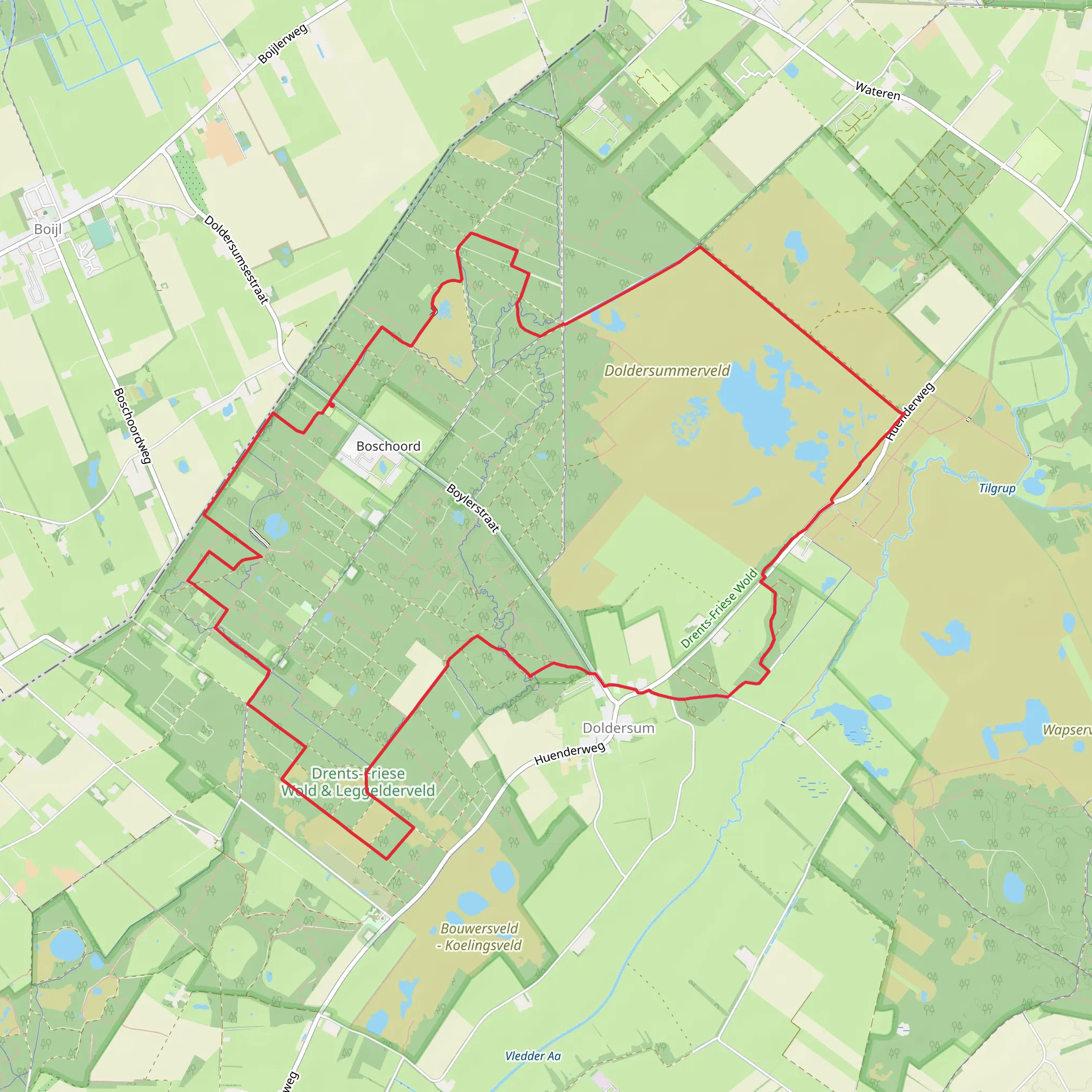
This easy, mostly level loop of about 15 km (9.3 miles) is ideal for a relaxed day in the Drents-Friese Wold region, where wide sandy tracks, heathland edges, and quiet forest lanes stitch together the open fields around Doldersum and the Vrouwenveld area. Expect minimal elevation gain—around 0 m (0 ft) overall, with only gentle, barely-noticeable undulations typical of glacially shaped northern Dutch landscapes.
Getting to the start (car + public transport)
Because your start point is listed only as “near” (no coordinates provided), the most practical “nearest known landmark” to anchor planning is Doldersum village (near Westerveld, Drenthe, Netherlands)—a common access point for loops that include Vrouwenveld.
- By car: Aim for Doldersum (village center) and look for parking near local trail access points on the edge of the village where forest and field tracks begin. In this area, parking is typically small and informal—arrive earlier on weekends to avoid full pull-ins.
- By public transport: The closest rail hubs are usually in the wider Meppel / Steenwijk area, with onward bus connections toward Westerveld villages. From the nearest bus stop, you may need a short walk (often 1–3 km / 0.6–1.9 miles) to reach the start of the loop depending on the exact stop and routing that day. Check current schedules close to your travel date and plan for limited service frequency in rural Drenthe.
If you share a lon/lat for the trailhead (or a HiiKER link), I can pin it to the nearest named road, parking area, or landmark and tailor the approach directions precisely.
What the route feels like underfoot
You’ll likely alternate between:
- Firm gravel and compacted sand tracks (easy walking, good for steady pacing)
- Short grassy or sandy stretches near field margins and heath edges (can be softer after dry spells)
- Forest lanes with occasional roots and shallow puddling after rain
Because the terrain is flat, the main “effort” factor is usually distance and wind exposure across open sections rather than climbing.
Landmarks, landscapes, and the character of Vrouwenveld
The Doldersum–Vrouwenveld area is known for its mosaic of woodland, heath, and agricultural clearings, a landscape shaped by centuries of land use and later conservation management. You’ll notice long, straight tracks in places—often reflecting historic forestry and land-division patterns—contrasting with more meandering paths where the route skirts natural edges.
Look out for: - Heathland margins: In late summer, heather can color the landscape; in other seasons, the same areas feel wide and airy with big skies. - Shelterbelts and forest blocks: These provide windbreaks and a different soundscape—quieter, with more bird activity. - Field-edge corridors: These are often the best places to spot wildlife moving between cover and feeding areas, especially early and late in the day.
Nature and wildlife to watch for
This region supports a classic northern Netherlands mix of species associated with heath, forest, and farmland edges.
Commonly encountered (season-dependent): - Roe deer: Often seen slipping across tracks at dawn/dusk. - Foxes and hares: More likely near open fields and quiet lanes. - Birdlife: Woodland songbirds in the forest sections; open-country birds along field edges; raptors may be seen circling on calmer days. - Insects: In warmer months, expect more activity near sunny edges—bring repellent if you’re sensitive.
Ticks can be present in grassy margins and low vegetation—especially in warmer seasons—so long socks and a quick check after the hike are sensible.
Navigation and wayfinding (using HiiKER)
Even on flat, easy terrain, this kind of loop can include many intersecting forestry tracks that look similar. Use HiiKER to: - Confirm you’re taking the correct branch at multi-track junctions - Keep an eye on progress through long straight sections (easy to drift onto a parallel track) - Identify any short connectors that can be missed if you’re chatting or moving quickly
A good habit here is to verify direction at every major junction, even if the path “feels” obvious.
Practical planning: timing, surfaces, and conditions
- Time estimate: Most hikers will take roughly 3–4 hours of walking time for 15 km (9.3 miles), plus breaks.
- Footwear: Light hiking shoes are usually enough; after rain, some sandy/forest sections can hold water, so shoes with decent grip help.
- Wind & exposure: Open stretches can feel cooler and windier than expected—pack a light layer even on mild days.
- Facilities: Rural loops often have limited services once you leave the village edge—carry water and snacks as if there are no resupply points mid-route.
Historical context of the region
Drenthe’s landscapes are strongly influenced by historic heathland use, peatland exploitation in the broader region, and later forestry and conservation efforts. Even where you’re walking on comfortable modern tracks, the pattern of open heath remnants, managed woodland, and agricultural parcels reflects long-term human shaping of the land—first through subsistence land use and grazing, later through more organized land management and nature restoration.
If you provide the exact trailhead coordinates (or the HiiKER route), I can: - Convert the start point to the nearest address/parking area/landmark - Break
Surfaces
Unknown
Sand
Asphalt
Grass
Ground
Wood
Paved
Concrete
Comments and Reviews
User comments, reviews and discussions about the Doldersummer and Vrouwenveld Loop, Netherlands.
average rating out of 5
0 rating(s)