
Download
3D Flyover
Add to list
More
17.5 km
~3 hrs 29 min
0 m
Loop
“Wander canal-side through Friesland’s big skies and reedbeds, where wind and water set the pace.”
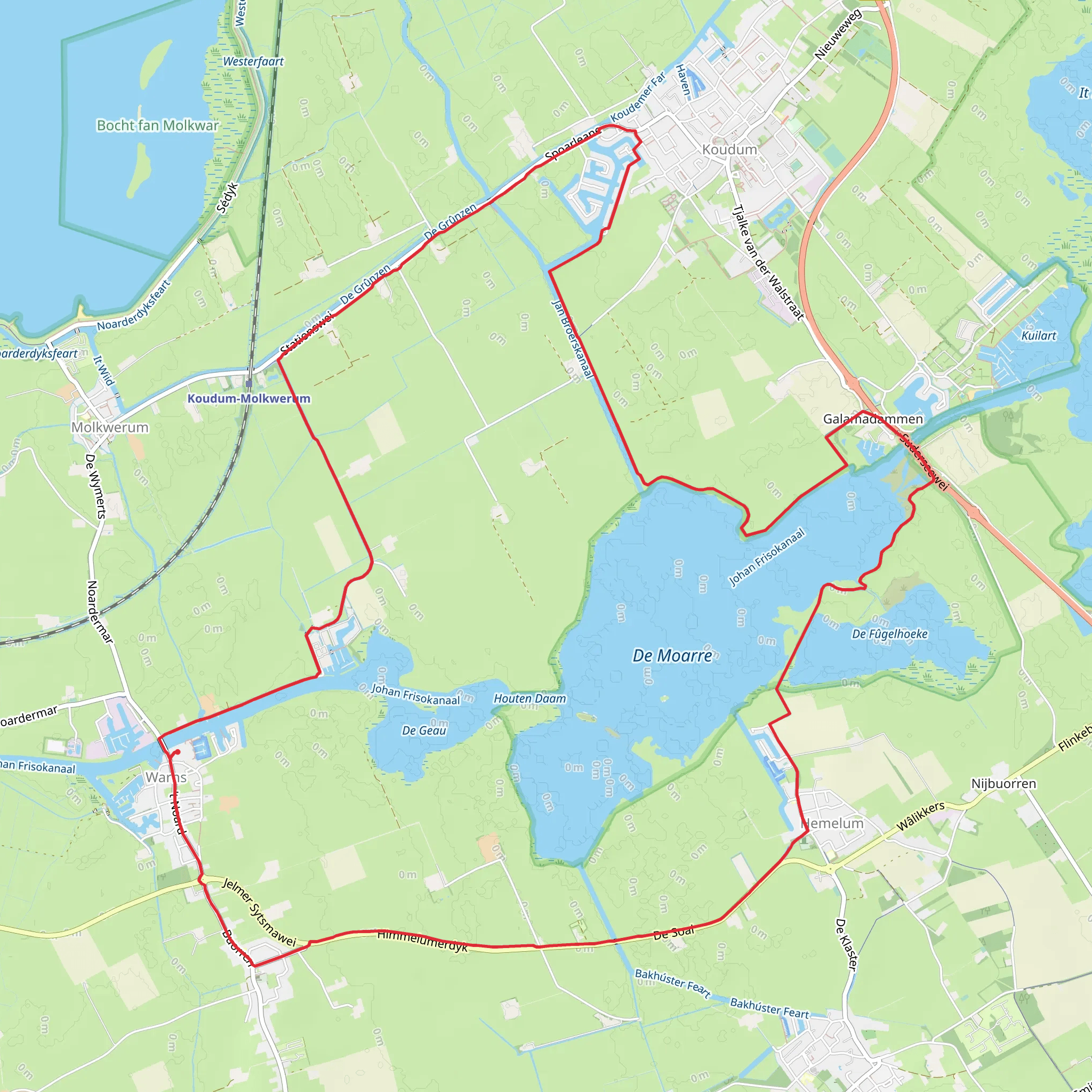
This easy loop is a flat, lowland walk of about 17 km (10.6 miles) with essentially 0 m (0 ft) of climbing, threading through classic Dutch polder scenery: straight drainage canals, wide skies, reedbeds, and open pastureland. Expect firm farm tracks, grassy levee paths, and short paved connectors between small waterways—ideal for a relaxed day where the main challenges are wind, exposed sections, and occasionally soft ground after rain.
Getting to the start (and what “near” likely means)
Your start point is listed only as “near,” so the most practical way to pin it down is to treat the trailhead as being close to the waterways De Moarre and De Geau in Southwest Friesland (Súdwest-Fryslân), Netherlands, where these names are commonly used for local watercourses and canals. The nearest reliable “significant landmark” to use as a navigation anchor is typically one of the villages along the Geau water system—often Woudsend or Heeg—both well-known watersports villages in the Frisian lake district.
- By car: Aim for public parking in a village center near the water (look for signed village parking areas near the marina/harbor). From there, you can pick up the loop on the nearest canal-side path.
- By public transport: The region is served by buses connecting larger hubs like Sneek to surrounding villages. A common approach is: train to Sneek (a major local rail hub), then bus onward to a Geau-side village (e.g., Woudsend/Heeg area), and walk a short link to the canal path.
If you share the lon/lat for the start, I can convert it to the nearest known address or landmark precisely and tailor the access instructions to the exact trailhead.
You’ll want to load the route in HiiKER before you go. This landscape is crisscrossed by canals and ditches, and while it’s flat and generally straightforward, it’s easy to take the wrong farm spur if you’re not watching your line.
What the terrain feels like underfoot
Over 17 km (10.6 miles), the footing is usually uncomplicated: - Levee-top grass paths beside canals (can be slick when wet, and narrow in places) - Gravel or compacted farm tracks between fields - Short paved stretches near villages, bridges, and road crossings
Because the elevation gain is negligible, the “difficulty” comes more from exposure than from hills: - Wind can be relentless across open pasture and water - Sun reflects off water and pale surfaces—bring eye protection on bright days - After rain, grassy edges can turn soft; waterproof footwear helps even on an “easy” route
Route rhythm and distance markers
While exact landmarks depend on the precise start point, a typical loop in this area breaks down naturally into four quarters:
0–4 km (0–2.5 miles): Canal-side settling-in You’ll likely begin on a maintained path near a village edge or a small bridge. Early on, you’ll get long views down straight waterways with reeds and grazing land. Watch for cyclists if you share any multi-use paths.
4–9 km (2.5–5.6 miles): Deep polder and big-sky walking This is the most “open” portion—fields, drainage ditches, and occasional farmsteads. Expect limited shade. If it’s breezy, this section can feel longer than the map suggests.
9–13 km (5.6–8.1 miles): Water crossings and village edges You’ll typically encounter one or more bridges (sometimes narrow) and possibly a short road connector. Be alert at crossings: traffic is usually light, but vehicles can move quickly on rural lanes.
13–17 km (8.1–10.6 miles): Return along the companion waterway The loop character often changes subtly on the way back—different bank, different wind angle, and new sightlines across the same lowland mosaic.
Landmarks, nature, and wildlife to look for
This is a landscape shaped by water management and agriculture, so the “landmarks” are often functional and quietly beautiful:
- Canals, ditches, and pumping infrastructure: You may pass small sluices, culverts, and water-control points—key features in keeping the land workable and settlements dry.
- Reedbeds and wet margins: Look for dense stands of reeds along calmer edges; these are important habitat zones.
- Pastureland and dairy country: Friesian lowlands are strongly associated with grazing and dairy farming; you’ll see wide, open fields and livestock.
Wildlife is often most active early and late in the day: - Waterbirds: ducks, geese, swans, coots, and herons are common along canals and lakeside margins. - Raptors over fields: kestrels and other birds of prey may hover or perch on posts scanning for small mammals. - Amphibians and insects in warm months: dragonflies and damselflies can be abundant near still water.
Practical cautions: - Give livestock space; stick to the path and keep gates as you find them. - Stay well back from ditch edges—banks can undercut and collapse, especially after wet weather. - In spring and early summer, some birds nest on or near the ground; keep noise down and avoid trampling verge vegetation.
Historical significance of the region
Southwest Friesland’s lowlands are a long-running story
AI Planner
Days planned around your pace, with somewhere to stay each night.
Surfaces
Unknown
Concrete
Asphalt
Comments and Reviews
User comments, reviews and discussions about the De Moarre and De Geau Loop, Netherlands.
average rating out of 5
0 rating(s)

