
Download
3D Flyover
Add to list
More
106.9 km
6 days
7 m
Multi Day
“A long, gentle loop through park-edge paths, whispering woods, and sandy wetlands—patiently rewarding steady feet.”
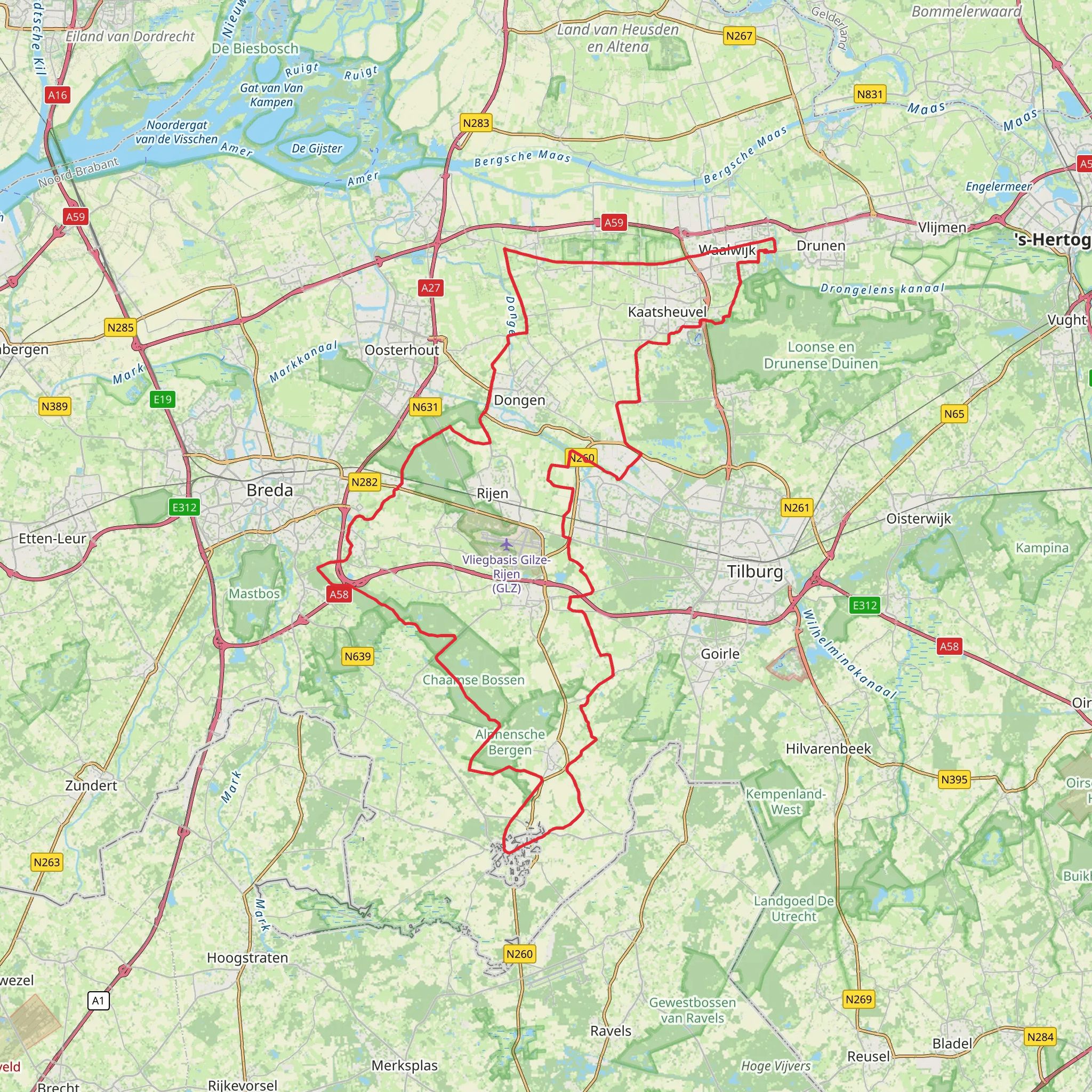
This is a long, low-relief endurance loop of roughly 107 km / 66.5 mi with very little cumulative climbing (expect only gentle rises and dips from old dunes and sand ridges rather than “hills”). It links three distinct landscapes you’ll feel change underfoot: urban-edge parkland around Het Zand, quieter mixed woodland sections often referred to locally as de Bosschen, and the broad, sandy production-forest-and-wetland mosaic of Boswachterij Dorst (a large forest reserve between Breda and Tilburg). (natuurfotografie.nl)
Because the route is long and flat, the main challenge isn’t steepness—it’s time on feet, repetitive surfaces (sand and forest tracks), and staying oriented through a patchwork of paths. For navigation, load the full track into HiiKER and keep an eye on where the loop transitions between built-up edges, forest grids, and fenced nature zones.
Getting to the start (public transport + car) and where “near” usually means
“Het Zand” is a common place-name in the Netherlands, so the most practical way to anchor this loop is by the landscape it clearly targets: Boswachterij Dorst, which sits between Dorst, Oosterhout, Rijen, and Teteringen (all in North Brabant). (birdingplaces.eu) A reliable, well-known access point on the north edge is Natuurpoortcafé BOS & Co, Vijf Eikenweg 56, 4903 RK Oosterhout—a widely used trailhead/meeting point for walks into Boswachterij Dorst. (explorebreda.com)
- By car: Aim for Vijf Eikenweg 56, 4903 RK Oosterhout (Natuurpoort BOS & Co). Parking here puts you directly on the forest edge and close to the network of wide sandy tracks. (explorebreda.com)
- By public transport: The easiest rail hubs are typically Breda or Tilburg, then a bus/taxi onward toward Dorst/Oosterhout and the Vijf Eikenweg area. If you’re stitching the full 107 km loop, plan your “bail-out” points around stations and bus corridors near Breda, Rijen, and Oosterhout (use HiiKER to mark them before you go).
What the terrain feels like over 107 km
You’ll spend most of the day (or two) on broad forest roads, sandy lanes, and compacted multi-use tracks. In Boswachterij Dorst, the sand can be energy-sapping—especially in dry spells—so pace by effort, not speed. Even though the stated elevation gain is “around 0 m,” you’ll notice subtle undulations where historic sand drift created low dunes and uneven forest floor. (irdvo.nl)
A good way to plan the day is in thirds: - 0–35 km (0–22 mi): easiest rhythm-building section—often firmer surfaces near settlements/edges, then gradually more forest track. - 35–75 km (22–47 mi): the “engine room” of the hike—long, quiet woodland stretches where navigation errors can cost time. - 75–107 km (47–66.5 mi): fatigue management—sand feels deeper, small detours feel bigger, and you’ll want reliable water/food stops.
Landmarks, nature, and the “why it looks like this” history
Boswachterij Dorst is not just “a forest”—it’s a landscape shaped by forestry, sand drift, and extraction pits. Several routes and local descriptions highlight leemputten (clay pits) that were historically used for brickmaking; today they hold water and have become important habitat for waterbirds. (mooisteroutes.nl)
Key features you’re likely to pass (exact order depends on the specific track you’re following):
- Leemputten / water pits: These are some of the most distinctive waypoints—open water in an otherwise sandy, pine-dominated setting. They’re repeatedly noted as scenic and wildlife-rich. (mooisteroutes.nl)
- **Sandy clear
AI Planner
Days planned around your pace, with somewhere to stay each night.
Surfaces
Asphalt
Unknown
Concrete
Paved
Dirt
Cobblestone
Wood
Comments and Reviews
User comments, reviews and discussions about the Het Zand, Bosschen and Boswachterij Dorst Loop, Netherlands.
average rating out of 5
0 rating(s)



