
Download
3D Flyover
Add to list
More
11.9 km
~2 hrs 22 min
0 m
Loop
“A gentle Valkenswaard loop where sandy Kempen paths, quiet vens, and heath echoes invite unhurried wandering.”
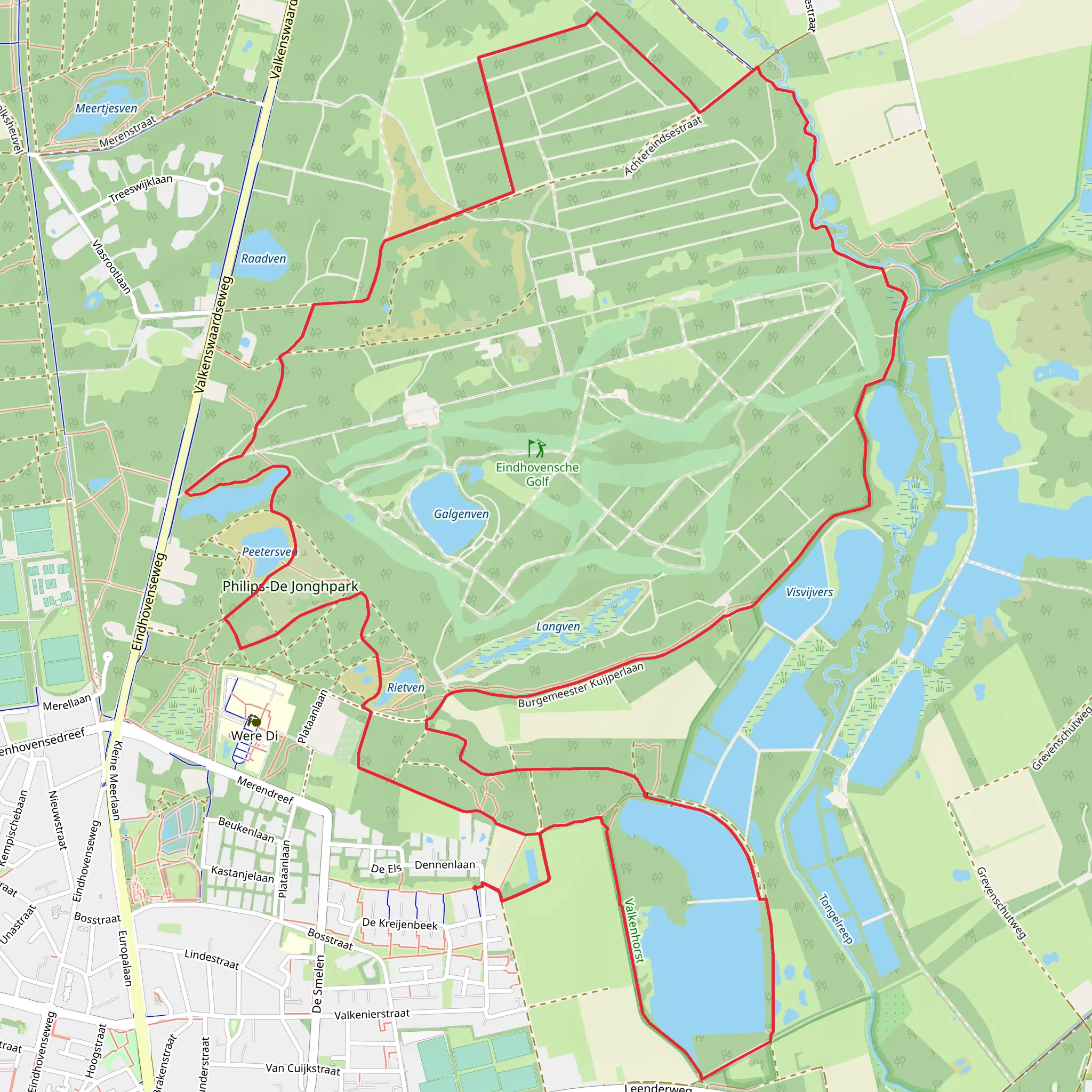
This easy, mostly level loop of about 12 km (7.5 miles) is ideal for a relaxed half-day walk on the edge of Valkenswaard, where sandy soils, heathland remnants, and small lakes/peaty pools create a classic Kempen landscape. With an estimated ~0 m / ~0 ft of elevation gain, the effort is steady and gentle—your main “challenges” are more about path surfaces, wet patches, and staying on the right track at junctions than any climbing.
Getting to the start (car + public transport)
Because the start point is listed only as “near” (no coordinates provided), the most practical way to plan is to aim for a well-known access point close to the Peetersven area on the Valkenswaard side of the countryside. A common, easy-to-navigate reference area is Valkenswaard town center (near Markt, Valkenswaard, Netherlands), then continue toward the greenbelt and ven (lake) areas south/southwest of town.
- By car: Set your navigation to Valkenswaard (Markt, 5554 CC Valkenswaard) as a reliable anchor, then use HiiKER to route you to the nearest trail access/parking for the loop. Parking is typically available near recreation access points and local roads bordering the nature areas; expect small lots rather than large trailhead complexes.
- By public transport: Valkenswaard is well connected by regional buses (often via Eindhoven). Plan to arrive at a central stop in Valkenswaard (commonly near the center), then walk or take a short local connection toward the countryside edge. Use HiiKER to pinpoint the closest access point from your arrival stop and to keep the approach walk efficient.
If you share the lon/lat for the intended start, I can convert it to the nearest known address or landmark and tailor the directions precisely.
What the route feels like underfoot You’ll likely alternate between: - Compact gravel and firm woodland tracks (easy, fast walking) - Sandy paths (slower, especially if dry and churned) - Short damp/soft sections near the ven and low-lying ground (can be muddy after rain)
Even on an “easy” loop, footwear matters here: trail shoes are fine in dry spells, but after wet weather, water-resistant footwear makes the day more comfortable.
Kilometer-by-kilometer expectations (approximate)
0–2 km (0–1.2 mi): Settling in on easy tracks
The opening tends to be straightforward: broad paths, gentle curves, and frequent junctions where local walkers and cyclists also pass through. This is where it’s easiest to drift onto a parallel track—keep HiiKER handy early on so you lock into the correct loop direction.
2–6 km (1.2–3.7 mi): The ven landscape and quiet nature pockets
As you near the Peetersven area, the scenery typically becomes more “open” and water-influenced: small lakes/ponds, reed edges, and damp hollows. Expect:
- Bird activity around the water margins (listen for calls from reedbeds and scrub)
- Insects in warm months—bring repellent if you’re sensitive
- Soft ground in shaded or low sections, especially after rain
This middle portion is where you’ll want to slow down a little: the most interesting nature details are often subtle—water plants, dragonflies in season, and the transition between woodland edge and open heath-like clearings.
6–9 km (3.7–5.6 mi): Woodland and sandy stretches
The loop often swings back through mixed woodland and sandy soils typical of the Kempen region. Sandy sections can feel deceptively tiring despite the flat profile. If it’s windy, you may notice more exposed stretches; if it’s hot, shade comes and goes, so carry water even for a short loop.
9–12 km (5.6–7.5 mi): Returning toward Valkenswaard
The final kilometers usually feel quick: firmer tracks reappear, junction density increases, and you may see more local foot traffic. This is another spot where navigation errors happen—multiple paths can look “right,” so confirm turns with HiiKER rather than relying on intuition.
Landmarks, nature, and wildlife to look for - Vens (peaty ponds/lakes): These are signature features of the region—often formed in low-lying, water-retaining ground. The edges can be fragile and muddy; keep to established paths to avoid damaging vegetation and to stay safe. - Heathland remnants and sandy soils: The Kempen landscape historically included extensive heath and drift sands. Even where woodland has reclaimed ground, you’ll still see the sandy character in the trail surface and plant communities. - Birdlife: Water and scrub attract a variety of birds. Early morning and late afternoon are typically best for activity. - Mammals: In quieter stretches you may spot signs rather than animals—tracks in soft sand, disturbed leaf litter, or droppings along path edges.
Historical context (the region) This part of North Brabant sits within the broader Kempen/Campine landscape, long shaped by poor sandy soils, heathland use, peat/wetland pockets, and later forestry and land improvement. Many of today’s woods and managed nature areas reflect a transition from older, more open heath-based land use to planned woodland and conservation-focused management. The presence of vens and wet hollows is a reminder that, even in a generally flat area, water and soil have always dictated where people
Surfaces
Sand
Dirt
Ground
Unknown
Gravel
Grass
Asphalt
Wood
Comments and Reviews
User comments, reviews and discussions about the Valkenswaard and Peetersven Loop, Netherlands.
average rating out of 5
0 rating(s)


