
Download
3D Flyover
Add to list
More
17.9 km
~3 hrs 35 min
0 m
Loop
“A breezy, mostly flat loop through peat lakes, whispering reedbeds, canals, and big-sky polders.”
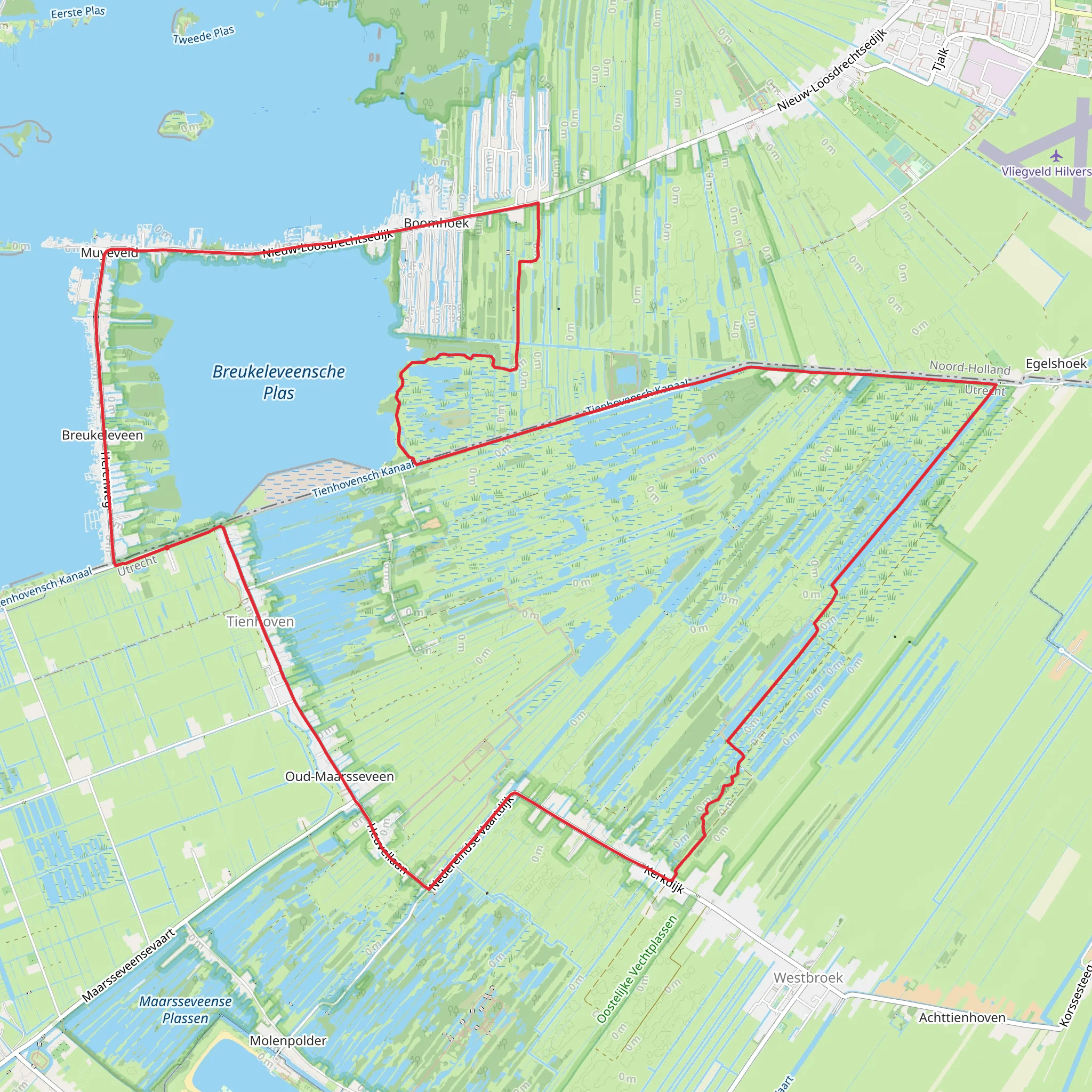
An easy, mostly level loop of about 18 km (11.2 mi) through classic Dutch lowland scenery—peat lakes, reedbeds, canals, and wide-open polder views—where the “effort” is less about climbing (expect roughly 0 m / 0 ft of elevation gain) and more about steady walking on firm paths with occasional exposed, breezy stretches.
Getting to the start (nearest landmark / address)
Because the start point wasn’t fully specified (“near …”), the most practical and well-known access for this loop is from the Tienhoven / Breukeleveen area just north of Utrecht, close to the Tienhovense Plassen nature area and the village of Tienhoven (Stichtse Vecht). A common, easy-to-find meeting point is near Tienhoven’s village center by the Kerkweg / Dorpsweg area, or a signed access point for Tienhovense Plassen (look for official nature-area signage and small parking pull-ins).
- By car: Aim for Tienhoven (Stichtse Vecht), Utrecht, Netherlands, and then follow local signs toward Tienhovense Plassen or Breukeleveen. Parking is typically small and scattered (roadside bays/pull-ins near trail access points), so arrive earlier on weekends.
- By public transport: The nearest major rail hubs are typically Maarssen or Breukelen (both on frequent routes in the Utrecht region). From there, local buses and/or a short taxi ride can get you toward Tienhoven. If you’re planning this precisely, check the bus stop closest to your chosen start point and time it with your train arrival.
If you share the route’s coordinates (or a GPX), I can pin the start to the nearest specific address/landmark and tailor the directions exactly.
What the terrain feels like
Expect flat, lowland walking on a mix of: - Paved cycle paths and quiet lanes near villages - Gravel/compacted paths along canals and lake edges - Narrower dike-top tracks with open exposure to wind
Underfoot is usually straightforward, but after wet periods you can get slick edges, soft verges, and puddled sections—especially where paths run beside reedbeds and drainage channels. Waterproof shoes aren’t mandatory in dry weather, but they’re helpful if rain is recent.
Route flow and key waypoints (approximate)
0–4 km (0–2.5 mi): village edges and polder lines
You’ll likely begin near Tienhoven’s quiet streets and quickly transition to polder infrastructure: straight drainage ditches, small bridges, and long sightlines. This early section is great for settling into a rhythm—easy navigation, minimal elevation change, and frequent views of grazing fields.
4–10 km (2.5–6.2 mi): peat lakes, reedbeds, and birdlife
As you approach the Tienhovense Plassen / Breukeleveen waters, the landscape shifts from farmland geometry to wetland mosaic—open water, reed fringes, and willow-lined edges. These lakes are part of a broader peatland story: much of this region’s watery character comes from historic peat extraction, which left behind pits that later filled with water, creating the “plassen” (lakes) that define the area today.
Wildlife is often the highlight here:
- Waterfowl (ducks, geese, swans) on open water
- Marsh and reedbed birds (listen for constant movement and calls in the reeds)
- Raptors occasionally cruising over open fields
Bring binoculars if you have them; even a casual scan can be rewarding.
10–14 km (6.2–8.7 mi): canal-side walking and big-sky exposure
This portion tends to feel more open and linear, often following canals, dikes, or long field boundaries. Wind can be the main “difficulty multiplier” on an otherwise easy hike—plan a light shell layer even on mild days. You’ll pass classic Dutch water-management features: sluices, culverts, pumping infrastructure, and carefully maintained banks that keep the polder system functioning.
14–18 km (8.7–11.2 mi): returning via quiet lanes and field margins
The final stretch usually threads back toward the village edge, with a calmer feel and more signs of daily rural life—farm access tracks, small bridges, and occasional cyclists. It’s a good section for a steady finish, with plenty of flat ground and frequent options to pause without blocking the path.
Navigation (use HiiKER)
This is the kind of landscape where paths can look deceptively similar—straight lines, repeated bridges, and multiple parallel tracks. Use HiiKER to: - Confirm you’re on the correct bank when canals split - Avoid accidentally following a cycle route that diverges from the loop - Check distance remaining (helpful because the terrain can feel “endless-flat”)
What to look out for
- Wind exposure: With little shelter, windchill can be noticeable even when temperatures are moderate.
- Narrow path edges: Some dike-top or canal-side paths have steep drop-offs into water. Give cyclists space and keep a steady line.
- Slippery surfaces: Algae on shaded pavement, wet wooden bridge decking, and muddy pinch points near reedbeds can be slick.
- Seasonal insects: In warmer months, wetlands can mean mosquitoes/gnats—pack repellent if you’re sensitive.
- Livestock and electric fencing: You may pass grazing areas; stay on
AI Planner
Days planned around your pace, with somewhere to stay each night.
Surfaces
Unknown
Asphalt
Grass
Concrete
Gravel
Paved
Comments and Reviews
User comments, reviews and discussions about the Breukeleveen and Tienhoven Loop, Netherlands.
average rating out of 5
0 rating(s)


