
Download
3D Flyover
Add to list
More
13.9 km
~2 hrs 46 min
0 m
Loop
“Circle Schildmeer through reedbeds and wide skies, where wind and water set a gentle pace.”
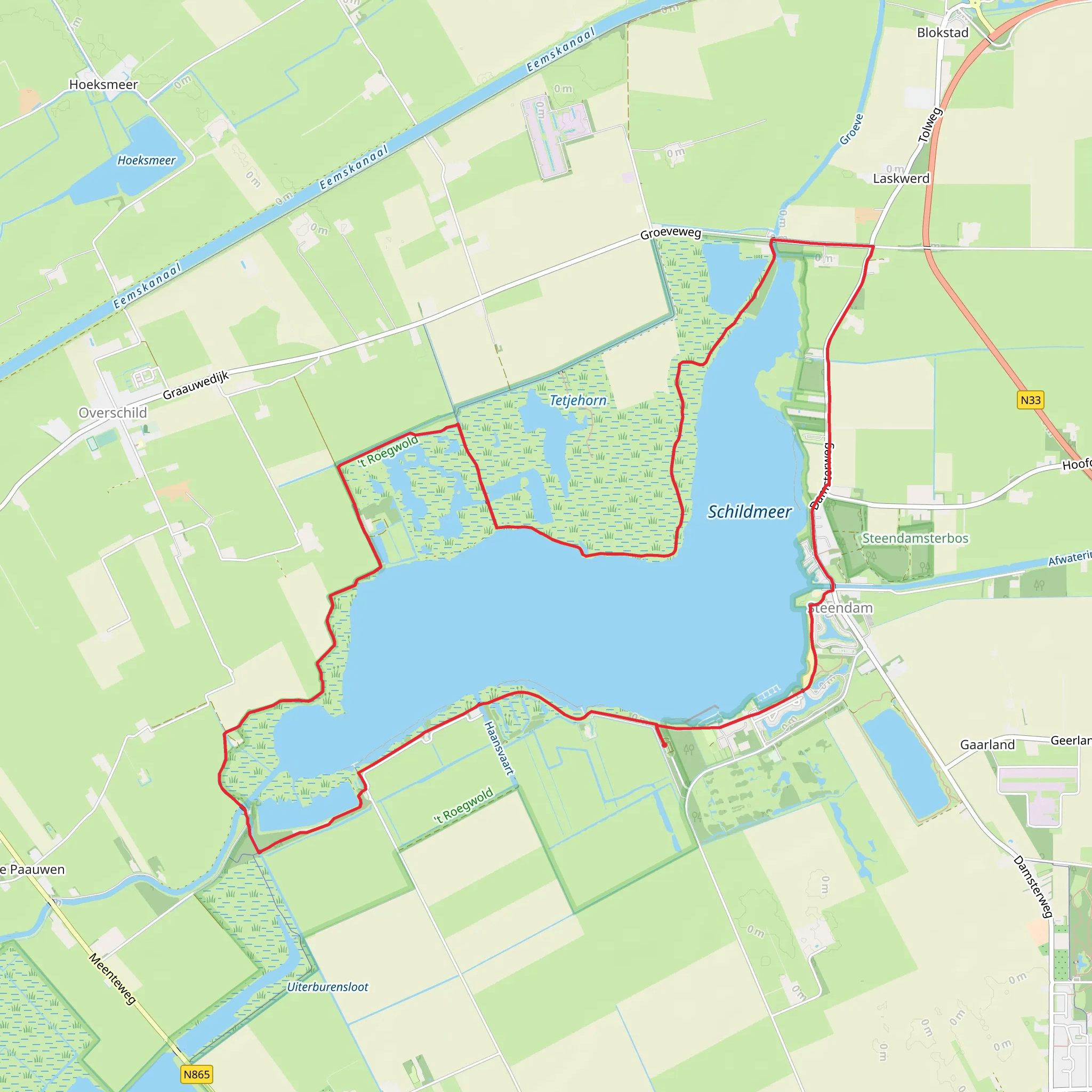
A flat, waterside loop of roughly 14 km (8.7 miles) with essentially 0 m (0 ft) of climbing, this walk is all about big skies, reedbeds, and open water rather than hills. Expect easy-going terrain, long sightlines, and a steady rhythm of dikes, lakeshore paths, and quiet rural tracks—ideal for a relaxed half-day outing, but still exposed enough that wind and weather can shape the day.
Where the hike starts (nearest landmark) + getting there
“Schildmeer” and “Tetjehorn” point strongly to the Schildmeer lake area near Steendam / Schildwolde in the province of Groningen, Netherlands. The most practical “pin” to aim for is the Schildmeer lakeshore around Steendam, where there are small marinas, lakeside parking areas, and access to the dike-top paths that ring parts of the water.
- By car: Navigate to Steendam (near Schildmeer), Groningen and look for public parking near the Schildmeer waterfront / marina area (often signed locally for the lake and watersports facilities). From there, you can pick up the lakeside/dike paths that make a natural start/finish point for a loop.
- By public transport: The area is rural, so transit usually involves a train to Groningen (or another regional hub) and then a bus toward Steendam/Schildwolde. From the nearest bus stop, plan on a short walk to the lakeshore. Use HiiKER to confirm the exact start point you choose and to see which stop minimizes road-walking.
If you share a coordinate (lon/lat) for the trailhead you have in mind, I can translate it to the nearest specific landmark/road access and tailor the approach directions precisely.
What to expect underfoot and on the ground Because the elevation gain is effectively nil, the “difficulty” comes from surface conditions and exposure, not steepness.
- Surfaces: A mix of compacted gravel, paved farm lanes, grassy dike tops, and narrow lakeside tracks. After rain, the softer sections can turn slick or muddy, especially where reeds and shade keep the ground damp.
- Exposure: The lake and surrounding open fields mean wind is a constant factor. A calm forecast can still feel brisk on the dike; in stronger winds, the perceived effort rises even on flat ground.
- Footwear: Light hiking shoes are usually enough, but if it’s been wet, consider something with better mud grip and a bit of water resistance.
A sensible way to break down the loop (approximate distances) The exact line varies depending on which side paths you choose, but a typical 14 km (8.7 mi) loop here naturally divides into three “chapters”:
1) Lakeshore and reed edge (about 4–5 km / 2.5–3.1 mi)
You’ll likely begin near the more developed lakeside access—marina edges, small beaches, or viewpoints—then transition quickly into quieter shoreline. Reeds often dominate the margins, and you’ll notice how the path alternates between open water views and sheltered stretches where vegetation blocks the wind.
2) Dike-top and open polder views (about 5–6 km / 3.1–3.7 mi)
This is the most “Groningen” feeling section: straight lines, big horizons, and the geometry of reclaimed land. Even without climbing, the dike can feel like a balcony over the landscape. In clear weather, the light can be striking—especially with low sun.
3) Return via rural lanes and water connections (about 3–4 km / 1.9–2.5 mi)
The loop typically closes on quieter tracks and lanes that stitch the lake back to your start. This is where you may pass small bridges, drainage channels, and farm access roads—easy walking, but pay attention to cyclists and local traffic on any paved stretches.
Navigation and wayfinding (use HiiKER)
Wayfinding is generally straightforward—water on one side, fields on the other—but the area can have multiple parallel tracks (dike top vs. lower service road vs. farm lane). Use HiiKER to: - keep the correct line where paths braid together, - avoid accidental detours onto private farm access, - confirm any short connectors that make the route a true loop rather than an out-and-back.
Key landmarks and scenery to look for - Schildmeer itself: A broad, shallow lake feel with long views and frequent bird activity. The shoreline character changes—some parts feel “wild” with reeds, others more recreational. - Reedbeds and drainage channels: These are classic lowland wetland features. Even when the lake is calm, the smaller channels can show subtle current and water-level management. - Dikes and polder landscape: The region’s identity is tied to water control and land management. The straightness of many paths and the presence of embankments, sluices, and canals are part of that story.
Nature and wildlife (what you’re likely to see) This is prime habitat for waterfowl and wetland birds, with seasonal variation: - Common sightings: ducks, geese, swans, coots, and gulls; in reedier sections, listen for smaller songbirds and reed specialists. - Raptors and larger birds: Depending on season and time of day, you may spot birds of prey hunting over open fields. - Mammals: Mostly subtle—small mammals in field margins; occasionally you’ll notice movement in reeds or along canal edges.
Wildlife etiquette matters here: keep a steady pace,
Surfaces
Unknown
Grass
Concrete
Asphalt
Gravel
Unpaved
Wood
Paved
Comments and Reviews
User comments, reviews and discussions about the Schildmeer and Tetjehorn Loop, Netherlands.
average rating out of 5
0 rating(s)



