
Download
3D Flyover
Add to list
More
18.2 km
~3 hrs 41 min
25 m
Point to Point
“Drift from Santpoort-Noord’s quiet lanes to Haarlem, past shimmering dune lakes and wind-brushed pines.”
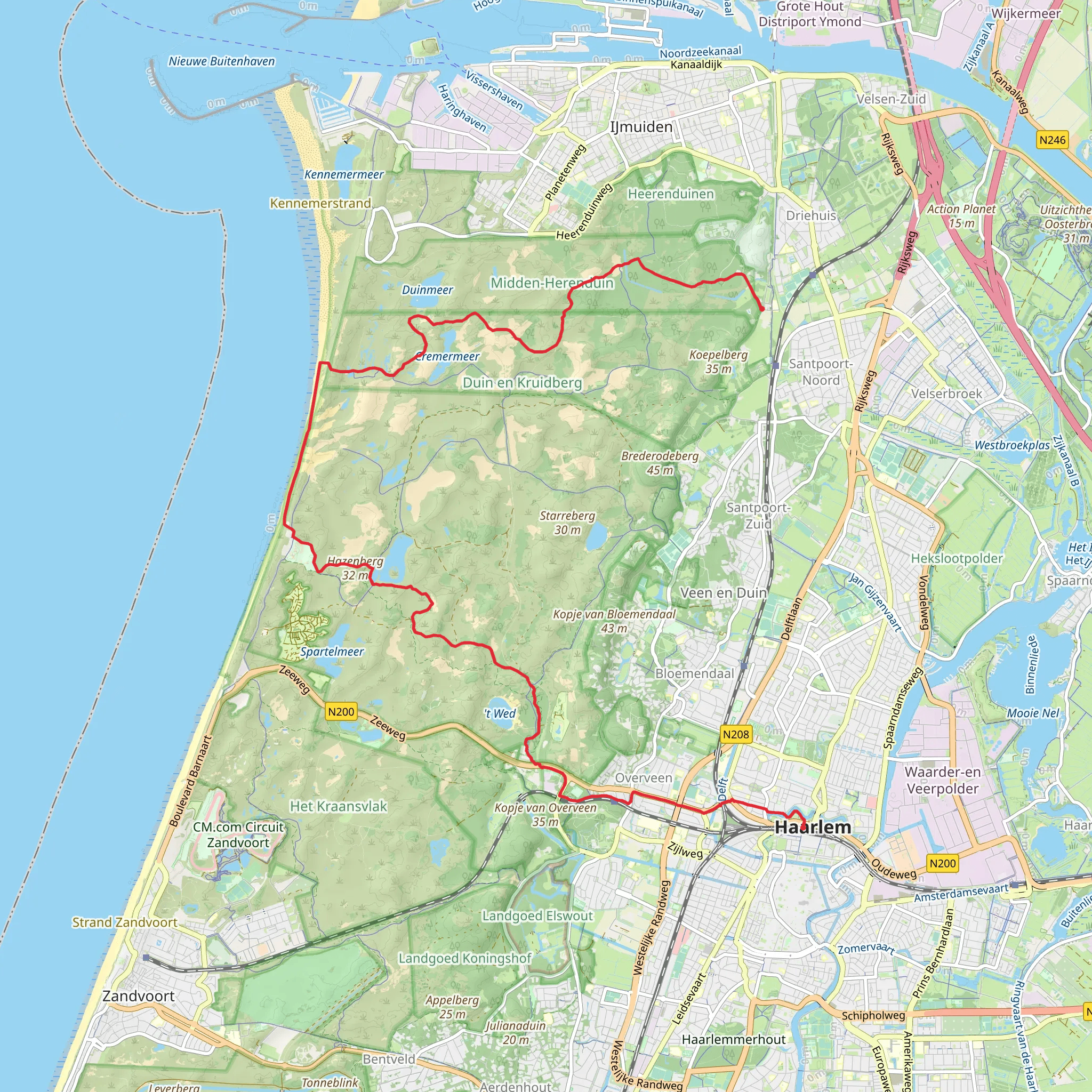
This is a low-lying, dune-and-lake walk on the edge of Zuid-Kennemerland National Park, linking the village of Santpoort-Noord to the historic city of Haarlem while threading past two classic dune lakes—Cremermeer and Vogelmeer. Expect mostly flat terrain (about 0 m / 0 ft of climbing overall), easy gradients, and a mix of compact sand paths, forest tracks, and occasional paved connectors. Total distance is about 18 km / 11.2 mi, typically 4–5.5 hours at a relaxed pace with stops for viewpoints and wildlife watching.
Getting to the start (public transport + car)
Start area (nearest landmark): the most practical “start point” for this route is around Santpoort Noord railway station (Station Santpoort Noord) in Santpoort-Noord (municipality of Velsen), a well-known access point to the dunes and the park edge.
- By train (recommended): Take an NS train to Santpoort Noord. From the station, you can walk straight into the village edge and pick up paths leading toward the dune reserve and lakes.
- By bus: Local buses connect Santpoort-Noord with Haarlem, IJmuiden, and surrounding towns; aim for stops near Station Santpoort Noord or the village center.
- By car: Park near Station Santpoort Noord or in designated village parking areas. Be mindful that some nearby dune access points have restricted parking and seasonal controls; if you choose a park entrance car park instead, confirm access rules before you go.
If you’re navigating on the day, load the route in HiiKER and keep an eye on path choices around the lakes—there are several tempting side tracks and signed nature detours.
What the route feels like underfoot - Surface: mostly firm sand/gravel paths and woodland tracks; short paved stretches near settlements. - Exposure: open dune sections can be windy; woodland offers shelter. - Wet spots: after rain, low dune hollows can hold water and some tracks can be soft. - Accessibility: generally easy walking, but not ideal for standard strollers/wheelchairs due to sand and uneven dune paths.
Key stages and approximate distances
0.0–3.5 km (0.0–2.2 mi): Santpoort-Noord to the dune edge
You’ll leave the residential streets quickly and transition into greener corridors—hedgerows, small wooded strips, and the first hints of dune landscape. This early section is a good warm-up: flat, straightforward, and a chance to settle into your pace. Listen for common songbirds (great tits, robins, chaffinches) in the scrubby edges.
3.5–9.0 km (2.2–5.6 mi): Cremermeer and surrounding dunes
Cremermeer is one of the standout landmarks: a dune lake set among sandy ridges and pine/oak woodland. The path network here often offers:
- Lakeside viewpoints where the water opens up between reeds
- Dune ridgelines with slightly higher, breezier walking (still minimal “elevation gain,” but you’ll feel gentle undulations)
- Reedbeds and wet hollows that attract waterfowl
Wildlife to look out for around Cremermeer:
- Water birds: mallard, coot, grebes; in migration seasons you may see additional ducks and waders
- Raptors: buzzards are common; kestrels sometimes hover over open patches
- Mammals: rabbits are frequent; foxes are possible but usually shy
Stay on marked paths—these dune ecosystems are sensitive, and some areas may be seasonally protected for breeding birds.
Vogelmeer and the best nature-watching stretch
9.0–13.5 km (5.6–8.4 mi): Vogelmeer loop-by and dune woodland
Vogelmeer (“Bird Lake”) is often the most rewarding section for quiet observation. The lake margins and surrounding scrub create a natural amphitheater for birdlife. You’ll likely pass:
- Reedy shorelines (excellent for spotting birds moving between cover and open water)
- Mixed woodland where the trail is shaded and the footing is usually firm
- Open sandy clearings that can feel surprisingly bright even on overcast days
Practical notes here: - Wind: the lakes can funnel gusts—bring a light shell even on mild days. - Binoculars: worth it; many birds keep to the far side of the water. - Noise discipline: quieter walking tends to reveal more wildlife.
13.5–18.0 km (8.4–11.2 mi): Transition toward Haarlem
As you angle toward Haarlem, the landscape gradually shifts from dune reserve character to more managed green corridors and urban edges. You’ll start seeing more cyclists and local walkers, plus clearer signage and more frequent junctions. This is where HiiKER is especially useful to avoid accidentally following a parallel path that leads you to a different neighborhood approach into the city.
Landmarks and historical context (what you’re walking through)
You’re moving along the Dutch coastal dune belt, a landscape shaped by wind, sand movement, and centuries of human management. The dunes here are not just scenic—they’ve long been important as:
- Natural coastal defense against the North Sea
- Freshwater catchment and filtration zones (dune sands naturally filter water)
- Biodiversity refuges where wet dune slacks, reedbeds, and dry sandy ridges sit close together
Approaching Haarlem, you’re heading into one of the Netherlands’
AI Planner
Days planned around your pace, with somewhere to stay each night.
Surfaces
Unknown
Sand
Asphalt
Unpaved
Gravel
Dirt
Ground
Concrete
Paved
Comments and Reviews
User comments, reviews and discussions about the Santpoort Noord to Haarlem via Cremermeer and Vogelmeer, Netherlands.
average rating out of 5
0 rating(s)



