
Download
3D Flyover
Add to list
More
11.9 km
~2 hrs 23 min
0 m
Loop
“Drift through Weerribben‑Wieden’s reed-fringed canals and floating boardwalks, where big skies invite unhurried reflection.”
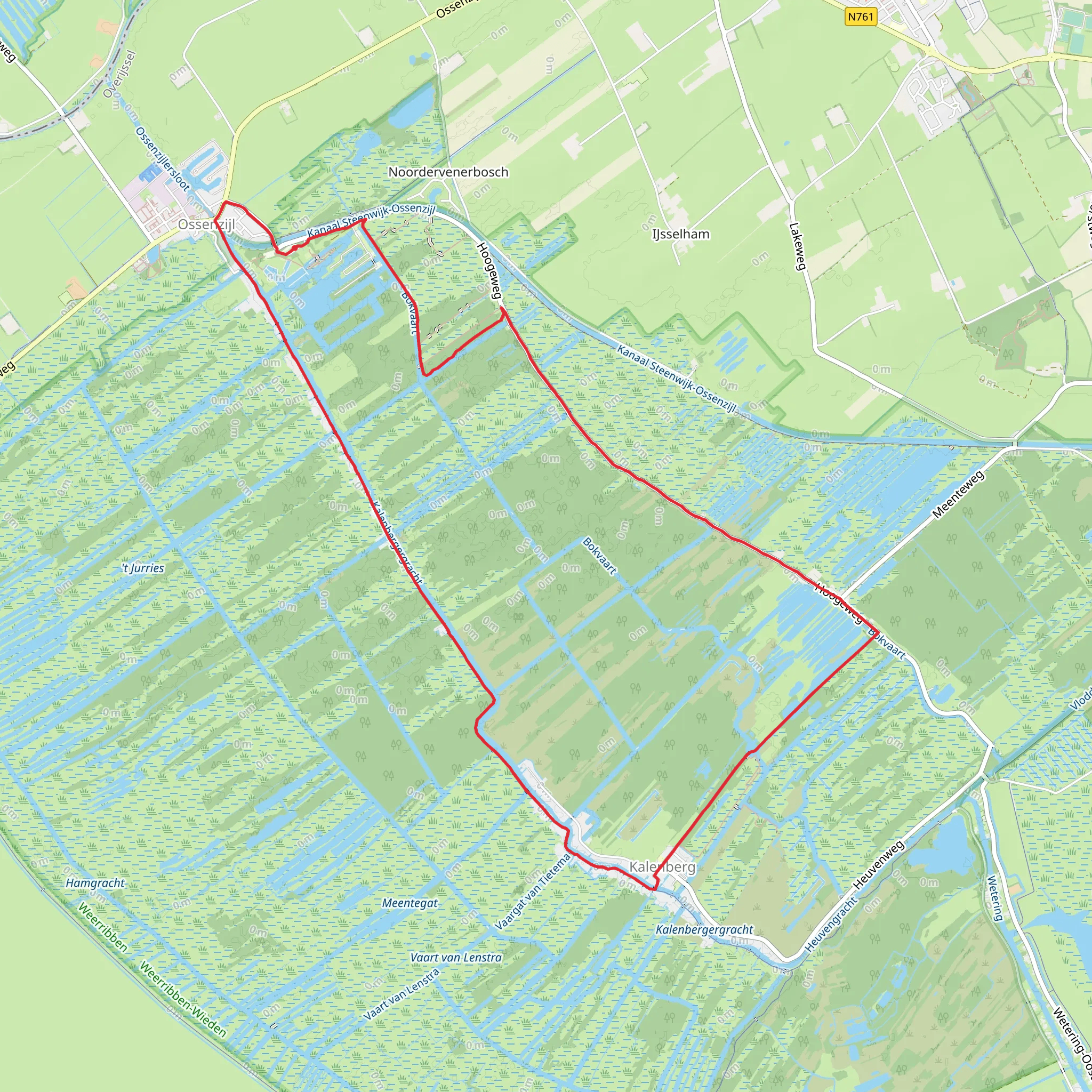
You’ll be walking in the heart of Nationaal Park Weerribben‑Wieden, a flat, water-shaped peatland landscape where canals, reed beds, wet woodland, and “floating” boardwalks define the day. At around 12 km / 7.5 mi with essentially 0 m / 0 ft of sustained climbing (any “ups and downs” are just tiny bridge ramps and dike undulations), this is a relaxed loop that’s more about scenery, birds, and big skies than effort.
Getting to the start (car + public transport)
Most practical start landmark: the Buitencentrum Weerribben (Visitor Center De Weerribben) area near Ossenzijl, commonly used as a trailhead for loops that pass Venebosch and the Kalenberg area. A frequently used start point for this loop style is near the junction of Hoofdstraat and Venebosweg in Ossenzijl (a recognizable access point for the Weerribben paths and waterways). (gps-route.org)
- By car: Aim for parking at/near Buitencentrum Weerribben (signed locally as the Weerribben visitor center). From there you can pick up the paths and quiet lanes that lead toward Kalenberg and the boardwalk sections. (staatsbosbeheer.nl)
- By public transport: The easiest approach is typically train to Steenwijk (major rail hub for the region), then a bus toward Ossenzijl / Kuinre / Kalenberg-area stops depending on the day/time. From the nearest stop, expect a short walk to the visitor-center/trail access. (Check the day-of travel plan and stop names in HiiKER so you can match the loop’s start point to the closest bus stop.)
What the route feels like underfoot
Expect a mix of: - Paved village lanes and dike-top paths (easy walking, can be breezy) - Unpaved peatland tracks that can be soft after rain - Wooden boardwalk/decking through wetter sections—great for access, but can be slick with algae, frost, or rain
Even though the elevation gain is negligible, the surface changes are what determine how fast you move. After wet weather, waterproof footwear is a comfort upgrade; in summer, the same sheltered wetland edges can mean mosquitoes.
Kilometer-by-kilometer: landmarks and scenery
0–2 km (0–1.2 mi): Settling in along canals and open water You’ll quickly get that classic Weerribben feel: straight waterways, reed margins, and long views across low fields. This area was shaped by centuries of peat cutting and water management—today it reads as a calm mosaic of water and land, but it’s a working, engineered wetland at its core.
2–5 km (1.2–3.1 mi): Toward Kalenberg—water village character
As you near Kalenberg, you’ll notice how the settlement pattern follows the water. In parts of the Weerribben, homes and small businesses historically oriented to canals because water transport mattered as much as roads (and in some places, more). (rd.nl)
You’ll likely cross a canal here—watch for cyclists and local traffic on narrow bridges.
5–8 km (3.1–5.0 mi): Kloosterkooi area—quiet wet woodland and cultural history
This middle section is the signature “heritage” portion of the loop: the Kloosterkooi is an historic duck decoy (eendenkooi) landscape—an ingenious, centuries-old trapping system using a decoy pond and curved “catch pipes,” traditionally worked by a kooiker (decoy man) with trained decoy ducks. The Kloosterkooi near Kalenberg was established in 1902 and is now managed as part of the protected Weerribben landscape. (kalenberg.nu)
Important planning note: the duck decoy sites are generally not freely accessible—they’re typically visited only via guided excursions or with specific access rules, so you’ll be skirting the area on public paths rather than wandering into the decoy itself. (staatsbosbeheer.nl)
Nature-wise, this is where you’ll feel the shift into **broekbos (wet woodland
Surfaces
Asphalt
Concrete
Unknown
Grass
Wood
Comments and Reviews
User comments, reviews and discussions about the Venebosch, Kloosterkooi and Pierikkluft Loop, Netherlands.
average rating out of 5
0 rating(s)

